
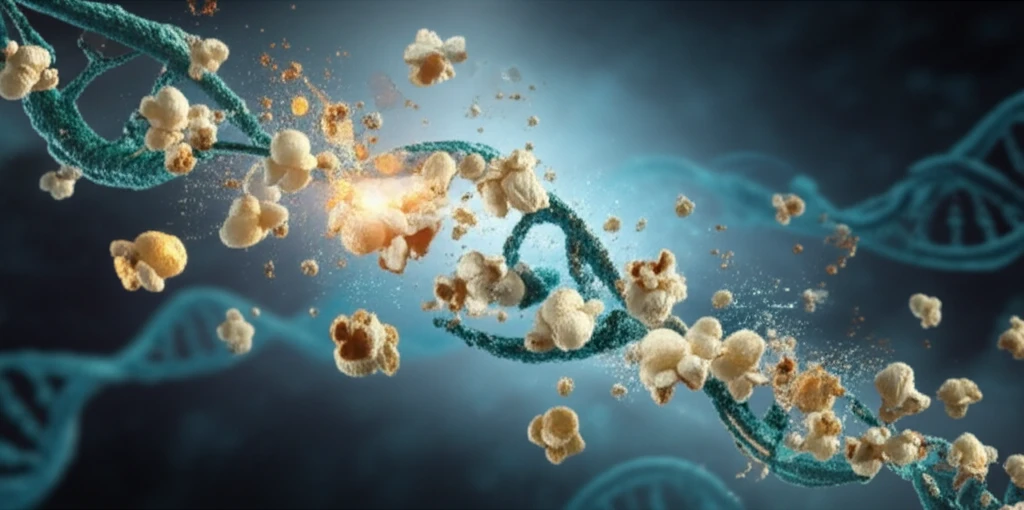
Popcorn kernels exploding from DNA strands

Popping Potential: Unlocking the Secrets of Brazilian Popcorn

"Genetic insights could help plant the seeds for better breeding programs and tastier treats."


For maize breeders, the ultimate goal is to develop superior hybrids. The choice of parent plants and optimization of genotypes through environmental interaction is key. But what about popcorn? Unlike standard maize, inbreeding (mating closely related plants) has a more pronounced effect, making it difficult to create stable lines. Understanding the genetics behind desirable traits like popping expansion is essential for improving popcorn breeding programs.

A recent study published in Ciencia e Investigacion Agraria delved into the genetic components influencing popping expansion and other traits in six Brazilian popcorn populations. Researchers aimed to assess inbreeding depression (the decline in performance due to inbreeding) and pinpoint genetic factors that could be harnessed for breeding efforts.

This article explores the study's findings and highlights how these insights can help popcorn breeders develop varieties with superior popping volume and overall yield, offering readers a glimpse into the science behind this beloved snack.

Decoding the Genes Behind the Pop: Key Findings

Popcorn kernels exploding from DNA strands

The study focused on six Brazilian popcorn landraces (locally adapted varieties): Amarelo, Beija-Flor, Branco, Rosa-claro, Roxo, and Viçosa. Researchers performed self-pollination to create inbred lines (S1 populations) and compared them to the original populations (S0). Several traits were evaluated, including:

These traits are vital for assessing the overall quality and yield potential of popcorn.

  • Plant height (PH)
  • Ear height (EH)
  • Prolificacy index (PI - number of ears per plant)
  • Hundred-grain-weight (P100)
  • Grain yield (GY)
  • Popping expansion (PE)
The analysis revealed significant inbreeding depression for most traits, meaning that the inbred lines performed worse than the original populations. The extent of this depression varied widely, from a modest 1.2% for popping expansion to a substantial 79% for grain yield. This highlights the challenge of inbreeding in popcorn and the need to carefully manage genetic diversity.

Popping into the Future: Implications for Breeders

The study's most promising finding was the identification of genetic components influencing popping expansion. The researchers discovered that additive gene effects (where each gene contributes a small, independent effect) were more important than dominance effects for this trait. This is good news because additive effects are easier to select for in breeding programs.

Furthermore, the study pinpointed specific popcorn populations that are well-suited for different breeding strategies:<ul><li>Amarelo and Rosa-claro: Ideal for extracting inbred lines for hybrid production due to their high capacity for popping expansion.</li><li>Beija-Flor and Viçosa: Excellent sources of lines with large additive effects and positive inbreeding depression, making them suitable for recurrent selection programs. These programs gradually improve traits over multiple generations.</li></ul>

By understanding the genetic architecture of key traits and the performance of different populations, breeders can make more informed decisions, leading to the development of popcorn varieties with improved popping expansion, higher yields, and enhanced overall quality. This research confirms that popping expansion is a trait that can be efficiently improved by selecting ideal breeding strategy.

About this Article -

This article was crafted using a human-AI hybrid and collaborative approach. AI assisted our team with initial drafting, research insights, identifying key questions, and image generation. Our human editors guided topic selection, defined the angle, structured the content, ensured factual accuracy and relevance, refined the tone, and conducted thorough editing to deliver helpful, high-quality information.See our About page for more information.

This article is based on research published under:

DOI-LINK: 10.4067/s0718-16202010000300011, Alternate LINK

Title: Inbreeding Depression And Genetic Components For Popping Expansion And Other Traits In Brazilian Populations Of Popcorn

Subject: General Agricultural and Biological Sciences

Journal: Ciencia e investigación agraria

Publisher: Pontificia Universidad Catolica de Chile

Authors: Emmanuel Arnhold, José Marcelo Soriano Viana, Freddy Mora, Glauco Vieira Miranda, Ricardo Gonçalves Silva

Published: 2010-12-01

Everything You Need To Know

1

What are the names of the popcorn varieties that were studied?

The study analyzed six Brazilian popcorn landraces: Amarelo, Beija-Flor, Branco, Rosa-claro, Roxo, and Viçosa. These are locally adapted varieties, and the researchers studied them to understand the genetic factors related to popping expansion. These are important because understanding the genetics of the different landraces can give breeders insights to create superior hybrids of popcorn.

2

What is inbreeding depression, and what impact did it have on the popcorn varieties studied?

Inbreeding depression is the decline in performance observed in inbred lines compared to the original populations. The study found significant inbreeding depression across several traits in the six Brazilian popcorn populations. The greatest impact was found in Grain Yield, which declined by 79%. Understanding the extent of inbreeding depression is crucial for popcorn breeders to manage genetic diversity effectively and to optimize breeding strategies. While popping expansion showed the smallest decline at 1.2%, it is still important to understand the effects of inbreeding on all of the characteristics of the popcorn.

3

What is popping expansion, and how do genes affect it?

Popping expansion refers to the volume increase of popcorn kernels when they pop. The study showed that additive gene effects have more influence than dominance effects on popping expansion in the tested Brazilian popcorn. This means that the impact of the genes works additively, which is important because it simplifies selection in breeding programs, making it easier for breeders to improve popping volume.

4

What traits were evaluated in the study?

The study measured several traits, including Plant Height (PH), Ear Height (EH), Prolificacy Index (PI), Hundred-grain-weight (P100), Grain Yield (GY), and Popping Expansion (PE). All of these traits are vital for assessing the overall quality and yield potential of popcorn. By evaluating these traits in both the original populations and the inbred lines, researchers could understand the genetic basis of popping expansion and other key characteristics.

5

How do the study's findings help popcorn breeders?

The findings help popcorn breeders develop superior varieties by providing genetic insights into popping expansion. Additive gene effects are easier to select for. This allows breeders to make informed decisions about which parent plants to choose. This can help in creating stable lines with improved popping volume and overall yield. The goal is to optimize genotypes through environmental interaction.

Newsletter Subscribe

Subscribe to get the latest articles and insights directly in your inbox.