
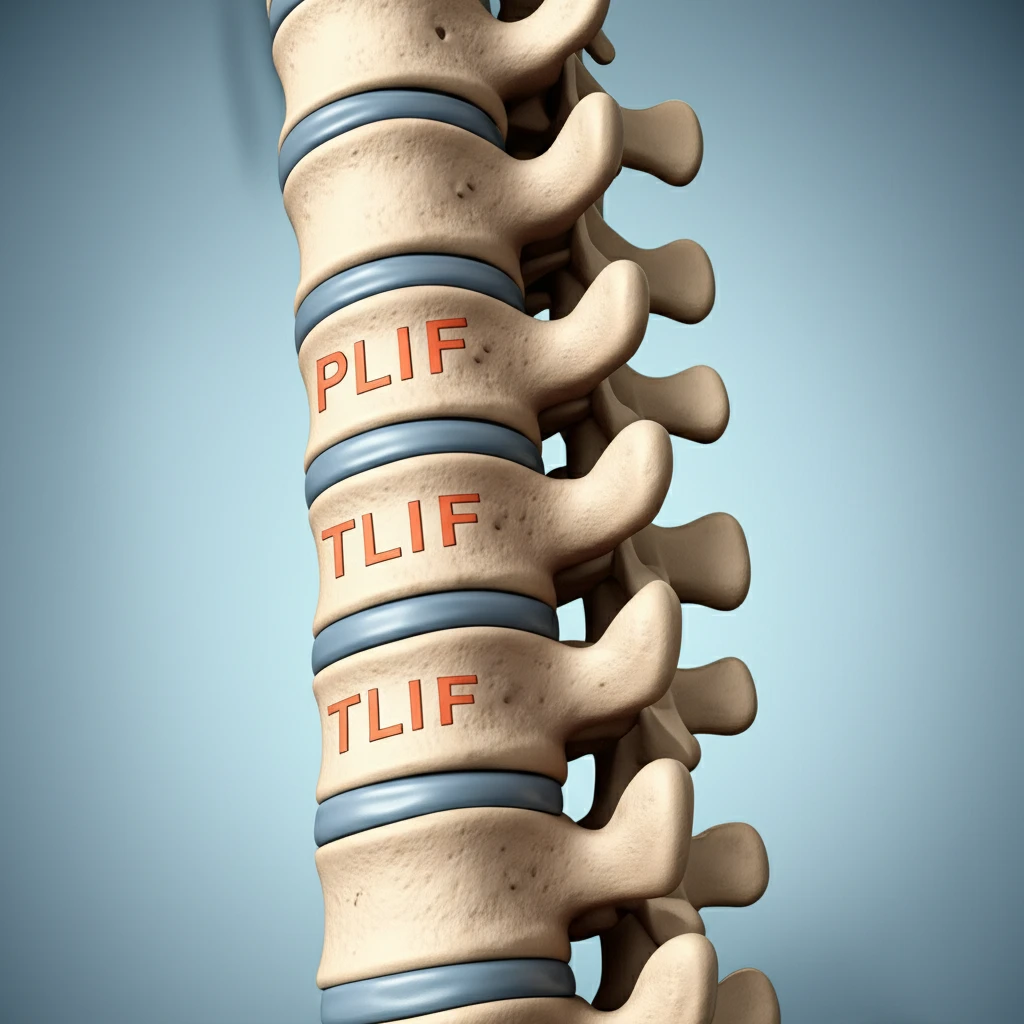
PLIF vs. TLIF: Choosing the Right Spinal Fusion for Your Back Pain

"Understanding Posterior Lumbar Interbody Fusion (PLIF) and Transforaminal Lumbar Interbody Fusion (TLIF) for Effective Back Pain Relief"
Chronic back pain can significantly impact your daily life, limiting your ability to work, enjoy hobbies, and even perform simple tasks. When conservative treatments like physical therapy and pain medication fail to provide adequate relief, spinal fusion surgery may be considered. Posterior Lumbar Interbody Fusion (PLIF) and Transforaminal Lumbar Interbody Fusion (TLIF) are two common surgical techniques used to stabilize the spine and reduce pain. Understanding the differences between these procedures can help you make informed decisions about your treatment options.
PLIF and TLIF both aim to achieve spinal fusion by placing a bone graft or cage between two vertebrae, encouraging them to grow together over time. This process stabilizes the spine, reduces motion, and alleviates pain caused by conditions such as degenerative disc disease, spondylolisthesis, and spinal stenosis. While the ultimate goal is the same, PLIF and TLIF differ in their surgical approach and the way the interbody space is accessed.
This article will delve into the details of PLIF and TLIF, explaining the surgical techniques, advantages, and disadvantages of each approach. We'll also explore the factors that surgeons consider when determining the most appropriate procedure for individual patients, helping you navigate the complexities of spinal fusion surgery.
The Scope of Spinal Fusion in Modern Back Pain Treatment
Spinal fusion surgery remains one of the most commonly performed procedures for chronic low back pain and degenerative spinal conditions in the United States, with hundreds of thousands of procedures performed annually. While exact figures vary by source and year of reporting, spinal fusion rates have generally trended upward over the past two decades as surgical techniques have evolved and patient populations have aged. The decision to pursue fusion surgery typically follows failed conservative treatments, and choosing between approaches like PLIF and TLIF depends on a range of patient-specific and anatomical factors.
Lumbar Interbody Fusion: Techniques and Trade-offs
Lumbar interbody fusion (LIF) is a widely used surgical procedure for treating various spinal pathologies, particularly degenerative diseases. The technique can be performed via multiple approaches, including posterior, transforaminal, anterior, and lateral routes, each carrying distinct theoretical advantages and disadvantages. PLIF, for instance, allows complete fusion from a single incision but limits the amount of disc space that can be removed, reducing the surface area available for fusion compared to anterior approaches. Despite numerous comparative studies, no single approach has emerged as definitively superior, and surgeons often base their technique selection on individual patient anatomy and clinical needs. Reference URL 1: https://pmc.ncbi.nlm.nih.gov/articles/PMC7595814/, Reference URL 2: https://www.spine-health.com/treatment/spinal-fusion/plif-potential-advantages-and-disadvantages
The Contested Legacy of PLIF
The posterior lumbar interbody fusion (PLIF) technique was first performed in the 1940s, making it one of the earliest interbody fusion methods developed. However, despite this early start, PLIF's reputation was marked by controversy and skepticism for roughly the next fifty years. It was only through the dedication and persistence of a small group of pioneering surgeons that the operation was eventually refined and accepted as a standard technique in spinal arthrodesis. Today, PLIF and its related methods are considered the gold standard in spinal fusion surgery. Reference URL 1: https://www.sciencedirect.com/science/article/pii/S1529943021001273
PLIF: A Direct Approach to Interbody Fusion
Posterior Lumbar Interbody Fusion (PLIF) involves accessing the spine through a posterior incision, directly over the affected vertebrae. The surgeon removes a portion of the lamina (the back part of the vertebra) to create a window into the spinal canal. This allows for direct decompression of the neural elements and access to the interbody space.
- Advantages of PLIF:
- Direct decompression of the spinal canal.
- Placement of two interbody cages for enhanced stability.
- Suitable for patients with significant spinal stenosis requiring extensive decompression.
- Disadvantages of PLIF:
- Greater retraction of nerve roots, potentially increasing the risk of nerve injury.
- Wider exposure of the spinal canal, which some surgeons believe may increase the risk of epidural scarring.
Emerging Evidence in Spinal Fusion
Recent research continues to refine our understanding of spinal fusion outcomes, with ongoing studies examining complication rates, recovery timelines, and long-term effectiveness of various techniques. While peer-reviewed literature offers growing data, many studies remain limited by sample size, follow-up duration, or lack of randomized controlled trial designs. As with any surgical field, the evidence base evolves gradually, and clinicians must weigh new findings against established clinical experience and patient-specific factors when making treatment decisions.
Limitations and Complications in Fusion Surgery
Spinal fusion, regardless of technique, carries inherent risks including hardware failure, adjacent segment disease, and incomplete fusion. Some critics argue that fusion surgery may be overutilized in cases where conservative management could suffice, leading to unnecessary surgical interventions and associated complications. Revision surgeries, where initial fusion procedures fail or produce suboptimal outcomes, represent a significant clinical challenge that continues to drive research into improving surgical approaches and patient selection criteria.
PLIF vs. TLIF: Head-to-Head Considerations
Direct comparisons between PLIF and TLIF remain an active area of investigation, with studies examining differences in operative time, blood loss, complication rates, and patient-reported outcomes. Both techniques share the goal of achieving solid bony fusion while decompressing neural structures, but they differ in their surgical approach and the degree of tissue disruption involved. Current evidence suggests that both approaches can achieve comparable clinical outcomes when performed by experienced surgeons, though the optimal choice often depends on the specific pathology being treated and the patient's anatomical characteristics.
Making the Right Choice: Consulting with Your Spine Surgeon
Choosing between PLIF and TLIF depends on a variety of factors, including the specific condition being treated, the patient's anatomy, and the surgeon's experience. A thorough evaluation, including a physical exam, review of imaging studies, and discussion of your individual needs and goals, is essential for determining the most appropriate surgical approach. Consulting with a qualified spine surgeon is crucial to make an informed decision and achieve the best possible outcome.
What the Evidence Suggests
Surgical intervention for lumbar degenerative conditions is typically considered when conservative treatments have failed, with posterior lumbar fusion (PLF) and posterior lumbar interbody fusion (PLIF) being two widely used techniques. A systematic review and meta-analysis comparing PLIF with posterolateral fusion (PLF) for lumbar spondylolisthesis aimed to determine which fusion method yields better clinical effectiveness. Recent comparative studies, including evaluations of minimally invasive techniques like UBE-PLIF, continue to explore whether newer approaches can reduce trauma and recovery time compared to traditional open PLIF. Reference URL 1: https://pmc.ncbi.nlm.nih.gov/articles/PMC12464296/, Reference URL 2: https://pmc.ncbi.nlm.nih.gov/articles/PMC3897839/
Trends and Market Growth in Spinal Fusion
Data from 2011 to 2022 examining national and regional trends in PLIF surgical outcomes in the United States suggests ongoing evolution in how these procedures are performed and optimized. The global spinal fusion market was valued at approximately USD 11.3 billion in 2025 and is projected to reach USD 19.7 billion by 2036, growing at a compound annual growth rate of roughly 5.2%. This market expansion reflects both increasing procedure volumes and continued development of new instrumentation, cages, and surgical technologies designed to improve patient outcomes. Reference URL 1: https://journals.sagepub.com/doi/full/10.1177/21925682261431259, Reference URL 2: https://www.futuremarketinsights.com/reports/global-spinal-fusion-market
Systemic Considerations in Spinal Fusion Access
Access to spinal fusion surgery varies significantly based on geographic location, insurance coverage, and healthcare system resources. Disparities in surgical outcomes may reflect differences in surgeon experience, hospital volume, and patient optimization practices across regions. As spinal fusion techniques continue to advance, ensuring equitable access to these procedures remains an important consideration for healthcare systems and policymakers alike.
Patient Outcomes and Revision Challenges
Revision spinal surgery, particularly cases involving extraction of previously implanted TLIF or PLIF cages, presents significant clinical challenges including risk of vascular injury and increased operative complexity. Studies examining the safety and viability of anterior lumbar interbody fusion (ALIF) in revision scenarios suggest that approach selection in complex cases requires careful consideration of prior surgical history and anatomical changes. The impact of lumbar curvature correction on both early and long-term postoperative outcomes further underscores the importance of individualized surgical planning. Reference URL 1: https://www.ijssurgery.com/content/early/2025/04/17/8753, Reference URL 2: https://www.tandfonline.com/doi/full/10.1080/08941939.2026.2696123