
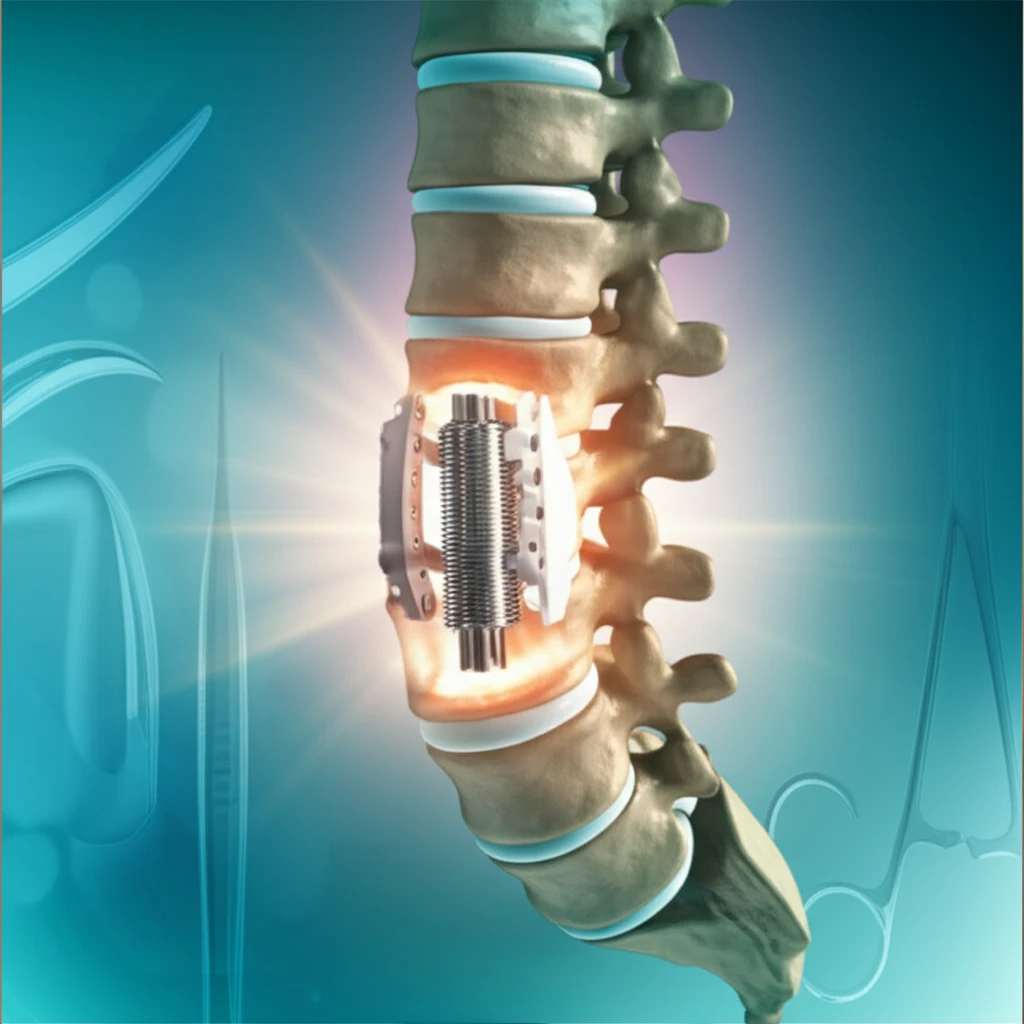
Illustration of a spinal fusion procedure, showing the insertion of a cage to stabilize the spine.

PLIF and TLIF: Navigating the Spine with Precision and Care

"Understanding Minimally Invasive Spinal Fusion: A Guide to PLIF and Modified TLIF Techniques"


Back pain, a common ailment affecting millions, often stems from issues within the spine. When conservative treatments fail, spinal fusion surgery may be considered. Two prominent techniques in this realm are Posterior Lumbar Interbody Fusion (PLIF) and Transforaminal Lumbar Interbody Fusion (TLIF). These procedures aim to alleviate pain and restore function by fusing vertebrae together.

This article will explore the nuances of PLIF and modified TLIF, examining their approaches, benefits, and considerations. We will discuss how these techniques aim to decompress neural elements and stabilize the spine. We'll explore the specific steps involved, from surgical procedures to post-operative care, to provide a comprehensive understanding of these spinal fusion methods.

Understanding these procedures is crucial for patients, healthcare providers, and anyone interested in spinal health. This article offers a clear, informative overview, providing insights into how PLIF and TLIF are used to improve the quality of life for individuals experiencing back pain and related conditions.

PLIF and Modified TLIF: A Detailed Look

Illustration of a spinal fusion procedure, showing the insertion of a cage to stabilize the spine.

PLIF, or Posterior Lumbar Interbody Fusion, is a surgical technique that involves accessing the spine through the back (posterior approach). The primary goal is to decompress the neural elements, such as the spinal cord and nerve roots, and fuse the vertebral bodies. This is typically achieved by inserting a cage filled with bone graft into the intervertebral space to promote fusion.

Modified TLIF, on the other hand, uses the same approach as PLIF but inserts the cage from one side of the spine. This approach is often considered less invasive. The surgeon accesses the spine through a small incision. Once the affected disc is removed, a cage packed with bone graft is inserted to provide stability and encourage fusion. Pedicle screws are commonly used to provide additional stability, and can be used for both PLIF and TLIF procedures.

  • Decompression: Both techniques aim to relieve pressure on the spinal nerves.
  • Fusion: Bone grafts and cages promote the fusion of vertebrae.
  • Stability: Pedicle screws may be used to enhance stability.
  • Approach: PLIF is done from both sides of the spine, while TLIF is often done from one side.
The choice between PLIF and modified TLIF often depends on factors like the patient's specific condition, the surgeon's experience, and the goals of the surgery. Both are important tools for addressing a range of spinal conditions, including degenerative disc disease, spondylolisthesis, and spinal stenosis, with the ultimate aim of alleviating pain and restoring spinal stability.

Conclusion: Embracing a Path to Improved Spinal Health

PLIF and modified TLIF represent significant advancements in spinal fusion surgery. These techniques offer effective solutions for individuals suffering from back pain and related spinal conditions. By understanding these procedures and their benefits, patients and healthcare professionals can make informed decisions to improve spinal health and overall quality of life. Ongoing research and advancements in surgical techniques continue to refine these methods, offering hope and improved outcomes for those in need.

About this Article -

This article was crafted using a human-AI hybrid and collaborative approach. AI assisted our team with initial drafting, research insights, identifying key questions, and image generation. Our human editors guided topic selection, defined the angle, structured the content, ensured factual accuracy and relevance, refined the tone, and conducted thorough editing to deliver helpful, high-quality information.See our About page for more information.

This article is based on research published under:

DOI-LINK: 10.1007/s00586-017-5269-2, Alternate LINK

Title: Plif And Modified Tlif Using The Plif Approach

Subject: Orthopedics and Sports Medicine

Journal: European Spine Journal

Publisher: Springer Science and Business Media LLC

Authors: Hossein Mehdian, Manish Kothari

Published: 2017-09-01

Everything You Need To Know

1

What are Posterior Lumbar Interbody Fusion (PLIF) and Transforaminal Lumbar Interbody Fusion (TLIF), and why are they performed?

Posterior Lumbar Interbody Fusion (PLIF) and Transforaminal Lumbar Interbody Fusion (TLIF) are surgical techniques used to address back pain and spinal instability. PLIF involves accessing the spine through the back to decompress neural elements and fuse vertebral bodies using bone grafts and cages. TLIF, a modified version, uses a similar posterior approach but typically inserts the cage from one side of the spine, often considered less invasive. Both procedures aim to alleviate pain, restore function, and stabilize the spine, particularly when conservative treatments have failed.

2

How do Posterior Lumbar Interbody Fusion (PLIF) and Transforaminal Lumbar Interbody Fusion (TLIF) differ in their surgical approach?

Posterior Lumbar Interbody Fusion (PLIF) and Transforaminal Lumbar Interbody Fusion (TLIF) both utilize a posterior (back) approach to access the spine. However, they differ in how the interbody cage is inserted. In PLIF, the surgeon typically accesses the spine from both sides to insert the cage. With TLIF, the cage is usually inserted from only one side of the spine. The TLIF approach is often favored for being less invasive, potentially reducing the risk of nerve damage and tissue disruption compared to PLIF. Both PLIF and TLIF may also use pedicle screws for enhanced stability.

3

What role do decompression, fusion, bone grafts, cages and pedicle screws play in Posterior Lumbar Interbody Fusion (PLIF) and Transforaminal Lumbar Interbody Fusion (TLIF) procedures?

In both Posterior Lumbar Interbody Fusion (PLIF) and Transforaminal Lumbar Interbody Fusion (TLIF) procedures, decompression involves relieving pressure on the spinal nerves to alleviate pain. Fusion is achieved by inserting bone grafts and cages into the intervertebral space to promote the vertebrae to grow together into a single, solid bone. Bone grafts stimulate bone growth and fusion, while cages maintain the disc height and provide structural support. Pedicle screws are often used to provide additional stability to the fused segment, enhancing the overall success of the procedure.

4

What spinal conditions can be addressed with Posterior Lumbar Interbody Fusion (PLIF) and Transforaminal Lumbar Interbody Fusion (TLIF)?

Posterior Lumbar Interbody Fusion (PLIF) and Transforaminal Lumbar Interbody Fusion (TLIF) are employed to treat a range of spinal conditions, including degenerative disc disease, spondylolisthesis (where one vertebra slips over another), and spinal stenosis (narrowing of the spinal canal). These conditions often cause back pain, leg pain, and neurological symptoms. By decompressing the neural elements and stabilizing the spine through fusion, PLIF and TLIF aim to reduce pain and improve the patient's quality of life.

5

How does a surgeon determine whether Posterior Lumbar Interbody Fusion (PLIF) or Transforaminal Lumbar Interbody Fusion (TLIF) is the most appropriate surgical approach for a patient?

The choice between Posterior Lumbar Interbody Fusion (PLIF) and Transforaminal Lumbar Interbody Fusion (TLIF) is determined based on several factors, including the patient's specific spinal condition, the extent of nerve compression, spinal instability, and the surgeon's expertise. TLIF is often preferred as a less invasive option, but PLIF may be more suitable for certain complex cases requiring more extensive decompression and fusion. The surgeon evaluates imaging studies, neurological assessments, and the patient's overall health to make the most informed decision, aiming to achieve optimal pain relief and spinal stabilization.

Newsletter Subscribe

Subscribe to get the latest articles and insights directly in your inbox.