
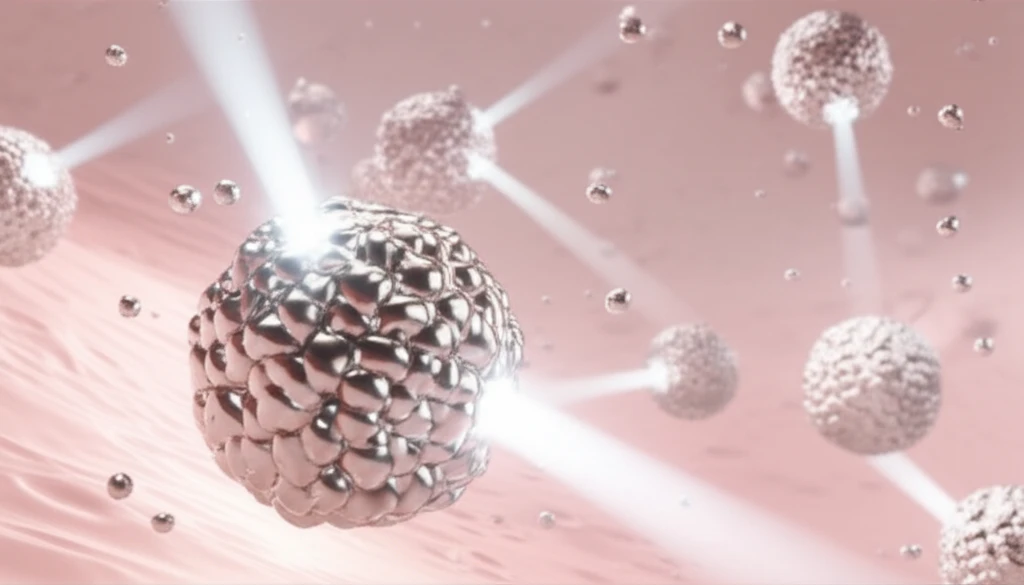
Platinum Nanoparticles: A Tiny Tool with Big Potential in Cancer Treatment

"Scientists are exploring how these nanoparticles can overcome radioresistance, offering new hope for more effective cancer therapies."
Radiation therapy remains a cornerstone in the fight against cancer, but its effectiveness is often hampered by the ability of cancer cells to resist treatment. This phenomenon, known as radioresistance, leads to treatment failure and subsequent relapse, posing a significant challenge in oncology. Overcoming radioresistance is crucial for improving patient outcomes and developing more effective cancer therapies.
Now, scientists are exploring innovative approaches to enhance the impact of radiation therapy, and one promising avenue involves the use of nanoparticles. These tiny particles, engineered from materials like platinum, offer the potential to amplify the effects of radiation within tumors while minimizing damage to healthy tissues. This targeted approach could revolutionize cancer treatment, making it more effective and less toxic.
Recent research has focused on the application of platinum nanoparticles to combat radioresistance. A study published in Cancer Nanotechnology investigates the impact of ultra-small platinum nanoparticles on Deinococcus radiodurans, an organism known for its extreme radioresistance. The findings shed light on the potential of nanoparticles to overcome radioresistance mechanisms, opening new doors for cancer therapy.
How Platinum Nanoparticles Enhance Radiation Therapy: A New Hope
The study explored the use of platinum nanoparticles (PtNPs), specifically, how these particles interact with and affect highly radioresistant organisms. The scientists synthesized ultra-small PtNPs with an average diameter of 1.7 nanometers. Then they examined the particles' uptake, toxicity, and impact on radiation response in Deinococcus radiodurans.
- Nanoparticle Synthesis: Platinum nanoparticles were created using radiolysis, a process that uses radiation to reduce platinum salts into nanoparticles. This method ensures the particles are stable and do not require additional chemicals for reduction.
- Bacterial Cultures: Deinococcus radiodurans, known for its extreme resistance to radiation, was used as a model organism. Researchers monitored bacterial growth by measuring optical density.
- Toxicity Assessment: The toxicity of PtNPs was evaluated by observing the ability of D. radiodurans to form colonies (CFU) and examining growth parameters.
- Irradiation Experiments: Bacteria were exposed to gamma rays with and without PtNPs to assess the impact on cell survival. Clonogenic assays were performed to quantify cell survival after irradiation.
- Microscopy Techniques: Synchrotron Deep-UV fluorescence microscopy and high-angle annular dark-field scanning transmission electron microscopy (HAADF-STEM) were used to visualize the nanoparticles within the cells.
- Quantification: Inductively coupled plasma mass spectrometry (ICP-MS) was used to quantify the platinum content within the bacterial cells.
The Future of Nanoparticles in Cancer Therapy
This study provides a compelling case for the use of metallic nanoparticles to enhance radiation therapy, especially in cancers known for their resistance. By demonstrating the ability of platinum nanoparticles to amplify radiation effects in radioresistant organisms, the researchers have opened a new avenue for improving cancer treatment outcomes. This approach has the potential to improve tumor targeting and overcome radioresistance, paving the way for more effective and less toxic cancer therapies.