
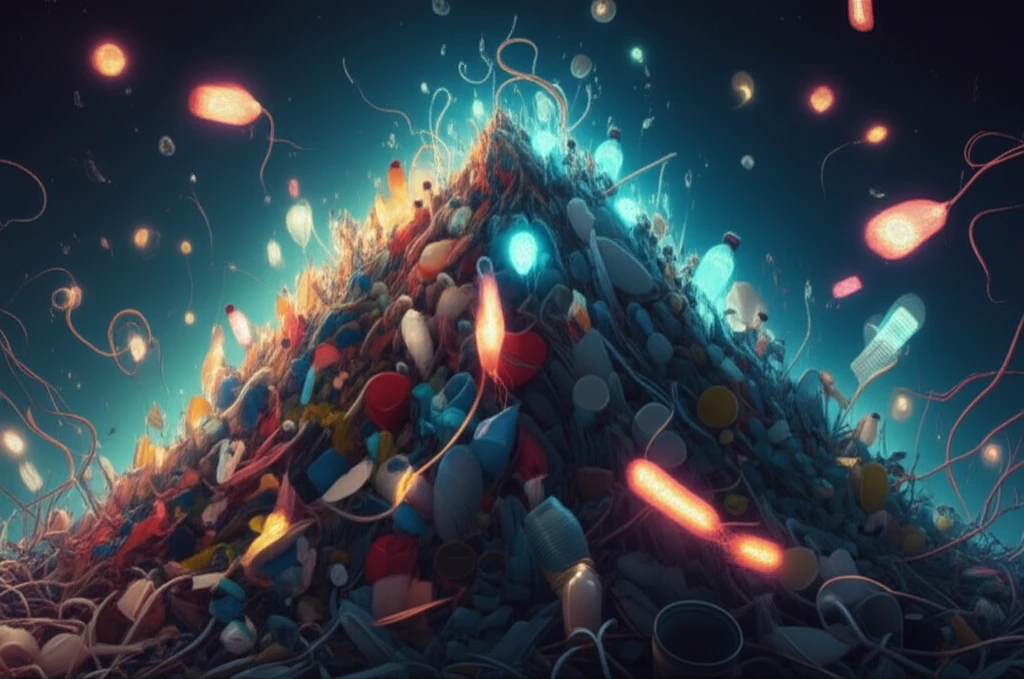
Bacteria consuming plastic waste.

Plastic-Eating Bacteria: Are They a Solution to PVC Pollution?

"Researchers isolate a strain of bacteria capable of degrading polyvinyl chloride, offering a glimmer of hope for tackling plastic waste."


Plastic pollution is one of the most pressing environmental issues of our time. The durability that makes plastics so useful also makes them incredibly resistant to natural degradation, leading to vast accumulations of waste in landfills and natural ecosystems. Among these, polyvinyl chloride (PVC) stands out as a particularly tough challenge.

But what if there was a biological solution? Scientists have long been exploring the potential of microorganisms to break down plastics through a process called biodegradation. The idea is simple: harness the natural metabolic capabilities of bacteria and fungi to convert complex plastic polymers into simpler, less harmful substances.

A recent study has identified a bacterial strain with the ability to degrade PVC. This article explores the findings of this research, examining the potential of this bacterial strain, Micrococcus species, to address PVC pollution, and what this discovery could mean for the future of plastic waste management.

Meet Micrococcus: A PVC-Degrading Microbe

Bacteria consuming plastic waste.

The research focused on isolating and identifying microbial strains capable of degrading PVC. Researchers collected samples from various environments known to be rich in plastic waste, including soil, industrial effluents, and marine sediments. They then used an enrichment culture technique to encourage the growth of microorganisms that could utilize PVC as a food source.

After a series of cultivations and tests, one bacterial strain stood out: a Micrococcus species. This strain demonstrated a remarkable ability to break down PVC, as evidenced by several key indicators:

  • Chloride Release: The bacteria released chloride ions from the PVC polymer, a clear sign of degradation.
  • Increased Cell Density: The population of bacteria grew in media where PVC was the only source of carbon.
  • Carbon Dioxide Production: The bacteria converted the carbon from PVC into carbon dioxide, indicating mineralization of the plastic.
  • Growth on PVC Film: The bacteria were able to colonize and grow directly on the surface of PVC film.
Further tests revealed that this Micrococcus species could release 0.36% of the chloride from PVC and mineralize 8.87% of the PVC into carbon dioxide over a 70-day period. While these percentages may seem small, they represent a significant step forward in the search for effective PVC-degrading microorganisms.

The Future of Plastic Waste: Aided by Microbes?

The discovery of a PVC-degrading Micrococcus species offers a promising avenue for addressing plastic pollution. While further research is needed to optimize the degradation process and scale up its application, this finding highlights the potential of bioremediation as a valuable tool.

Future studies could focus on:

<ul><li>Identifying and isolating enzymes involved in PVC degradation</li><li>Optimizing conditions for PVC degradation (pH, temperature, nutrient availability)</li><li>Exploring synergistic effects of combining different microbial consortia</li><li>Developing in situ applications for plastic waste remediation</li></ul><br>By combining modern remediation approaches with the natural capabilities of microorganisms, we can move closer to a future where plastic waste is no longer an insurmountable environmental challenge.

About this Article -

This article was crafted using a human-AI hybrid and collaborative approach. AI assisted our team with initial drafting, research insights, identifying key questions, and image generation. Our human editors guided topic selection, defined the angle, structured the content, ensured factual accuracy and relevance, refined the tone, and conducted thorough editing to deliver helpful, high-quality information.See our About page for more information.

This article is based on research published under:

DOI-LINK: 10.5897/ajb11.3630, Alternate LINK

Title: Isolation Of Polyvinyl Chloride Degrading Bacterial Strains From Environmental Samples Using Enrichment Culture Technique

Subject: Agronomy and Crop Science

Journal: AFRICAN JOURNAL OF BIOTECHNOLOGY

Publisher: Academic Journals

Authors: Rajashree Patil

Published: 2012-04-17

Everything You Need To Know

1

What type of bacteria is showing promise in breaking down PVC?

Scientists have identified a specific strain of bacteria, belonging to the Micrococcus species, that can degrade PVC. This particular strain was isolated and shown to break down PVC by releasing chloride ions, increasing its population density in media containing PVC, producing carbon dioxide, and growing directly on PVC film.

2

What key indicators demonstrate the Micrococcus species' ability to degrade PVC?

The Micrococcus species' ability to degrade PVC was confirmed through several key observations. These include the release of chloride ions from the PVC polymer, growth in media where PVC was the sole carbon source, conversion of PVC carbon into carbon dioxide, and the ability to colonize and grow on PVC film.

3

How effective is the Micrococcus species in degrading PVC over a specific time period?

The Micrococcus species, over a 70-day period, was able to release 0.36% of the chloride from PVC and convert 8.87% of the PVC into carbon dioxide. While these percentages may seem small, they signify a substantial advancement in identifying microorganisms capable of effectively degrading PVC.

4

What are the potential future implications and research directions based on the discovery of the PVC-degrading Micrococcus species?

The discovery of this specific Micrococcus species provides a promising approach for managing PVC waste through bioremediation. Future research could focus on optimizing the degradation process, exploring genetic modifications to enhance the bacteria's efficiency, and developing practical applications for large-scale plastic waste treatment. The understanding of enzyme mechanisms, detailed metabolic pathways, and the precise genetic makeup enabling PVC degradation in the Micrococcus species are also necessary for future research.

5

Why is PVC considered a particularly challenging type of plastic waste?

PVC, or polyvinyl chloride, poses significant environmental challenges due to its durability and resistance to natural degradation. When PVC waste accumulates in landfills and natural ecosystems, it persists for extended periods, contributing to pollution and potential harm to wildlife. Unlike some other plastics, PVC contains chlorine, which can release harmful substances when incinerated, complicating disposal efforts.

Newsletter Subscribe

Subscribe to get the latest articles and insights directly in your inbox.