
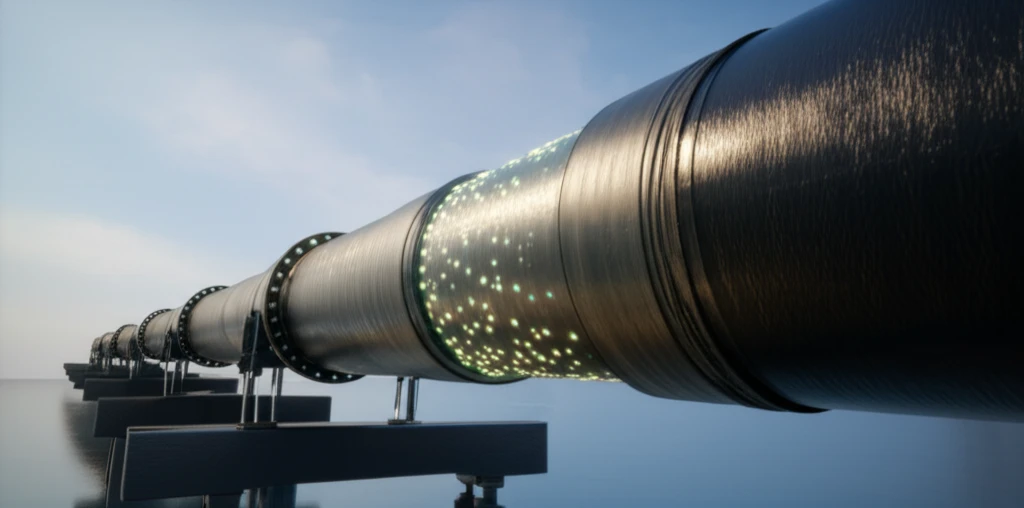
Surreal illustration of a pipeline with composite wrap and epoxy grout, highlighting its strength.

Pipeline Under Pressure? How Epoxy Grouts Offer a Stronger Fix

"Discover how advanced epoxy grouts and finite element analysis are revolutionizing pipeline repair, ensuring safer and more durable infrastructure."


Oil and gas pipelines are the unsung heroes of modern energy, silently transporting resources across vast distances. However, these vital arteries are constantly under threat. Over time, pipelines face deterioration from corrosion, physical damage, and the relentless forces of nature. The consequences of pipeline failure can be devastating, leading to environmental disasters, economic losses, and potential safety hazards.

Recognizing these risks, the oil and gas industry is continuously innovating to enhance pipeline integrity. One promising area is the use of composite repair systems, which employ advanced materials to reinforce weakened sections. A critical component of these systems is the grout or putty used to fill gaps and transfer loads between the pipe and the reinforcing composite wrap.

Recent research detailed in the Journal of Pressure Vessel Technology is shedding light on the remarkable potential of epoxy grouts in pipeline repair. By meticulously characterizing the mechanical properties of different epoxy grouts and employing finite element analysis (FEA), engineers can now design more effective and reliable repair solutions.

The Science of Stronger Pipelines: Understanding Epoxy Grouts

Surreal illustration of a pipeline with composite wrap and epoxy grout, highlighting its strength.

Epoxy grouts are more than just fillers; they are engineered materials designed to withstand extreme conditions. These materials must exhibit exceptional compressive, tensile, and flexural strength to ensure lasting pipeline integrity. Researchers have been rigorously testing various epoxy grouts to understand their behavior under stress and identify the best candidates for repair applications.

The mechanical properties of epoxy grouts determine how well they perform in a repair scenario. Key characteristics include:

  • Compressive Strength: The ability to withstand squeezing forces without deformation. This is vital for transferring loads from the pipe to the composite wrap.
  • Tensile Strength: The capacity to resist pulling forces, preventing cracking and ensuring the grout remains intact.
  • Flexural Strength: The resistance to bending, crucial for maintaining structural integrity under dynamic loads.
  • Young's Modulus: A measure of stiffness, indicating how much the material deforms under stress.
By carefully analyzing these properties, engineers can select the ideal grout for specific repair needs. For instance, a grout with high compressive strength may be preferred for applications where load transfer is paramount, while a grout with high tensile strength might be chosen for areas prone to cracking.

Looking Ahead: The Future of Pipeline Repair

The ongoing research into epoxy grouts and FEA modeling is paving the way for a new era of pipeline repair. By understanding the intricate behavior of these materials, engineers can design more effective, reliable, and cost-efficient solutions. This not only enhances the safety and longevity of existing pipelines but also reduces the environmental risks associated with pipeline failures. As the demand for energy continues to grow, these innovations will play a crucial role in ensuring the safe and sustainable transport of vital resources.

About this Article -

This article was crafted using a human-AI hybrid and collaborative approach. AI assisted our team with initial drafting, research insights, identifying key questions, and image generation. Our human editors guided topic selection, defined the angle, structured the content, ensured factual accuracy and relevance, refined the tone, and conducted thorough editing to deliver helpful, high-quality information.See our About page for more information.

Everything You Need To Know

1

What are epoxy grouts and why are they important in the context of pipeline repair?

Epoxy grouts are specially formulated materials used in pipeline repair to fill gaps and transfer loads between the pipeline and any reinforcing composite wrap. They are designed to withstand extreme conditions and maintain pipeline integrity. Unlike regular fillers, epoxy grouts possess exceptional compressive, tensile, and flexural strength, making them critical for durable repairs.

2

What does mechanical properties characterization mean, and why is it important for using epoxy grouts?

Mechanical properties characterization is the process of rigorously testing epoxy grouts to understand their behavior under different types of stress. This involves measuring key characteristics such as compressive strength (resistance to squeezing), tensile strength (resistance to pulling), flexural strength (resistance to bending), and Young's Modulus (stiffness). By understanding these properties, engineers can select the most appropriate grout for specific repair needs, ensuring optimal performance and longevity of the repair.

3

What is finite element analysis (FEA), and how is it used in pipeline repair with epoxy grouts?

Finite element analysis (FEA) is a computer modeling technique used to simulate the behavior of epoxy grouts in pipeline repair scenarios. FEA allows engineers to predict how the grout will perform under various loads and conditions, helping them to design more effective and reliable repair solutions. By using FEA, potential weaknesses can be identified and addressed before implementation, minimizing risks and optimizing the repair design. FEA is important because physical testing can be expensive and slow.

4

What are composite repair systems, and how do epoxy grouts play a role in them?

Composite repair systems utilize advanced materials, including epoxy grouts, to reinforce weakened sections of pipelines. The grout acts as a critical interface, transferring loads between the original pipe and the reinforcing composite wrap. This distributes stress and strengthens the pipeline, preventing further deterioration and potential failures. Composite repair systems are important because they extends the lifespan of aging pipelines, ensuring safer and more reliable infrastructure.

5

How are epoxy grouts and finite element analysis being used by the oil and gas industry to improve pipeline safety?

The oil and gas industry uses epoxy grouts, mechanical properties characterization, and finite element analysis (FEA) to address the ongoing threats to pipeline integrity, such as corrosion and physical damage. These methods help engineers develop stronger, more durable repair solutions, reducing the risk of environmental disasters, economic losses, and safety hazards associated with pipeline failures. The combination of these advanced techniques ensures the safe and sustainable transport of vital resources.

Newsletter Subscribe

Subscribe to get the latest articles and insights directly in your inbox.