
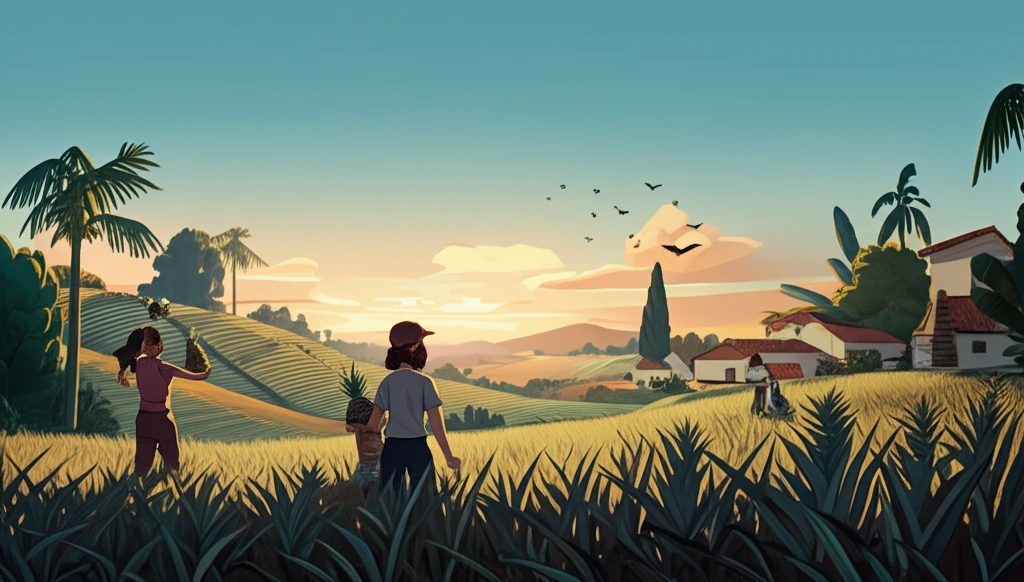
Pineapple's Comeback: How Family Farms Are Keeping the Tradition Alive

"Discover the untold story of Monte Alegre de Minas' pineapple farmers who are battling monoculture and economic shifts to preserve their heritage."
In the rolling hills of Monte Alegre de Minas, Brazil, agriculture isn't just a business—it's a deeply woven part of the local identity. For generations, family farms have been the backbone of the community, shaping its economy and culture. Among these agricultural traditions, pineapple cultivation holds a special place, marking the region as a significant producer in Brazil.
The story of pineapple farming in Monte Alegre de Minas began in the 1940s and by the 1980s, the region was celebrated as the “National Capital of Pineapple,” producing an impressive 149 million fruits annually. But as the global agricultural landscape evolved, these family farms faced new challenges. From rising production costs and lack of government incentives to the expansion of sugarcane, soybean, and corn cultivation, many farmers found themselves at a crossroads.
Despite these pressures, many family farmers in Monte Alegre de Minas have refused to let the tradition fade. These farmers are more than just producers, they are custodians of a legacy. Through innovative strategies and unwavering determination, they continue to grow pineapples, balancing economic realities with cultural preservation. This article explores their inspiring journey, highlighting the challenges they face and the strategies they employ to keep their farms—and their heritage—alive.
A Crop with Economic Reach
The pineapple is a tropical plant with an edible fruit and is the most economically significant plant in the family Bromeliaceae, underscoring its commercial importance worldwide. In Uganda, one pineapple farmer reports that the crop's returns have allowed her to educate all seven of her children and build a family home with her husband, demonstrating how pineapples can anchor household economies.
Export Varieties and Market Pressures
In Ghana's Ekumfi district, farmers cultivate several pineapple varieties, including MD 2, which is grown mainly for export, alongside Smooth Cayenne and Sugar Loaf. Yet despite this specialization, the Uganda Investment Authority notes that market instability remained one of the biggest constraints for pineapple growers for years, showing that even well-suited varieties do not guarantee stable incomes.
Traditions Rooted in Family
Traditions survive when families deliberately uphold them across generations; one family's annual drive to the same Jersey Shore town has been maintained for 30 years because both parents' families summered there and the next generation was determined to keep it going. This same commitment appears on family farms, where scholarly attention has focused on family-based agriculture as a response to broader economic pressures reshaping the countryside.
The Heart of the Matter: Family Farms and Pineapple Production
Family farms play a crucial role in Brazil’s agricultural sector, producing a significant portion of the food consumed in urban areas while providing employment and income in rural communities. These farms are characterized by a close connection between family labor and land, fostering a sense of stewardship and tradition. However, they often face systemic challenges such as limited access to agricultural policies, low market prices, and difficulties in commercializing their products.
- Rising Production Costs
- Lack of Incentives
- Competition from Monoculture Crops
Why Family Farms Persist
Research on family farms in Austria, Italy, and Poland finds that this focus is mainly a reaction to several trends, such as economic pressures, large-scale land grabbing, and the restructuring of agrifood chains. The persistence of the family farm model is thus understood less as nostalgia and more as a deliberate resilience strategy against consolidation in modern food systems.
When Tradition Meets Market Realities
The limits of the traditional approach are visible in Uganda, where market instability for years remained one of the biggest constraints on pineapple farmers, undermining the reliability of farm income. Meanwhile, images of industrial pineapple production circulated on platforms like Pinterest highlight a scale of operations far beyond the reach of most family holdings, illustrating the competitive pressure small producers face.
Local Roots Across Borders
Comparisons across Austria, Italy, and Poland show that family farms in different countries respond to the same pressures of economic consolidation and agrifood chain restructuring, even as their crops and landscapes differ. In Vermont, a steakhouse demonstrates a parallel principle for meat: local beef, pork, and poultry from Vermont farms form the foundation of the kitchen's offerings, and sourcing close to home means fresher ingredients and a shorter journey from farm to plate.
Sustaining the Legacy
The story of pineapple farmers in Monte Alegre de Minas is a testament to the resilience and resourcefulness of family farms in the face of adversity. By embracing diversification, leveraging government programs, and maintaining a strong connection to their cultural roots, these farmers are not only surviving but also thriving. Their efforts ensure that pineapple production continues to be a vital part of the region’s economy, identity, and cultural heritage for generations to come. Supporting these farmers means investing in a sustainable future that honors both tradition and progress.
Close to Home, Close to the Plate
Commentators point to the value of supporting local producers, noting that sourcing close to home means fresher ingredients and a shorter journey from farm to plate. This principle, articulated by a Vermont steakhouse that keeps tradition alive by cooking over an open flame, applies equally to pineapple growers whose local markets reward short supply chains and community ties.
From Local Fields to Global Markets
Uganda's pineapple farmers are now breaking into global markets after years in which a harvest once meant losses, a sign that export channels can transform farm fortunes. The Ghanaian example of MD 2, a variety grown mainly for export, suggests that access to international demand is a key frontier for family farms seeking stability beyond local buyers.
Systemic Pressures on Smallholders
Family farms operate within larger systems shaped by economic pressures, large-scale land grabbing, and the restructuring of agrifood chains, forces documented across Austria, Italy, and Poland. These systemic challenges mean that the survival of family-run pineapple farms depends not only on farming skill but on how well smallholders navigate consolidation in global food networks.
Farms That Raise Families
The real-world payoff of family farming is deeply personal: through pineapple farming, one Ugandan woman has educated her seven children, built a family home with her husband, and diversified into coffee, poultry, and piggery. Accounts of daily farm life similarly capture both the joys and challenges of family farms, where livelihoods and family identity are inseparable.