
Paving the Future: How Smart Rock Technology is Revolutionizing Asphalt Compaction

"Discover how innovative sensor technology is providing unprecedented insights into asphalt compaction, leading to stronger, longer-lasting roads."
Compaction is a cornerstone of asphalt pavement construction. The process, which involves applying external force to asphalt mixtures, directly impacts the density, air void distribution, and overall quality of the road surface. Subpar compaction leads to roads that are susceptible to cracking, rutting, and moisture damage, significantly shortening their lifespan.
The Superpave gyratory compactor (SGC) is a popular method used in laboratories to simulate field compaction. By applying both shear and compression, the SGC mimics the forces asphalt experiences on real roads. However, a gap exists between laboratory results and field performance, prompting researchers to dig deeper into understanding what happens during compaction at a particle level.
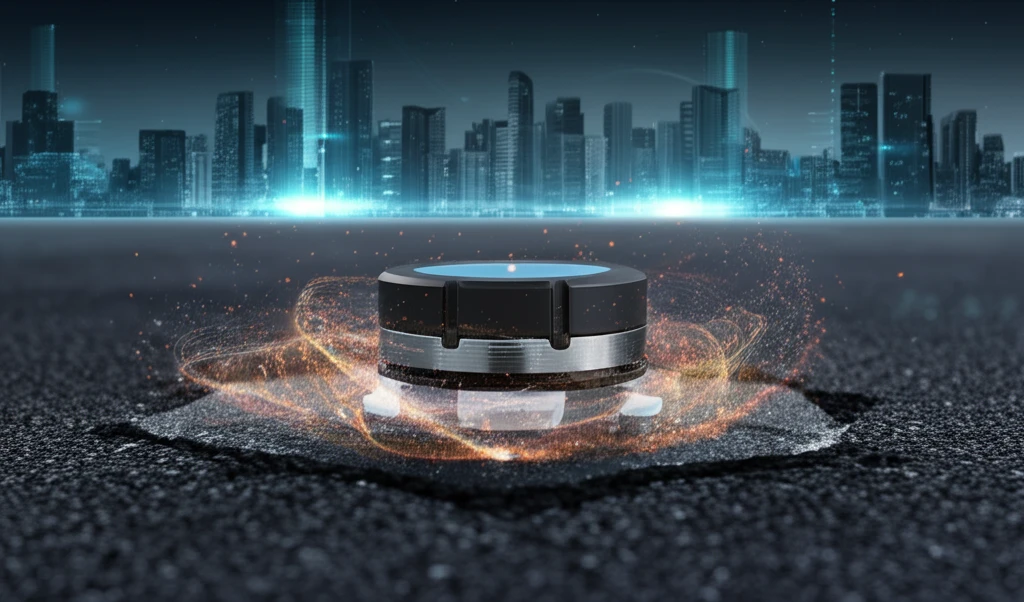
Enter SmartRock, a real-time particle motion sensor designed to provide a meso-scale view of compaction. This innovative technology offers insights into how individual particles move and interact during the SGC process, paving the way for optimized asphalt mixtures and improved road construction practices.
Sensor Uptake and Measured Impact
SmartRock is a relatively new class of particle-motion monitoring sensor built on microelectromechanical systems (MEMS) and combined with attitude sensors to track the behavior of individual aggregates during compaction. Compaction quality is commonly evaluated through indices such as porosity, density, and compaction degree, with compaction degree—the ratio of actual field density to a standard density established in laboratory conditions—being the most widely used indicator. Recent work has embedded SmartRock sensors in gyratory and field compaction tests to study the effect of temperature and roller action on the compaction process of asphalt mixtures. Complementary studies have also paired SmartRock kinematic data with CT scanning technology to establish relationships between aggregate motion and void-volume changes in asphalt concrete. Together, these efforts reflect the technology's growing role in quantifying how aggregates reorganize during compaction rather than at the final result alone.
Conventional Compaction Quality Control
Historically, compaction control has relied on density-based verification such as measuring the resulting density or compactness of a finished layer against benchmarks. These verification-style methods are generally performed after compaction rather than continuously during it, so localized weak spots or over-compacted zones may go undetected. More recent instrumented approaches seek to observe the compaction process in real time, but this subsection has no dedicated source material, so the specific strengths and shortcomings of standard methods cannot be stated with certainty here. Any detailed comparison of conventional versus instrument-based control should therefore be treated as evolving and context-dependent.
Precursors and Early Development
The idea of embedding instruments in construction materials to study behavior at the particle scale has roots in geomechanics, where particle-level observation has long been a research goal. The specific SmartRock sensor lineage is comparatively recent and tied to advances in microelectromechanical systems, but a fully documented timeline of foundational milestones is not available in the source material for this subsection. Consequently, any historical narrative about the technology's early development should be regarded as general background rather than established fact.
What Exactly is SmartRock and How Does it Work?
SmartRock is a cutting-edge sensor initially developed for the railroad industry, now adapted for asphalt mixture research. Encased in a durable, 3D-printed shell made of high-temperature resistant ABS with Nylon, SmartRock can withstand the harsh conditions of asphalt compaction. Its size and shape are designed to mimic real aggregate, ensuring it integrates seamlessly into the mixture.
- Real-Time Monitoring: Provides continuous data on particle movement during the SGC process.
- Rotation Tracking: Measures the rotation of particles, which is crucial for understanding how they interact and compact.
- Orientation Analysis: Tracks the orientation of particles, revealing how they align and interlock during compaction.
- Data Accuracy: Employs BLE and Kalman filtering to reduce errors and ensure reliable measurements.
Current Research Trajectories
Active research on instrumented-particle monitoring is broad and fast-moving, spanning field compaction trials, laboratory gyratory testing, and digital-twin style modeling of pavement compaction. Since this subsection has no specific source material, the precise studies, metrics, and findings cannot be itemized here with confidence. Readers should treat the details of the latest literature as reported by individual research groups rather than as a settled consensus.
Persistent Challenges and Limitations
The source material notes that because the interaction mechanisms between aggregates under compaction are not fully understood, engineering problems such as uneven compaction and over-compaction remain prone to occur in practice. Despite this, SmartRock is reported to be an effective tool for monitoring the compaction process of asphalt mixtures, with dynamic responses such as relative rotation in the x- and y-directions and stress in the z-direction emerging as promising indicators of compactness. A comprehensive review of SmartRock applications in asphalt mixtures and pavement likewise concentrates on compaction mechanisms and deformation studies. Taken together, these sources indicate that while SmartRock adds valuable particle-level data, incomplete understanding of aggregate interaction remains a core underlying limitation.
Comparing Monitoring Approaches
Rigorous head-to-head comparisons between instrumented-particle sensors and other compaction-monitoring techniques are not covered by the source material for this subsection, so no quantitative conclusions can be drawn here. In general terms, investigators weigh the richer, particle-level detail provided by embedded sensors against their cost per sensor and the practical constraints of instrumenting a full construction site. Such trade-offs are typically discussed case by case, and the field has not settled on a single preferred approach to date.
The Road Ahead: Future Applications and Research
SmartRock technology represents a significant leap forward in asphalt compaction research and practice. By providing real-time, meso-scale data on particle movement, it offers insights that can lead to more durable, longer-lasting roads. While this study focuses on laboratory SGC compaction, the potential applications extend to field compaction, intelligent compaction techniques, and improved asphalt mixture designs. As sensor technology continues to advance, we can expect even more innovative solutions that enhance the quality and sustainability of our infrastructure.
Expert Consensus and Open Gaps
Real-time and accurate monitoring of compaction quality is regarded as one of the key steps in pavement construction. In studies using embedded SmartRock sensors, roller passes and temperature were shown to affect the compactness of asphalt mixtures and its uniformity, with uniformity assessed via the semivariance function and corroborated through indoor gyratory compaction testing. Experts further emphasize that the compaction quality of asphalt surface courses significantly affects overall pavement performance, yet the dynamic response and compaction-degree variation of the top, middle, and bottom surface courses during vibrational compaction have received limited research. The synthesis emerging from this work is that SmartRock supplies particle-scale insight that complements traditional density-based evaluations, while important gaps remain in understanding layer-by-layer behavior during vibrational compaction.
Anticipated Directions
Looking ahead, the direction of smart-sensor compaction technology is expected to move toward richer datasets captured automatically throughout construction. Integrating particle-level measurements with digital-twin-style models is a plausible next step, but this subsection has no source material, so forward-looking statements should be read as reasoned speculation rather than documented findings. The specific features, timelines, and adoption patterns of future systems remain open questions.
Systemic and Industry-Wide Considerations
At a systemic level, smarter compaction monitoring is part of a wider push toward data-driven decision-making in pavement construction, where better layer quality translates into longer service life and lower maintenance costs. Since this subsection has no dedicated source material, broader statements about industry adoption, standardization, or cost dynamics cannot be verified here. General claims along these lines should be treated as high-level context rather than evidence-backed conclusions.
Construction Crews and Pavement Lifespans
The quality of base course compaction significantly influences a pavement's overall performance, making compaction one of the most consequential steps in road construction. In a case study of granular base-layer compaction, a SmartRock sensor positioned at the bottom of the layer responded actively to roller impact and produced reasonable particle-movement results. Monitoring particle movement in this way translates otherwise invisible aggregate motion into measurable data that crews can act on during construction. The broader aim is to help contractors reach more consistent compaction quality and thereby build more durable pavements.