
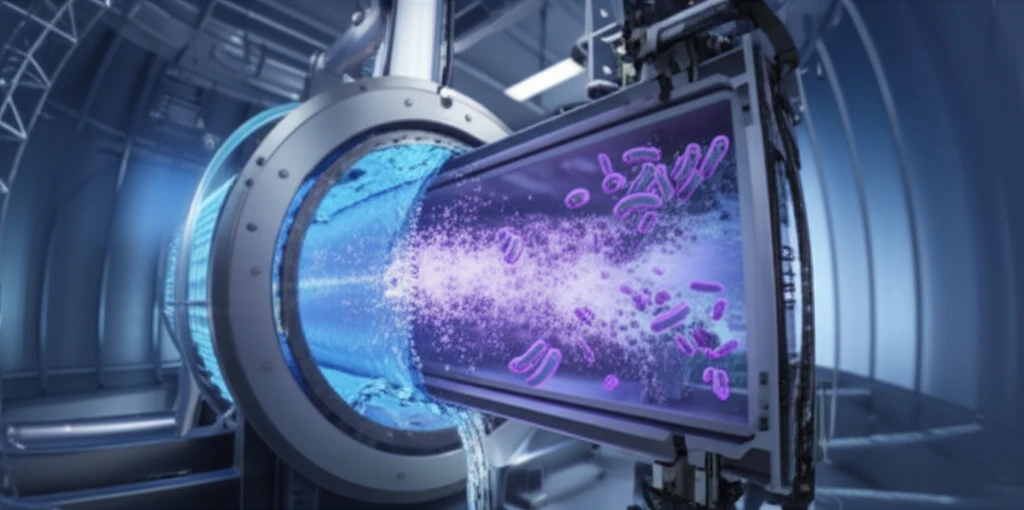
Rotating packed bed system purifies water, neutralizing E. coli with ozone.

Ozone vs. E. coli: The Unexpected Hero in Water Disinfection

"Discover how rotating packed bed technology is revolutionizing water treatment, offering a powerful solution against harmful bacteria like E. coli."


Access to clean and safe water is a cornerstone of public health. Traditional disinfection methods often struggle with efficiency and the formation of harmful byproducts. In the quest for better solutions, scientists have been exploring innovative technologies to enhance water treatment processes.

Ozone, a powerful disinfectant, has long been recognized for its ability to eliminate bacteria, viruses, and other contaminants. However, maximizing ozone's effectiveness requires advanced delivery systems that ensure thorough mixing and contact with the water. This is where the rotating packed bed (RPB) technology steps in, offering a promising solution for efficient water disinfection.

This article delves into a recent study that investigates the use of RPB as a novel disinfection contactor for inactivating E. coli, a common indicator of water contamination. By examining the performance of RPB in comparison to traditional methods, we uncover the potential of this technology to transform water treatment and safeguard public health.

Rotating Packed Bed (RPB): A Game-Changer in Water Disinfection?

Rotating packed bed system purifies water, neutralizing E. coli with ozone.

The study centers on the application of rotating packed bed (RPB) technology, a process intensification device, for ozone disinfection. RPB involves a rapidly rotating bed of packing material that creates a high-gravity environment, resulting in:

The goal was to assess whether RPB could enhance the inactivation of Escherichia coli (E. coli) in water. E. coli is frequently employed as an indicator organism to gauge the effectiveness of water disinfection techniques. The scientists meticulously evaluated the impact of several factors on E. coli inactivation, including:

  • Enhanced mass transfer between ozone gas and water.
  • Improved mixing and contact between the disinfectant and microorganisms.
  • Reduced short-circuiting and recirculation issues common in conventional contactors.
The performance of RPB was compared against traditional bubble reactors. The results indicated that RPB significantly outperformed conventional methods, achieving higher disinfection efficacy at lower ozone concentrations and shorter contact times. This breakthrough suggests that RPB could be a more efficient and cost-effective solution for water disinfection.

The Future of Clean Water: RPB and Beyond

The findings of this study highlight the potential of rotating packed bed technology as a superior alternative to conventional water disinfection methods. By offering enhanced efficiency, reduced costs, and minimal byproduct formation, RPB represents a significant step forward in safeguarding water quality and public health. As research and development in this field continue to advance, we can expect even more innovative solutions to emerge, paving the way for a future where clean, safe water is accessible to all.

About this Article -

This article was crafted using a human-AI hybrid and collaborative approach. AI assisted our team with initial drafting, research insights, identifying key questions, and image generation. Our human editors guided topic selection, defined the angle, structured the content, ensured factual accuracy and relevance, refined the tone, and conducted thorough editing to deliver helpful, high-quality information.See our About page for more information.

This article is based on research published under:

DOI-LINK: 10.1016/j.chemosphere.2018.09.149, Alternate LINK

Title: Rotating Packed Bed As A Novel Disinfection Contactor For The Inactivation Of E. Coli By Ozone

Subject: General Medicine

Journal: Chemosphere

Publisher: Elsevier BV

Authors: Taoran Liu, Dan Wang, Han Liu, Wei Zhao, Wei Wang, Lei Shao

Published: 2019-01-01

Everything You Need To Know

1

What is rotating packed bed technology and why is it important for water treatment?

Rotating packed bed (RPB) technology is a process intensification device used to enhance ozone disinfection in water treatment. It utilizes a rapidly rotating bed of packing material to create a high-gravity environment. This enhances mass transfer between ozone gas and water, improves mixing and contact between the disinfectant and microorganisms, and reduces short-circuiting and recirculation issues typically found in conventional contactors. RPB's significance lies in its potential to offer a more efficient and cost-effective solution for water disinfection, crucial for public health.

2

Why is E. coli important when talking about water disinfection?

Escherichia coli (E. coli) is used as an indicator organism to determine the effectiveness of water disinfection techniques. Its presence indicates fecal contamination and the potential presence of other harmful pathogens. E. coli's significance is rooted in its ability to signal broader water quality issues. Effective inactivation of E. coli by methods like ozone disinfection in rotating packed bed (RPB) systems demonstrates the ability to eliminate dangerous microorganisms, ensuring safer water for consumption and use.

3

What is ozone and why is it used in water disinfection?

Ozone is a powerful disinfectant used to eliminate bacteria, viruses, and other contaminants in water. Its effectiveness depends on how well it mixes with and contacts the water being treated. Ozone's importance stems from its strong oxidation capabilities, which can destroy pathogens without leaving harmful chemical residues. Pairing ozone with rotating packed bed (RPB) technology maximizes its disinfection potential through enhanced mass transfer and mixing.

4

What are traditional bubble reactors and how do they compare to rotating packed bed systems?

Traditional bubble reactors are conventional water disinfection methods that are often compared to newer technologies like rotating packed bed (RPB) systems. Bubble reactors typically involve bubbling ozone gas through water to achieve disinfection. However, they can suffer from lower efficiency, short-circuiting, and recirculation issues. RPB outperforms traditional bubble reactors by achieving higher disinfection efficacy at lower ozone concentrations and shorter contact times, offering a more efficient and cost-effective solution for water disinfection.

5

Why is water disinfection so important?

Water disinfection is the process of eliminating harmful bacteria, viruses, and other contaminants from water to make it safe for consumption and various other uses. It is critically important for public health because it prevents the spread of waterborne diseases. The implications of effective water disinfection extend to improved sanitation, reduced healthcare costs, and enhanced overall well-being. Technologies like rotating packed bed (RPB) are pivotal in advancing water disinfection methods.

Newsletter Subscribe

Subscribe to get the latest articles and insights directly in your inbox.