
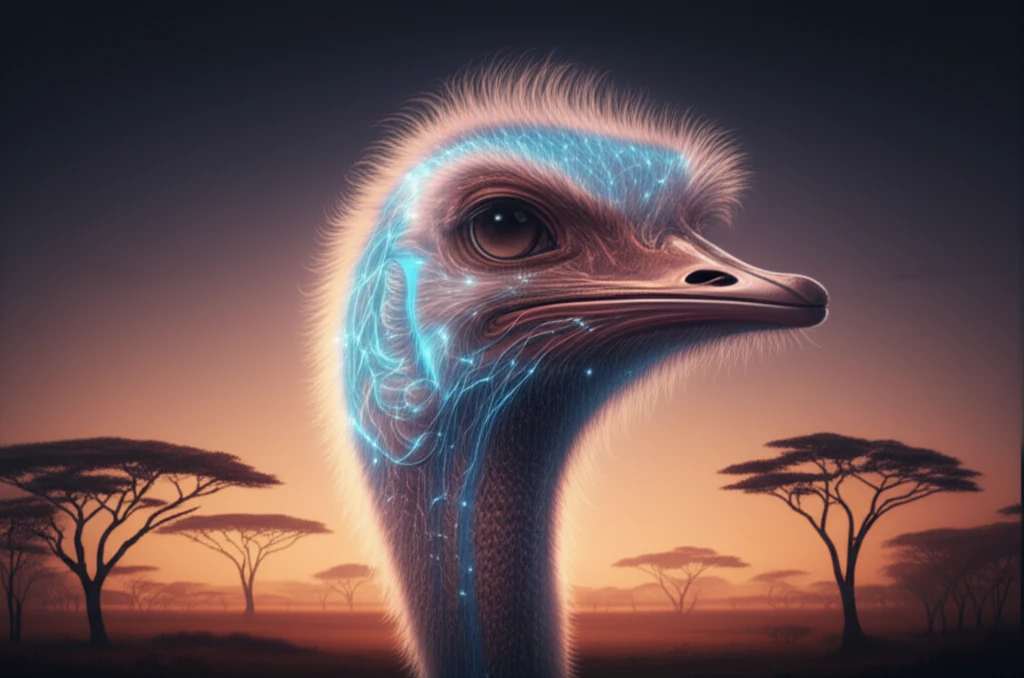
Ostrich Brains: More Than Just Bird Brains?

"Unlocking the Secrets of the African Ostrich Brain: A Journey into Anatomy and Behavior"
The African ostrich, native to the harsh climates of Africa and the Arabian Desert, has captured human attention for its economic value and unique biological features. As ostrich breeding becomes increasingly popular, understanding these birds is paramount. While external features have been documented, the intricate details of the ostrich brain remain largely unexplored.
This article sheds light on the fascinating world of the ostrich brain, drawing from morphological research to provide a clear and accessible overview. We'll examine its gross anatomy, key dimensions, and histological structures, offering insights into how these features relate to the ostrich's remarkable abilities.
Whether you're a seasoned bird enthusiast, a curious student, or simply intrigued by the wonders of nature, this journey into the ostrich brain promises to be both enlightening and captivating.
The Ostrich Brain: Surprising Complexity
Despite the popular 'bird brain' stereotype, ostriches possess brains that are more functionally complex than their small size might suggest. The olfactory bulbs of the ostrich brain are notably small, indicating ill-developed olfaction, while the cerebellum is disproportionately prominent and controls the bird's complicated physiological functions. Birds in general possess large, complex brains that process, integrate, and coordinate environmental information and direct the body's responses.
Multi-Modal Imaging of Ostrich Head Anatomy
Researchers have employed multiple imaging modalities to map ostrich head anatomy in detail. A tri-method atlas comparing serial anatomical sections with CT and MRI scans taken at regular intervals throughout the ostrich head represents one such approach. Additional studies have used 3D reconstructions to visualize the brain endocast, paranasal air sinuses, and surrounding cranial structures, while morphological investigations have focused on gross anatomy, brain part dimensions, and histological structures of the African ostrich brain.
A Century of Avian Brain Research
The study of avian brain anatomy has a long history, with foundational work dating back to the early twentieth century. Researchers have progressively refined their understanding of how bird brains are organized and how they differ from mammalian brains. While early studies laid important groundwork, modern imaging technologies have dramatically expanded the resolution and scope of what can be investigated in avian neuroanatomy.
A Deep Dive into Ostrich Brain Anatomy
The ostrich brain, rhomboid in shape, presents a unique anatomical landscape. The wide rostral angle is formed by the front part of the cerebrum, while the caudal angle comes from the cerebellum and medulla oblongata. The brain is divided into three main sections: the hindbrain (medulla oblongata and cerebellum), the midbrain (cerebral peduncles and optic lobes), and the forebrain (thalamus, pineal body, hypophysis, optic tracts, cerebrum, and olfactory lobes).
- Cerebrum: The largest part of the brain, completely covering the diencephalon and much of the midbrain. It features a sagittal dorsomedial swelling called the wulst.
- Olfactory Bulbs: Small, with an undeveloped olfactory lobe. Unlike mammals, ostriches lack olfactory tracts.
- Diencephalon: Includes the thalamus, hypothalamus, and epithalamus (pineal body). The pineal body is an inverted tubal structure.
- Optic System: Large optic chiasm and optic tracts are prominent, leading to the optic lobes.
- Cerebellum: Characterized by a central vermis with transverse fissures and small lateral floccules.
- Medulla Oblongata: Displays a clear pontine flexure, though a pons or trapezoid body isn't always obvious.
Largest Study Validates Avian Brain Organization
The largest study of its kind has provided new evidence supporting the organizational complexity of the avian brain. The research compared historical microscopic brain sections with digital imprints of the braincase interior, covering 136 specimens. This approach allowed researchers to correlate internal brain structure with the shape of the surrounding skull, offering insights into how the brain fits within and is shaped by its bony enclosure.
The Brain-Eye Paradox in Ostriches
A persistent challenge to viewing ostriches as cognitively capable is the fact that their brain is remarkably small, even smaller than their eye. This unusual brain-to-eye ratio is often cited by skeptics who question whether such a small brain can support sophisticated behavior. However, advocates counter that brain size alone is a poor proxy for intelligence, and that the ostrich's visual prowess and survival strategies reflect neural efficiency rather than cognitive limitation.
Ostriches Stand Apart Among Birds
When compared to other bird species, the ostrich is unique in having a brain literally smaller than its eye, a peculiarity that sets it apart even among birds with relatively small brains. While many bird species have brains that are small relative to body size, the ostrich takes this trend to an extreme. This comparison highlights the ostrich's unusual neurological proportions and raises questions about how such a small brain manages the demands of the world's largest living bird.
Why Ostrich Brains Matter: Linking Structure and Survival
The unique morphology of the ostrich brain is closely linked to the bird's survival in harsh environments. For instance, the cerebellum, responsible for coordination and balance, is highly developed, reflecting the ostrich's remarkable running speed and agility.
Rethinking 'Bird Brain' Assumptions
The cumulative evidence challenges simplistic dismissals of avian intelligence based on brain size alone. Ostrich brain research reveals a complex organ whose functional organization defies expectations set by its modest dimensions. As imaging and analytical methods continue to improve, researchers are likely to uncover further subtleties in how the ostrich brain is adapted to its ecological niche.
Efficiency Over Size: The Ostrich Brain as a Model
An ostrich brain weighing only about 40 grams is nonetheless a highly efficient organ designed for sensory processing and rapid motor response. Future research may focus on understanding how such a compact brain achieves the neural computations necessary for the ostrich's survival behaviors. The ostrich could serve as a model for studying brain efficiency and the relationship between neural architecture and behavioral output.
Beyond the Ostrich: Implications for Comparative Neuroanatomy
Ostrich brain research fits into broader questions about how brain structure relates to behavior across the animal kingdom. The challenges of studying a flightless bird with unusual proportions underscore the limitations of applying mammalian-centric frameworks to avian neuroanatomy. As more species are studied with modern methods, the diversity of brain solutions to ecological problems becomes increasingly apparent.
Mapping the Ostrich Endocranium
Detailed anatomical studies have revealed that the adult ostrich endocranium shows a compact S-shaped curve, with the forebrain situated rostrodorsally and the hindbrain along the caudoventral axis, a typical avian configuration. The average brain of the African ostrich weighs approximately 26.34 grams, with a length of 59.26 mm and width of 42.30 mm. These measurements provide baseline data important for veterinary medicine, comparative anatomy, and conservation efforts.
While the ostrich brain is relatively underdeveloped compared to some other species, its structure reflects adaptations to its specific ecological niche. The small olfactory bulbs suggest a reduced reliance on smell, while the emphasis on visual processing is evident in the prominent optic system.
Further research into the ostrich brain can provide valuable insights into avian neurology, evolutionary adaptations, and the relationship between brain structure and behavior. Understanding these unique features contributes to a broader appreciation of the complexity and diversity of the natural world.