
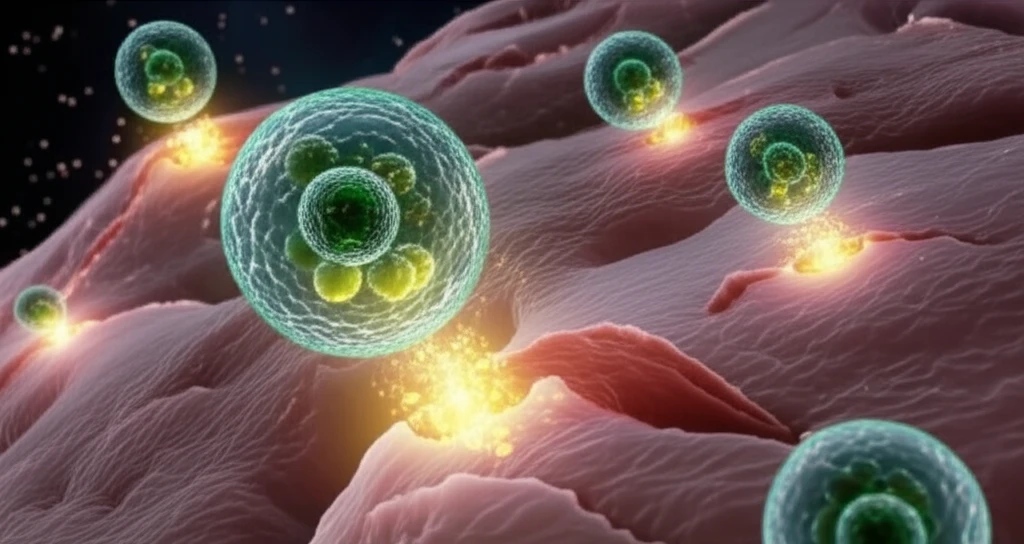
Osteoarthritis Breakthrough: Can Exosomes Offer a New Path to Cartilage Repair?

"New research explores how exosomes loaded with KLF3-AS1 could revolutionize osteoarthritis treatment by promoting cartilage regeneration."
Osteoarthritis (OA), a common age-related degenerative joint disease, affects millions worldwide, causing pain, stiffness, and reduced mobility. Characterized by the progressive breakdown of articular cartilage, OA results from an imbalance between the synthesis and degradation of chondrocytes and the extracellular matrix (ECM). While current treatments focus on managing symptoms, the need for effective cartilage repair strategies is paramount.
In recent years, cell-based therapies have emerged as promising avenues for cartilage regeneration. Mesenchymal stem cells (MSCs), known for their self-renewing and multipotent capabilities, can differentiate into various cell types, including chondrocytes. MSCs can be sourced from autologous (patient's own) or allogeneic (donor) tissues, with in vitro proliferation techniques enhancing cell numbers for transplantation. MSC-based therapies aim to restore the structure and function of damaged tissues, and their efficacy in cartilage repair has been demonstrated in both animal studies and human clinical trials.
Researchers are increasingly focused on understanding how MSCs exert their therapeutic effects. It has been suggested that MSCs secrete biologically active factors that mediate the tissue microenvironment, regulating cell migration, proliferation, differentiation, and matrix synthesis. Among these factors, exosomes – nano-sized vesicles released by cells – play a vital role in intercellular communication. These exosomes transport proteins, mRNAs, microRNAs, and long noncoding RNAs (lncRNAs), influencing recipient cells' behavior. Accumulating evidence indicates that MSC-derived exosomes (MSC-exo) promote cartilage repair, making them a focal point for innovative OA therapies.
KLF3-AS1: A Novel Target for Osteoarthritis Treatment?
A groundbreaking study has identified a specific lncRNA, KLF3-AS1, enriched in MSC-derived exosomes, as a potential therapeutic target for OA. This research delves into the role of exosomal KLF3-AS1 in promoting cartilage repair and chondrocyte proliferation, offering new insights into OA treatment.
- Preparation and Identification of MSCs and MSC-exosomes: hMSCs and MSC-derived exosomes (MSC-exo) were prepared and characterized using transmission electron microscopy (TEM) and flow cytometry.
- OA Model Development: IL-1β-induced OA chondrocytes and collagenase-induced rat models of OA were established for experimental studies.
- KLF3-AS1 Silencing: Lentivirus-mediated siRNA targeting KLF3-AS1 was transfected into MSCs to silence KLF3-AS1 expression.
- Gene and Protein Expression Analysis: Real-time quantitative PCR (qRT-PCR) and western blotting were used to examine mRNA and protein levels of key cartilage-related molecules like type II collagen alpha 1 (Col2a1), aggrecan, matrix metalloproteinase 13 (MMP13), and runt-related transcription factor 2 (RUNX2).
- Cellular Function Assays: Cell proliferation, apoptosis, and migration were evaluated using CCK-8 assays, flow cytometry, and transwell assays.
- Histopathological Studies: HE staining and immunohistochemistry were performed for detailed histopathological assessments.
Future Directions and Therapeutic Implications
This research underscores the potential of exosomal lncRNA KLF3-AS1 as a therapeutic target for osteoarthritis. By promoting cartilage repair and chondrocyte proliferation, this innovative approach offers a new direction for OA treatment. Further studies are needed to fully elucidate the mechanisms of action and to translate these findings into clinical applications, ultimately improving the lives of individuals affected by OA.