
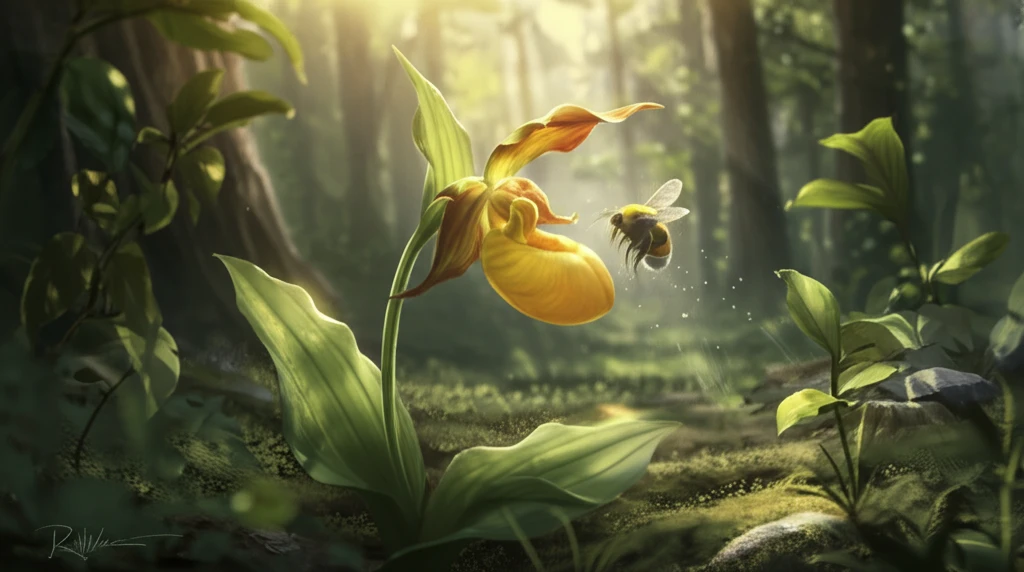
Orchid Size Matters: How Bumblebees Influence Plant Evolution

"Discover the surprising role of bee size in the pollination of Cypripedium orchids and what it means for plant diversity."
In the world of plant evolutionary ecology, it's often assumed that pollination syndromes—specific combinations of flowering periods, floral shapes, colors, scents, and rewards—are highly specialized. These traits are thought to reflect a tight interdependence between plant species and the sensory preferences of their pollinators. However, nature rarely fits neatly into predefined categories. Plant species with wide distributions can exhibit considerable variation, often divided into distinct variants or subspecies. This raises an intriguing question: if floral traits vary significantly within a species, does this indicate differences in pollination syndromes?
Consider Cypripedium parviflorum, a widely distributed orchid in North America, commonly known as the yellow lady's slipper. This species presents an ideal case study for exploring the nuances of pollination ecology. Subdivided into three varieties—makasin, parviflorum, and pubescens—C. parviflorum displays notable differences in floral characteristics. While var. pubescens boasts larger flowers, size variations within these orchid types have been observed to vary due to age, sunlight and soil types. Despite their close proximity in shared habitats, the question lingers: do these varieties remain reproductively isolated, perhaps relying on different insect species for pollination based on their respective flowering seasons and floral dimensions?
A recent study delved into the pollination ecology of two sympatric varieties of Cypripedium parviflorum in Missouri, United States, to unravel the impact of floral dimensions on pollinator diversity. By comparing insect visitors to sympatric populations of C. parviflorum vars. parviflorum and pubescens, the research sought to determine whether floral traits dictate pollinator specialization or if these orchids attract a broader range of pollinators regardless of size. The findings shed light on the intricate relationships between orchids and their pollinators, challenging conventional assumptions about pollination syndromes and offering insights into the factors driving plant evolution.
Orchid Specialization in Numbers
Orchid pollination is marked by extraordinary specialization, with many species evolving flowers so intricate that they are accessible to only a small number of insect types, which in turn are unlikely to pollinate anything but orchids. Large-scale statistical work shows that the frequency distributions for the number of pollinator species per orchid have long tails, meaning most orchids are served by very few pollinator species while a handful attract many. Altitudinal studies of orchid diversity show that the density of species with specific pollination systems shifts predictably with elevation, captured by polynomial regressions. Gaps remain striking: a review of the bog orchid genus Platanthera found a number of species within the group that have no pollinator information at all.
Flower Structure, Hand Pollination, and Conservation Practice
The standard understanding of orchid pollination centers on the family's complex flower structures and the diverse ecological interactions they support with pollinators. In cultivation, hybridizers bypass these natural systems by hand-pollinating parent plants, a technique demonstrated, for example, in attempts to produce winter-blooming orchids from two parent species. For conservation, established methods primarily concern orchid propagation and translocation, though researchers note that conservation actions that do not meet the definition of translocation are also important for maintaining existing rare orchid populations. These practical approaches sit alongside the acknowledged intricacy of natural pollination as described in reference guides to the family.
From Pollinia to Pseudopollen: A Century of Discovery
Since Darwin's era, the defining mechanism of orchid pollination has been understood through pollinia: when a pollinator enters the flower it touches the viscidium, which promptly sticks to its body, generally on the head or abdomen. Early naturalists contrasted these specialists with the more promiscuous flowering plants that rely on enticement and reward to lure whatever insect comes along. Some orchids, such as species of Maxillaria and Polystachya, attract pollinators with pseudopollen, a powdery mass on the labellum sometimes composed of detached outgrowths called papillae. These mechanisms illustrate how the plant evolved flowers so intricate they are only accessible to a couple of insect types, ensuring those insects really only ever pollinate other orchids.
Bee Size and Orchid Pollination: A Delicate Balance
The study meticulously observed and collected insects entering the labella (the pouch-like petal) of Cypripedium parviflorum varieties, comparing insect communities between sympatric and allopatric populations in Missouri. Over four seasons, a total of 235 insects were collected and analyzed, revealing a fascinating pattern: the most effective pollen carriers were small- to medium-sized bees, averaging 6.75 mm in length, 2.28 mm in width, and 1.82 mm in depth. These native bees, particularly polylectic females from the family Halictidae (sweat bees), emerged as the dominant pollen mass carriers for both orchid varieties.
- A diverse range of bees pollinate C. parviflorum, reflecting local distributions and seasonal changes.
- There is overlap in bee species visiting both varieties and in their flowering periods.
- Floral morphometrics suggest limited intergradation between the two sympatric varieties.
- Intraspecific isolation at one site appears influenced by differing phenology, floral presentation, and regional distribution.
Regional Reviews and a Continental Decline
Recent research has expanded orchid pollination study to regions previously neglected, including a review of pollination studies in China that traces the field's relatively late start there and identifies Chen (1988) as the first to review orchid pollination biology and differentiate pollination types. In Guatemala, a literature review synthesizes existing knowledge on pollination of the country's orchids, which play a key role in the ecosystems of this Central American country through their diverse and specialized pollinator interactions. A preliminary Australian study found several orchid species have suffered a 60 percent decline in pollen movement and fertilisation since 1925, with the biggest drop starting in the 1970s and researchers suggesting rising temperatures and land clearing may be contributing factors. Because plant populations may persist for a time after pollination fails, applying this approach across Australia's orchid diversity could allow pollination failure to be detected earlier and more consistently at a continental scale.
When Pollination Fails: The Limits of Reserves
Research on orchid conservation cautions that successful pollination depends on additional factors beyond simple flower-pollinator matching. Conservation literature documents pollen limitation and fruiting failure, such as in the northern food-deceptive orchid Calypso bulbosa in relation to canopy closure, as well as pollinator shifts driving evolution, for example in spur length in the moth-pollinated orchid Platanthera bifolia. Conservationists considering establishing additional reserves and parks to protect remaining orchid populations must therefore weigh two problems that complicate protection of these species. These documented failures underline that pollination is a real and recurring bottleneck in orchid persistence.
Deception, Traps, and Trade-offs in Pollination Strategy
A basic structural comparison shows orchids are monoecious, or bisexual, bearing both male and female reproductive organs, with the column holding the female parts and the anther the male parts. On the behavioural side, strategies diverge sharply: hammer orchids are pollinated by thynnine wasps, with the labellum of the flower resembling a female wasp and also producing chemicals that lure male wasps. Historically, the debate over these elaborate adaptations has centered on whether co-evolution drives both partners, or whether the alternative 'pollinator shift' model applies, in which long tongues in hawkmoths were present before the long spurs of the orchids and evolved without any reciprocal interactions. These comparisons illustrate the range from a simple bisexual structure to elaborate, deceptive pollination machinery.
Implications for Conservation and Understanding Plant Evolution
This research highlights the importance of considering multiple factors—including flowering time, floral presentation, regional bee distribution, and bee size—when studying plant-pollinator interactions. The subtle interplay of these factors can drive intraspecific isolation and potentially lead to the evolution of new plant species. Further research, including studies on pollinia transport distances and the presence of post-pollination barriers, is needed to fully understand the reproductive dynamics of Cypripedium parviflorum and other orchids. By unraveling the complexities of orchid pollination, scientists can gain valuable insights into plant evolution and develop more effective conservation strategies for these captivating and ecologically significant plants.
From Greenhouse Practice to Continental-Scale Evidence
Practical experts note that hand-pollinating orchids such as Phalaenopsis is the easy part of propagation, since germinating the resulting seed pods requires laboratory conditions. Commentary on the state of orchid pollination points to sobering data: analysis of over 10,000 preserved Australian orchid specimens indicates a greater than 60 percent decline in pollination since the 1970s, with reductions linked to increased land-use intensity and rising temperatures. Together, the practical and scientific perspectives converge on the same message: pollination is the fragile bottleneck in orchid reproduction. The preserved-specimen approach offers a way to track this decline across both time and space.
Narrow Pollinator Dependencies and Elevational Frontiers
Looking ahead, the future of many orchids hinges on extremely narrow pollinator dependencies: many orchid species rely on a single species as their pollinator, or a very narrow group of them, attracted by specific scents, colours and shapes, as with many spider orchids (Caladenia species) that are pollinated only by male thynnine wasps. Spatial analyses show that pollination mechanisms are driving orchid distribution, with the species density of both nectarless and nectariferous orchids following a hump-shaped curve that peaks between 300-900 m in all phytogeographical regions studied. This trend depends strongly on habitat cover and pollinator availability. Protecting both habitat and the pollinator species themselves will therefore be central to future orchid conservation.
The Geography of Knowledge: Bias in Orchid Pollination Research
Global patterns in orchid pollination are constrained by where research actually happens. A review of the field covering the 55 years since the publication of the seminal work notes that most orchid pollination biologists work in regions where orchid epiphytes are either rare or absent. Consequently, geographical biases concerning the number of studies undertaken are prevalent in the data, skewing any global picture. Any broad understanding of orchid pollination must therefore be read with these regional gaps in mind.
Humans, Honeybees, and Shifting Seasons
Human activity is reshaping orchid pollination in ways that are only beginning to be documented. Introduced honeybees (Apis mellifera) are likely impacting orchid pollination globally, though their role as legitimate pollinators remains unresolved, since most studies of interactions between introduced and native bees have focused on other plant families. Evaluations of introduced Apis mellifera as potential pollen wasters are very scarce, an important gap given that orchids can attract pollinators with nonrewarding flowers via various modes of deception. Climate change adds a further layer: a case study from central Europe found that pollination mode predicts the phenological response to climate change in terrestrial orchids, based on inter-annual variability in flowering of orchids in a French Mediterranean region.