
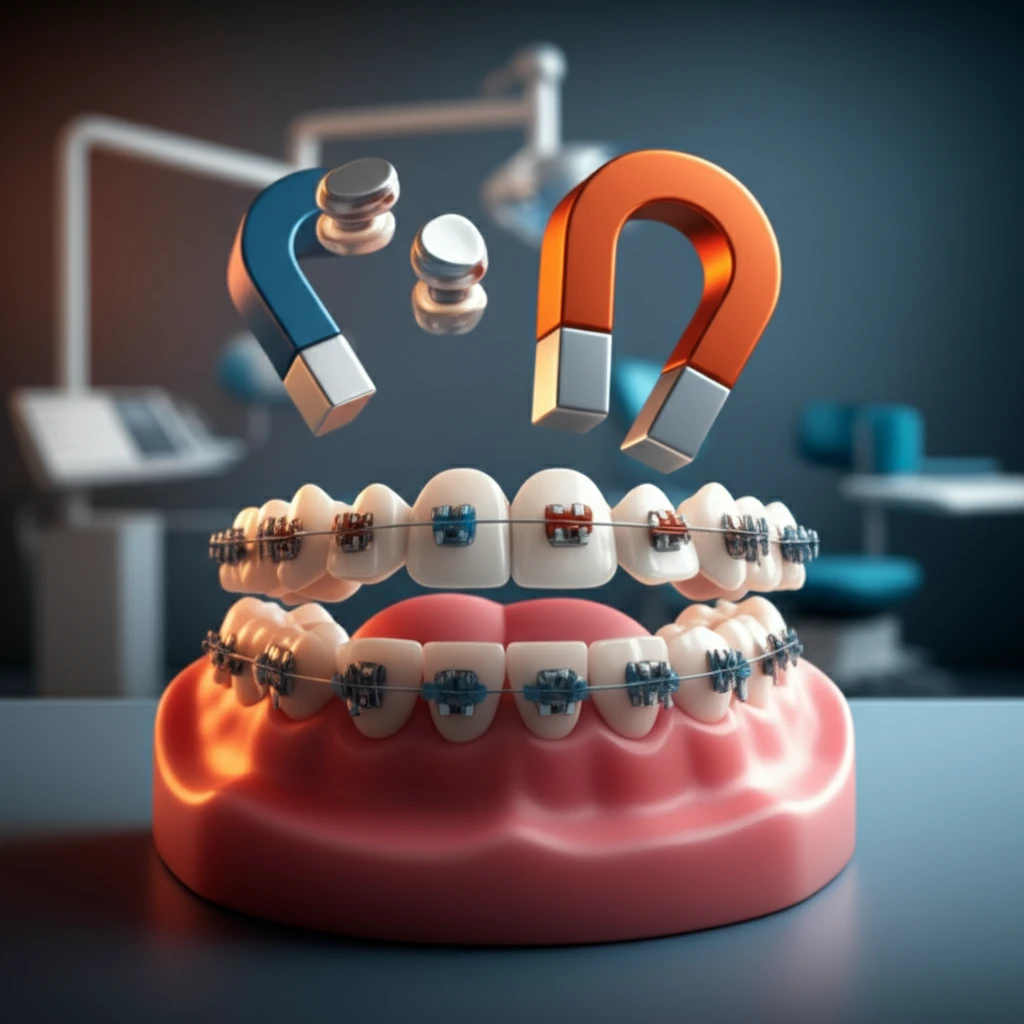
Comparison of magnetic bite-blocks and traditional orthodontic braces for open bite treatment.

Open Bite Breakthrough: Comparing Magnetic and Traditional Treatments

"Discover which orthodontic approach – magnetic bite-blocks or rapid molar intruders – offers superior results for correcting anterior open bite in growing patients."


Correcting skeletal open bite presents a unique challenge in orthodontics, requiring not only the effective closure of the open bite but also significant improvements in facial balance. A commonly accepted strategy involves managing or reducing posterior dimensions by carefully intruding the posterior teeth. Early intervention is often favored, providing opportunities to guide growth and potentially prevent the need for more invasive treatments later in life.

Early treatment also offers psychological benefits, boosting a child's confidence by enhancing their appearance during formative years. However, treatment during growth spurts can be particularly complex, especially regarding patient compliance. Posterior bite-blocks have demonstrated effectiveness in controlling posterior dentoalveolar height in the maxilla by either intruding molars or halting their eruption.

Traditional posterior bite-blocks serve as passive appliances, relying solely on the patient's biting force. To enhance their effectiveness, modifications such as adding springs or magnets have been explored to apply additional force to the posterior teeth. This article explores two specific methods: magnetic bite-blocks (MBBs) and rapid molar intruders (RMIs), comparing their impacts on growing patients with anterior open bite.

Magnetic Bite-Blocks (MBBs) vs. Rapid Molar Intruders (RMIs): Which Method Delivers Better Results?

Comparison of magnetic bite-blocks and traditional orthodontic braces for open bite treatment.

A recent clinical study aimed to evaluate and compare the effectiveness of two distinct treatment approaches for anterior open bite in growing patients: magnetic bite-blocks (MBBs) and rapid molar intruders (RMIs) combined with posterior bite-blocks. The study focused on identifying the differences in vertical and horizontal morphological changes induced by each method.

The study involved thirty participants, divided into two groups. The first group, consisting of fifteen patients (six boys and nine girls) with a mean age of 11.2 years, were treated using MBBs. The second group, also comprising fifteen patients (four boys and eleven girls) with a mean age of 10.9 years, received RMIs attached to posterior bite-blocks. Cephalometric radiographs were taken before and immediately after the appliance removal to measure the morphological changes. The treatment period for both groups lasted approximately four months.

  • MBBs: These use magnets to apply continuous force to intrude posterior teeth. They aim to control vertical growth, encourage mandible rotation, and improve facial balance.
  • RMIs: These devices consist of elastic modules with coil springs, applying force to the molars via bands or tubes. They correct open bites, improve appearance through mandible rotation, and advance the chin.
  • Measurements: Researchers measured various parameters on cephalometric radiographs to assess skeletal and dental changes. These included SNA, SNB, ANB angles, incisor inclinations, and overbite/overjet. Statistical analyses were performed to compare the outcomes between the two groups.
The results indicated that the MBB group showed significantly greater decreases in the SNA angle, ANB angle, overjet, and maxillary incisor angle (p < 0.05). This suggests that MBBs had a more pronounced effect on the maxilla and maxillary dentition, effectively restraining maxillary forward growth and retracting the maxillary incisors compared to RMIs. As a result, changes in intermaxillary relationships and overjet were more distinct in the MBB group. The occlusal plane angle decreased more significantly in the RMI group.

Choosing the Right Approach for Open Bite Correction

The study highlights that while both MBBs and RMIs are effective in treating anterior open bite, the anteroposterior differences between the appliances suggest that MBBs may be more suitable for patients with Class II open bites and maxillary incisor protrusions. Ultimately, the choice of treatment should be based on a comprehensive evaluation of the patient's specific needs and skeletal and dental characteristics. Further research and clinical experience will continue to refine these approaches, optimizing outcomes for patients seeking effective open bite correction.

About this Article -

This article was crafted using a human-AI hybrid and collaborative approach. AI assisted our team with initial drafting, research insights, identifying key questions, and image generation. Our human editors guided topic selection, defined the angle, structured the content, ensured factual accuracy and relevance, refined the tone, and conducted thorough editing to deliver helpful, high-quality information.See our About page for more information.

This article is based on research published under:

DOI-LINK: 10.4041/kjod.2015.45.1.38, Alternate LINK

Title: Early Treatment Of Anterior Open Bite: Comparison Of The Vertical And Horizontal Morphological Changes Induced By Magnetic Bite-Blocks And Adjusted Rapid Molar Intruders

Subject: Orthodontics

Journal: The Korean Journal of Orthodontics

Publisher: Korean Association of Orthodontists

Authors: Mhd Hassan Albogha, Ichiro Takahashi, Mhd Naser Sawan

Published: 2015-01-01

Everything You Need To Know

1

What is an anterior open bite, and why is it important to correct?

Anterior open bite is when the front teeth don't meet when biting down. Correcting this often involves intruding, or moving up, the posterior teeth to allow the front teeth to come together. This is important not only for improving the bite, but also for enhancing facial balance and a person's appearance. Early intervention is preferred to guide growth and avoid more complex treatments later.

2

What are magnetic bite-blocks (MBBs) and rapid molar intruders (RMIs), and how do they work to correct an open bite?

Magnetic bite-blocks (MBBs) use magnets to apply continuous force to the molars, encouraging them to intrude. This helps control vertical growth of the maxilla, allows the mandible to rotate, and improves facial balance. Rapid molar intruders (RMIs) use elastic modules with coil springs to apply force to the molars. Like MBBs, they aim to correct open bites, enhance appearance by rotating the mandible, and in some cases, advance the chin.

3

How do researchers measure the effectiveness of different open bite treatments?

Researchers take cephalometric radiographs before and after treatment to measure changes in skeletal and dental structures. Key measurements include angles like SNA, SNB, and ANB, which indicate the relationship between the maxilla and mandible. They also assess incisor inclinations and overbite/overjet to evaluate how the teeth have moved. Statistical analyses are then used to compare the outcomes between different treatment methods.

4

What were the key differences observed between magnetic bite-blocks (MBBs) and rapid molar intruders (RMIs) in the study?

The study found that magnetic bite-blocks (MBBs) had a greater impact on the maxilla and maxillary dentition. Specifically, MBBs were more effective at restraining maxillary forward growth and retracting the maxillary incisors compared to rapid molar intruders (RMIs). RMIs, on the other hand, had a more significant effect on decreasing the occlusal plane angle.

5

How do you decide which treatment, magnetic bite-blocks (MBBs) or rapid molar intruders (RMIs), is the right choice for correcting an open bite?

The choice between magnetic bite-blocks (MBBs) and rapid molar intruders (RMIs) depends on the individual's specific needs. MBBs may be more suitable for those with Class II open bites and protruding maxillary incisors, as they have a greater effect on the maxilla. A comprehensive evaluation of the patient's skeletal and dental characteristics is crucial in determining the most appropriate treatment approach. Further clinical experience will help refine these approaches to improve patient outcomes.

Newsletter Subscribe

Subscribe to get the latest articles and insights directly in your inbox.