
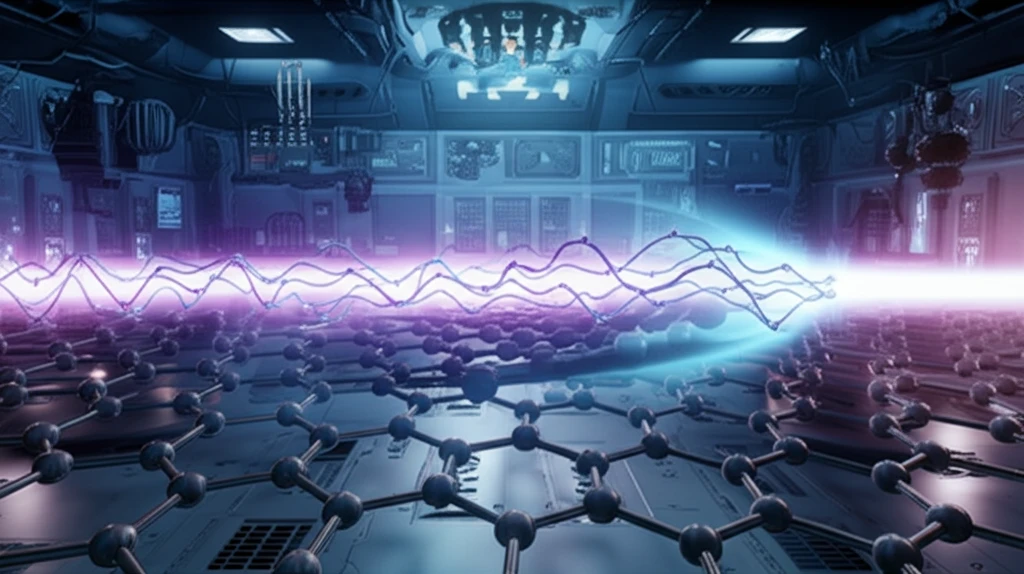
One-Way Street for Light: Graphene's Revolutionary Trick to Bend Light

"Scientists discover how drift-induced graphene plasmons can revolutionize optical devices, creating 'one-way' light flow without magnets."
For years, scientists have dreamed of creating optical systems where light flows in only one direction. In conventional photonics, light travels both ways, constrained by a fundamental principle called Lorentz reciprocity. This principle, related to the time-reversal symmetry of Maxwell's equations, makes it challenging to build devices like optical isolators and circulators that dictate the direction of light.
The increasing demand for highly integrated all-photonic systems has spurred a search for ways to break this reciprocity. Traditional methods involve using static magnetic fields to create a gyrotropic response, but this approach is bulky and hard to integrate into nanoscale devices. Other methods, such as using nonlinear effects or opto-mechanical interactions, have limitations like high power requirements or weak responses.
Now, a team of researchers is exploring a novel solution: using a graphene sheet biased with a drift electric current. Their theoretical model shows that this method creates a strong nonreciprocal response, allowing for 'one-way' propagation of surface plasmon polaritons. This approach not only enables unidirectional light flow but also significantly enhances the propagation length of graphene plasmons, opening new doors for optical technology.
Graphene's 'One-Way' Light Trick
The key to this breakthrough lies in graphene's unique properties. Graphene, a single layer of carbon atoms, boasts ultrahigh electron mobility, allowing electrons to drift at significant velocities when an electric current is applied. This drift current interacts with light in a way that breaks the symmetry of light propagation, enabling light to travel in one direction while being blocked or attenuated in the opposite direction.
- Subwavelength Control: Enables light manipulation at scales smaller than the wavelength of light.
- Magnetic-Free: Eliminates the need for bulky magnets, simplifying device integration.
- Enhanced Propagation: Boosts the distance light can travel through graphene.
- Tunable Response: The 'one-way' effect can be adjusted by changing the drift velocity or the chemical potential of the graphene.
A New Dawn for Optical Circuits
This breakthrough offers a promising route toward building advanced optical circuits, such as optical isolators and circulators, which are essential components in modern communication systems. By harnessing the unique properties of graphene and electric currents, scientists can create compact, efficient, and tunable devices that control light at the nanoscale. This research opens new avenues for innovation in nanophotonics, paving the way for faster, more efficient, and more integrated optical technologies.