
Ocean Acidification: How It's Affecting Fish and What It Means for Us

"New research reveals the surprising ways ocean acidification impacts fish, challenging previous assumptions and raising concerns about marine ecosystems."
Our oceans are facing a silent but potent threat: ocean acidification. As we pump more and more carbon dioxide into the atmosphere, a significant portion is absorbed by the seas, leading to a decrease in pH levels. This change in ocean chemistry has far-reaching implications for marine life, especially for creatures living in already challenging environments.
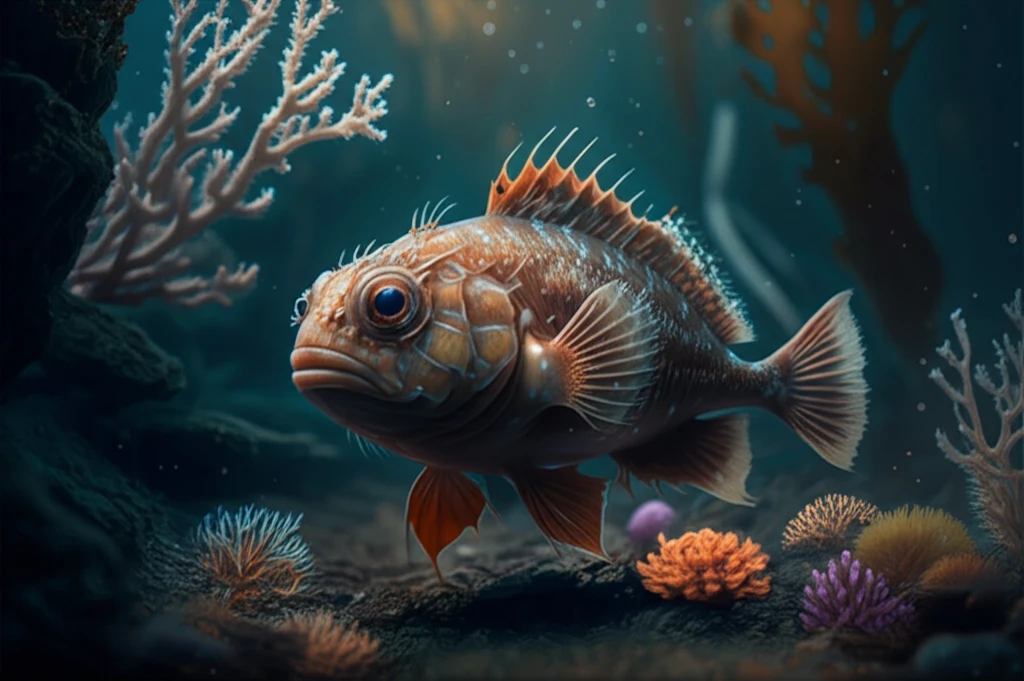
For years, scientists believed that teleost fish, a group that includes most of the fish we eat, were relatively resilient to these changes due to their well-developed acid-base regulatory systems. However, emerging research is painting a more complex and concerning picture. A recent study published in Conservation Physiology sheds light on how ocean acidification is affecting the woolly sculpin (Clinocottus analis), a small fish inhabiting the rocky intertidal zones of the California coast.
The study reveals that ocean acidification isn't just a looming threat, but an active stressor reshaping the physiological capabilities of marine life, with consequences that ripple through the food web and potentially impact us all.
A Global Chemical Shift
Ocean acidification is the ongoing lowering of seawater pH driven by the ocean's absorption of atmospheric carbon dioxide. Because monitoring coverage and measurement methods vary by region, precise global figures remain an area of active research rather than settled statistics. The process is widely understood to be most pronounced where cold, CO2-rich waters rise to the surface, making some coastal and high-latitude regions especially vulnerable. Experts generally regard acidification as a slow but persistent chemical shift that can alter marine habitats and the livelihoods of communities that depend on the sea.
Defining Ocean Acidification and Its Reach
Ocean acidification is defined as the ongoing decrease in the pH of the Earth's oceans, meaning that average seawater pH is dropping over time. The process affects the entire world's oceans, including coastal estuaries and waterways, not just the open sea. Because many economies depend on fish and shellfish, and people worldwide rely on ocean food as a primary source of protein, this chemical shift carries real economic and nutritional consequences. Excess carbon dioxide is also having profound effects in the water, putting shelled animals at risk as they struggle to build their protective structures.
From Carbonic Acid to Calcium Carbonate
The foundational understanding of ocean acidification begins with the observation that CO2 from anthropogenic sources is emitted into the atmosphere before dissolving into the ocean to form carbonic acid, and that this increase in ocean acidity is what researchers now call ocean acidification. An early and lasting milestone was recognizing that rising atmospheric CO2 is not only a driver of global warming but also a direct driver of this separate chemical process. Researchers also established how the increased acidity of ocean and coastal waters reduces the saturation or availability of calcium carbonate minerals, which are the building blocks for the skeletons and shells of many marine organisms. These findings point to cascading effects on people who depend on seafood, on the commercial fishing industry including aquaculture, and on seabirds and mammals that rely on these ecosystems for food.
The Hidden Costs of Acidity: What the Woolly Sculpin Reveals
The woolly sculpin, like many intertidal organisms, is accustomed to harsh conditions: fluctuating temperatures, salinity, and oxygen levels. Researchers Joshua R. Hancock and Sean P. Place from Sonoma State University sought to understand how ocean acidification might compound these existing stresses, particularly in relation to hypoxia, or low oxygen conditions. They exposed sculpins to both current and projected future ocean pH levels and meticulously examined their metabolic rates, hypoxia tolerance, and acid-base regulatory capacity.
- Increased Metabolic Rate: Sculpins in acidified water worked harder to maintain internal balance.
- Decreased Hypoxia Tolerance: The increased energy demand reduced their ability to cope with low oxygen conditions.
- Acid-Base Regulation: Their bodies ramped up acid-base regulatory capacity (Na+,K+-ATPase activity) to maintain cellular function
A Fast-Moving Research Field
Ocean acidification is a highly active research area, with outlets like Phys.org regularly reporting new advancements and breakthroughs and databases such as ScienceGate tracking the latest published papers, hot topics, and the most-cited documents in the field. Recent peer-reviewed work published in journals such as Marine Biology Research continues to expand the evidence base on how acidification affects marine systems. One notable modeling study highlighted by Nature examines how ocean acidification will persist across global ocean regions, identifying the Arctic as the area that experiences relief from acidification the latest under negative emissions scenarios. The combined picture is a field where findings are evolving quickly and where regional variation, such as the Arctic's slow recovery, is becoming a central concern.
Planetary Boundaries and a Breached Threshold
A 2025 planetary health check reported by Euronews concluded that the oceans have already breached the critical acidification boundary, an intensifying trend that stems primarily from fossil fuel emissions and, together with warming and deoxygenation, affects everything from coastal fisheries to the open ocean. Related analysis describes acidification as set to become the seventh breached planetary boundary, with such breaches disrupting ecosystems, food supplies, and the oceans' ability to absorb CO2. Scientists also note that while ocean life survived the long, gradual changes of the past, the current speed of acidification is very worrisome, and emissions could reduce surface pH by another 0.4 unit in this century alone and by as much as 0.7 unit beyond 2100. Commentators nonetheless stress that failure is not inevitable—it is a choice that must and can be avoided.
Acidification Versus Global Warming
Ocean acidification is the reduction of the average pH of seawater caused by the absorption of a large amount of atmospheric CO2, and it occurs when atmospheric CO2 levels increase substantially. Whereas global warming concerns rising temperatures from greenhouse gases, acidification is a distinct chemistry problem: as oceans absorb more CO2, the water itself becomes more acidic. Broader analyses such as Greenly's outline why acidification is happening, its economic impacts, how the damage so far is being tracked, and what can be done about it. The two phenomena share a root cause in CO2 emissions but operate through different mechanisms and therefore require their own tracking and response strategies.
The Bigger Picture: What This Means for Our Oceans
This research underscores that the impact of ocean acidification on marine ecosystems is more nuanced and potentially more severe than previously thought. Even fish with robust regulatory systems can face significant physiological challenges, leading to trade-offs that affect their survival and behavior. As ocean acidification continues, these subtle shifts in the physiology of key species can have cascading effects throughout the food web, impacting biodiversity, fisheries, and the overall health of our oceans. Understanding these complex interactions is crucial for developing effective conservation strategies and mitigating the impacts of climate change.
Progressive Deterioration and a Living Example
Ocean acidification expert Ken Caldeira describes acidification not as one looming cliff-edge catastrophe but rather as a process of 'progressive deterioration,' a framing that shapes how scientists and policymakers understand the risk. A concrete illustration comes from research on California mussels, where analyses reveal how, over more than 60 years, a critical marine species has responded to acidification by transforming its shell composition. Experts had expected aragonite, the stronger of the two shell minerals, to emerge as the dominant mussel shell mineral because it preferentially forms in warmer waters, yet the observed changes show species responding in less predictable ways. Such findings feed into broader social and economic assessments that weigh the value of ecosystem services, including work that examines the case of cold-water corals.
Modeling the Trajectories Ahead
Computer simulations used for ocean acidification projections simulate ocean-atmosphere interactions, climate, ocean chemistry, and the complex feedbacks among them. These models demonstrate that stronger and more immediate action can reduce the levels of acidification that would occur under a higher-emissions future, meaning the trajectory ahead is not fixed. Updated syntheses of research, such as the CBD Technical Series report on the impacts of ocean acidification on marine biodiversity, continue to consolidate what is known about how species and ecosystems will fare. Together, this work suggests that the next frontiers lie in refining model projections and expanding the evidence base on biodiversity impacts.
Mitigation Policy as a Lever
Ocean acidification and climate change are deeply interlinked, and researchers have examined the synergies and challenges of addressing both under the UNFCCC framework. One line of analysis quantifies the relative impact on future ocean acidification of different aspects of global climate change mitigation policy, such as the year global emissions peak, how fast they decline afterward, and the long-term minimum emissions that prove possible. At the same time, ocean acidification, a decrease in ocean pH due to CO2 uptake from the atmosphere, endangers marine life, especially organisms reliant on calcium carbonate, through altered biological processes and knock-on effects on ecosystems. The systemic challenge is that carbon policy choices made today will determine not just temperature outcomes but also the future acidity of the oceans.
Beyond the Laboratory
Most ocean acidification studies to date have taken place in laboratories, which makes it difficult to assess how whole ecosystems composed of multiple, interacting species would be affected in the real world. The mechanism itself is well understood: acidification results from ocean-atmosphere interactions whereby carbon dioxide from the atmosphere is drawn down into the water and reacts with water molecules to form carbonic acid, which then further breaks down into hydrogen ions and bicarbonate ions. Researchers are therefore turning to natural laboratories, such as coastal sites with naturally elevated CO2, to observe ecosystem-level responses directly. These efforts aim to connect the chemistry of acidification with the human stakes of declining marine ecosystems.