
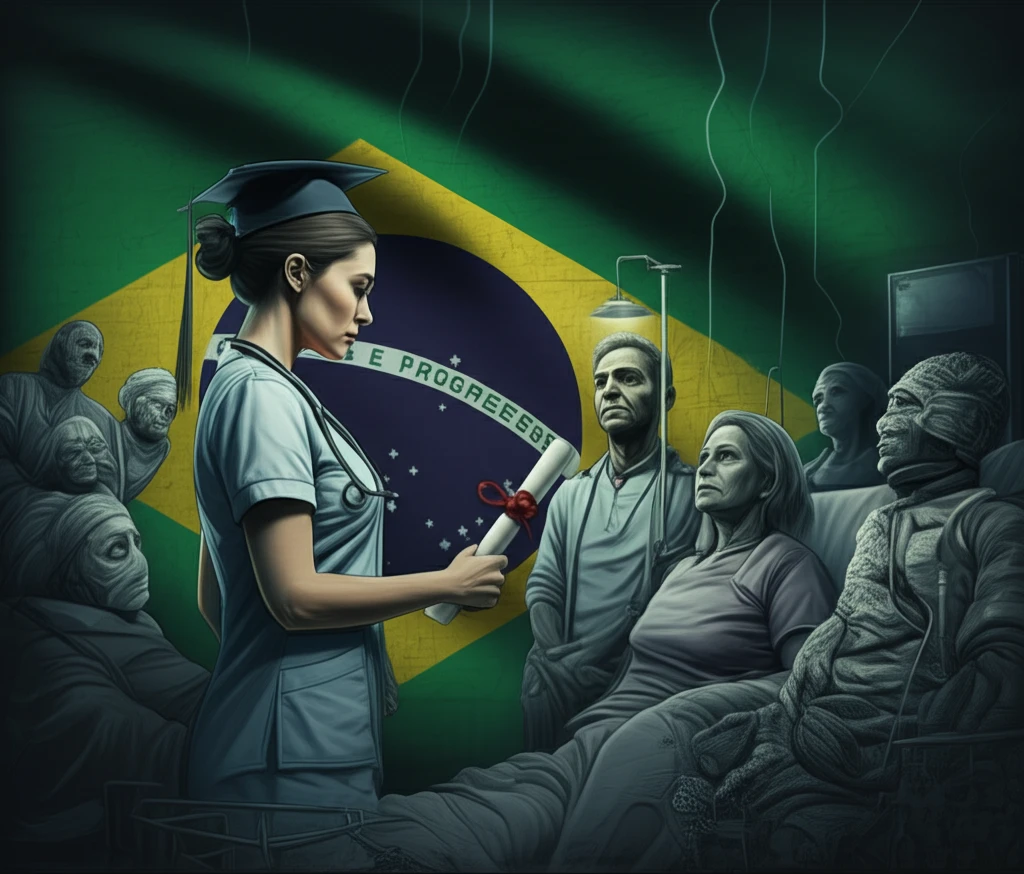
Nursing Education: Bridging the Gap Between Curriculum and Real-World Healthcare

"A deep dive into how nursing education is evolving to meet the demands of a changing healthcare landscape and the pivotal role of the Brazilian Unified Health System (SUS)."
The Brazilian Sanitary Reform, which began in the late 1970s, emerged as a response to widespread dissatisfaction among healthcare professionals, workers, and citizens. It addressed critical issues such as citizen rights, access to healthcare services, and the overall structure of the Brazilian health system. This movement led to significant studies and research highlighting the intricate relationships between health and social structures.
By the early 1980s, Integrated Health Actions (AIS) were developed, marking the first strategic design for co-management, decentralization, and universal healthcare access. The landmark VIII National Health Conference further solidified the fight for health reform, ultimately leading to the creation of the Unified Health System (SUS).
The SUS, born from the Brazilian Sanitary Reform and enshrined in the 1988 Constitution, partially incorporated the movement's proposals. It defined health as a social right guaranteed by the State through public economic and social policies, ensuring access to health services for all Brazilians.
The Numbers Behind a Shifting Profession
Recent nursing statistics document a measurable shift in the profession's educational preparation, including a drop in associate degree attainment from 30.1% in 2015 to 24.3% in 2022. Broader datasets track enrollment trends, degree pathways, workforce demographics, and career growth, alongside applications, admissions, retention, and graduation rates. The National League for Nursing's research provides a comprehensive demographic profile of current nursing students, documenting ethnic-racial identity and other characteristics. Aggregated statistics also capture job satisfaction, average salaries, the nursing shortage, and COVID-19's impact on the profession.
Licensure Pathways and the Gaps in Standard Curricula
The standard pathway into practice typically involves meeting state licensing requirements, as New York's nursing license requirements illustrate. Yet accepted curricula leave notable gaps: one study reports that nurses received no evidence-based training during their university studies or in the workplace, forcing them to rely on self-learning through internet sources that were often incomplete or inconsistent. Similarly, education about nursing care for patients with intellectual and developmental disabilities remains limited in basic nursing education programs and among practicing nurses. Research in this area also emphasizes standardized data-collection procedures, with nursing education managers assisting in questionnaire distribution to ensure consistency across sites.
From Industrial Mass Schooling to Nursing Milestones
Modern education has its origins in the Industrial Revolution, when societies shifted toward mass schooling to meet the demands of a rapidly changing world, marking the beginning of formalized education systems. The term 'milestone' traces back to markers of distance along roads, and in education and nursing it has come to denote key developmental or curricular benchmarks. In nursing curricula, developmental milestones are a core topic, with pediatric milestones routinely drilled for NCLEX success using memory tricks and study aids. These origins and usages help explain how nursing education's formal milestones evolved out of broader educational history.
The Evolution of Nursing Education in Brazil
A bibliometric study was conducted to identify trends and gaps in nursing education research. This study analyzed theses and dissertations cataloged in the Center for Studies and Research in Nursing (CEPEN) from 2003 to 2007, focusing on how nursing education addresses the National Curricular Guidelines (DCN) within the context of the SUS. The research aimed to understand how educational programs are adapting to meet the demands of the Brazilian public health system.
- A majority of the studies (89%) employed qualitative research methods.
- Most data collection involved interviews (open or semi-structured), followed by documentary analysis, participant observation, and focus groups.
- The dominant theoretical frameworks included hermeneutics, dialectics, and the analysis of content from Bardin, as well as the theoretical analysis of speech from Fiorin.
- Six studies specifically investigated competencies and skills, addressing general competencies, healthcare attention, administration, management, and interdisciplinarity.
New Evidence on Mental Health, Rural Training, and Curricular Gaps
A recent narrative review of the nursing education literature examined methods, content, outcomes, and gaps in curricula addressing vulnerable populations' mental health needs. An umbrella review on rural healthcare investigated how decentralised nursing education can contribute to social responsibility by educating nurses rurally, drawing on documentation from 15 decentralised classes. That review involved nursing students, newly graduated nurses, and clinical supervisors as participants, using a systematic literature search as its data source. Journals such as Nurse Education Today regularly publish this evolving body of nursing education research.
The Critical Thinking Critique
A recurring criticism of nursing education is that it does not sufficiently develop critical thinking for clinical decision-making, a focus of research among nursing students in Uganda. Uganda's healthcare system, like many others globally, demands nurses who can swiftly analyze complex situations in practice. Where curricula fail to build these skills, graduates may be unprepared for the judgment calls that clinical settings require. Such critiques suggest that technical knowledge alone is insufficient without deliberate instruction in clinical reasoning.
Comparing Pathways and Countries
Nursing education is frequently compared across degree pathways and across countries. Within the United States, the Associate Degree in Nursing (ADN) and Bachelor of Science in Nursing (BSN) are two dominant entry routes, and comparisons weigh factors such as online delivery, career advantages, and future career options. Internationally, analyses contrast how government and nursing organizations shape education in different systems, as in a comparison of Nigeria and Poland that highlights Nigeria's rich educational heritage. Such side-by-side comparisons help prospective students and policymakers weigh the trade-offs inherent in different educational models.
Conclusion: Charting the Future of Nursing Education
This bibliometric study serves as a valuable resource for researchers and academics, fostering reflection on nursing education and highlighting the urgent need for expanded research in this field. These findings underscore the importance of aligning nursing education with the principles of the SUS to ensure that nursing professionals are well-prepared to meet the healthcare needs of the Brazilian population. Further studies are needed to evaluate the outcomes of nursing education programs and their impact on the quality of healthcare delivery.
What Experts Say the Field Needs
Expert commentary in the field emphasizes the need for education that keeps pace with today's rapidly changing healthcare environment, which is why integrated digital education solutions and up-to-date content are increasingly central to nursing faculty practice. In Brazil, a stakeholder-consensus approach produced an Education Quality Improvement Toolkit designed to systematically improve student, faculty, and program areas tied to universal health coverage and access. The toolkit is considered potentially culturally adaptable across settings. Practicing experts also debate advanced credentials, with doctoral pathways such as the PhD and DNP presented as ways to deepen educational and research impact, and commentary is widely aggregated through dedicated nursing education blogs.
Accreditation, Access, and Who Steers the Future
Accreditation is widely described as paramount to the future of nursing education, since it determines eligibility for licensure, employment, and further education. Expanding access is another frontier: sponsored nursing courses, funded by organizations that support nursing education, are emerging as a pathway to more accessible training. Looking ahead, scholars have long asked where the 'locus of control' for nursing education lies and what direction the field should take. These developments point toward a future shaped by accreditation standards, funding models, and ongoing questions about who steers the profession's preparation.
Systemic Pressures Beyond the Classroom
Students pursuing nursing education face systemic challenges that extend beyond the classroom, shaped in part by how institutions structure their programs—for example, requiring an 'initial foundations program' before entry into the nursing program. Rural nurses, meanwhile, contend with burnout driven by the very systemic conditions that schools teach only as abstract theory, such as social determinants of health described as a faraway concept. At the national level, systemic pressures on nurses and healthcare workers have fueled calls for change, including criticism of policies like Return Service Agreements that are seen as repressive and anti-student. Together, these accounts show that the gap between curriculum and practice is as much a systems problem as an instructional one.
The People Behind the Profession
The human dimension of nursing education is rooted in the legacy of Florence Nightingale, who developed modern nursing out of her own life experiences and beliefs. Students face the real challenges of nursing school and the dedication that clinical work demands, as nursing schools and their graduates demonstrate. Research also highlights real-world impact at scale, such as scoping studies of clinical nursing and midwifery research across African countries. Meanwhile, educators are testing how to deliver hands-on realism, with 2026 comparisons of virtual reality versus mannequins suggesting there is no clear winner—only smarter integration through a hybrid model.