
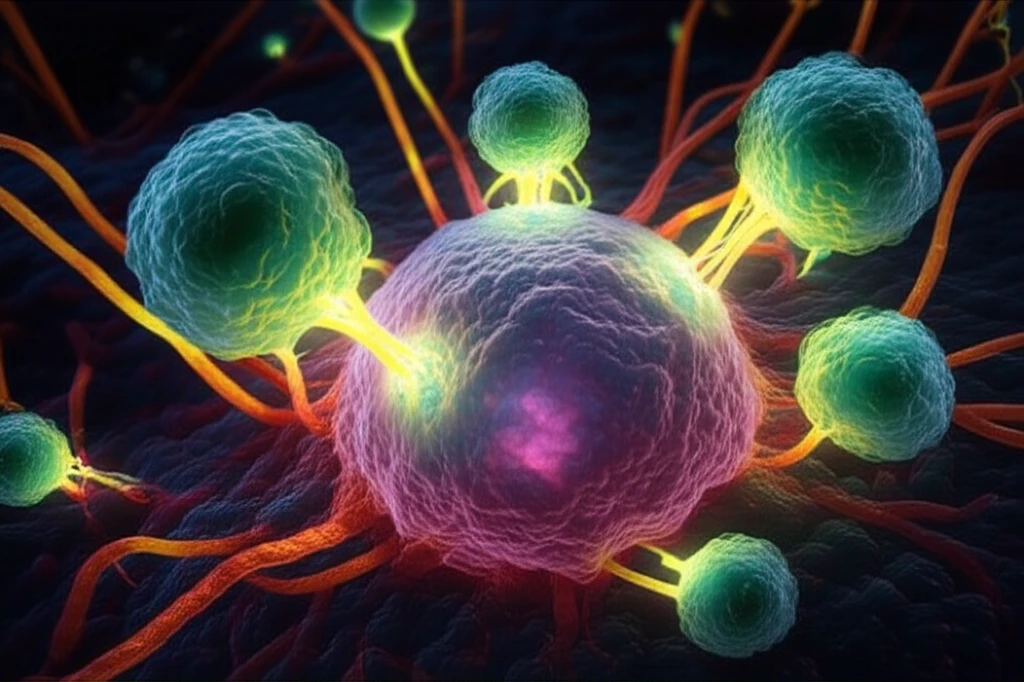
Natural Killer (NK) cells attacking a tumor cell.

NK Cells: Your Body's Natural Born Killers (and How They Keep You Healthy)

"Unlocking the Secrets of Natural Killer Cells for Enhanced Immunity"


Natural Killer (NK) cells are essential components of your immune system, acting as a first line of defense against various threats. These specialized lymphocytes, comprising 10-15% of all lymphocytes in your blood, are always on patrol, ready to eliminate infected or cancerous cells.

Originally identified for their ability to spontaneously kill tumor cells, NK cells are now recognized as key players in both innate and adaptive immunity. Unlike T cells, they don't require prior sensitization to recognize and destroy abnormal cells, making them rapid responders to emerging dangers.

This article explores the fascinating world of NK cells, delving into their unique characteristics, diverse roles in health and disease, and how they contribute to overall well-being. From fighting infections to preventing cancer and even supporting pregnancy, we'll uncover the crucial functions of these natural born killers.

What Makes NK Cells Special?

Natural Killer (NK) cells attacking a tumor cell.

NK cells possess a unique set of features that distinguish them from other immune cells:

Cytotoxicity: NK cells can directly kill target cells, such as virus-infected cells or tumor cells, by releasing cytotoxic granules containing perforin and granzymes. Perforin creates pores in the target cell membrane, allowing granzymes to enter and trigger apoptosis (programmed cell death).

  • Cytokine Production: Beyond direct killing, NK cells secrete a variety of cytokines, including interferon-gamma (IFN-γ) and tumor necrosis factor-alpha (TNF-α). These cytokines activate other immune cells, enhance the inflammatory response, and contribute to viral and tumor control.
  • Receptors: NK cells express a diverse array of activating and inhibitory receptors. These receptors enable NK cells to distinguish between healthy cells and abnormal cells. Activating receptors trigger NK cell activity when they bind to ligands on target cells, while inhibitory receptors prevent NK cell activation when they bind to MHC class I molecules on healthy cells.
  • Chemokine Production: NK cells also produce chemokines, signaling molecules that attract other immune cells to the site of infection or inflammation. This helps to coordinate a broader immune response.
Subsets of NK Cells: NK cells aren't a homogenous group. There are different subsets with specialized functions. These subsets are classified based on the expression of surface markers like CD56 and CD16, and include CD56dimCD16+, CD56brightCD16–, CD56+/NKp46+, and specialized types like uterine NK cells (uNK) which support pregnancy.

The Future of NK Cell Research

NK cells are essential for maintaining health, fighting infections, preventing cancer, and even supporting pregnancy, and are now recognized as vital components of both the innate and adaptive immune responses.

Ongoing research continues to uncover new insights into NK cell biology and their potential for therapeutic applications. Understanding how to harness the power of NK cells could lead to novel strategies for treating cancer, viral infections, and autoimmune diseases.

From understanding their diverse receptor repertoire to manipulating their activity in targeted therapies, NK cells hold immense promise for improving human health. Monitoring and supporting NK cell function could be a key component of a proactive approach to wellness.

About this Article -

This article was crafted using a human-AI hybrid and collaborative approach. AI assisted our team with initial drafting, research insights, identifying key questions, and image generation. Our human editors guided topic selection, defined the angle, structured the content, ensured factual accuracy and relevance, refined the tone, and conducted thorough editing to deliver helpful, high-quality information.See our About page for more information.

This article is based on research published under:

DOI-LINK: 10.5114/ceji.2012.32732, Alternate LINK

Title: Biology And Role Of Nk Cells – Selected Data

Subject: Immunology

Journal: Central European Journal of Immunology

Publisher: Termedia Sp. z.o.o.

Authors: Paulina Niedźwiedzka-Rystwej, Małgorzata Herberg, Wiesław Deptuła

Published: 2012-01-01

Everything You Need To Know

1

What exactly are Natural Killer cells, and what is their primary function in the body?

Natural Killer cells, or NK cells, are a type of lymphocyte that makes up about 10-15% of the lymphocytes in your blood. They are part of your immune system and are always circulating, looking for cells that are infected or cancerous. They were originally identified by their ability to kill tumor cells, and don't require prior sensitization to recognize and destroy abnormal cells.

2

How do Natural Killer cells differentiate between healthy cells and cells that need to be eliminated?

NK cells distinguish between healthy and unhealthy cells through a complex system of activating and inhibitory receptors. Activating receptors trigger the NK cell to kill a target cell when they bind to specific ligands on the target cell's surface. Inhibitory receptors, on the other hand, prevent the NK cell from activating if they bind to MHC class I molecules, which are present on healthy cells. This balance ensures that NK cells primarily target abnormal cells while sparing healthy ones.

3

What mechanisms do Natural Killer cells employ to eliminate infected or cancerous cells?

NK cells use several methods to eliminate infected or cancerous cells. One primary mechanism is cytotoxicity, where NK cells release cytotoxic granules containing perforin and granzymes. Perforin creates pores in the target cell membrane, allowing granzymes to enter and trigger apoptosis, or programmed cell death. Additionally, NK cells secrete cytokines like interferon-gamma (IFN-γ) and tumor necrosis factor-alpha (TNF-α), which activate other immune cells and enhance the overall immune response.

4

Are all Natural Killer cells the same, or are there different types with specialized roles?

Yes, there are different subsets of NK cells, each with specialized functions. These subsets are classified based on the expression of surface markers like CD56 and CD16. For example, you have CD56dimCD16+ and CD56brightCD16– subsets. Uterine NK cells (uNK) are a specialized type which plays a crucial role in supporting pregnancy. These different subsets allow the immune system to fine-tune its response to various threats.

5

What are some of the current areas of Natural Killer cell research, and what potential implications could this research have for treating diseases?

Research indicates that NK cells are essential for maintaining health, fighting infections, preventing cancer, and even supporting pregnancy. The ongoing research focuses on how to harness and enhance the natural ability of NK cells to target and eliminate diseased cells. This includes exploring ways to boost NK cell activity in cancer immunotherapy, develop NK cell-based therapies for viral infections, and understand the role of NK cells in autoimmune diseases. Understanding these functions could also lead to innovative approaches to manage and treat various health conditions.

Newsletter Subscribe

Subscribe to get the latest articles and insights directly in your inbox.