
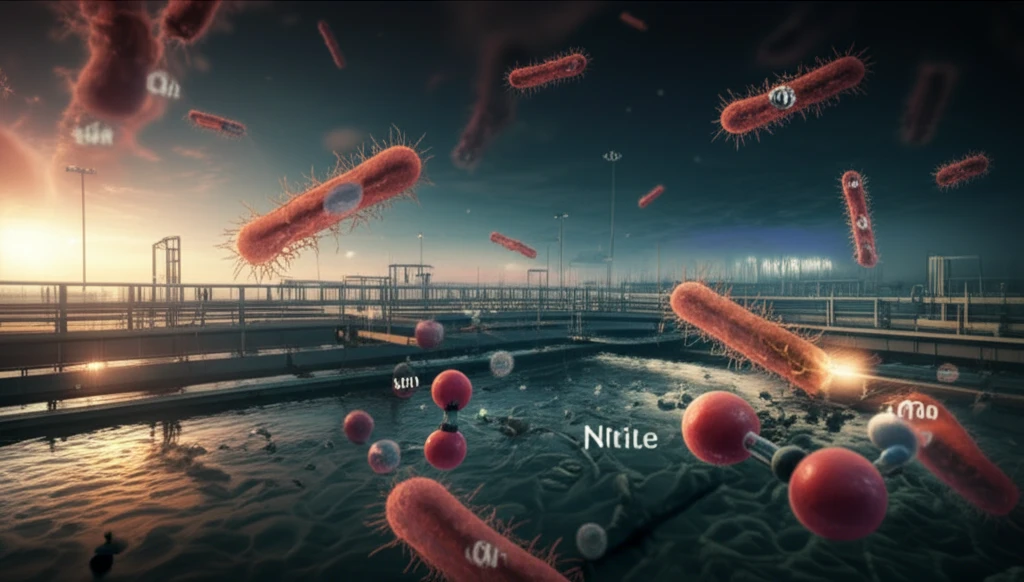
Surreal illustration of wastewater treatment with DAMO bacteria and nitrite.

Nitrite's Double-Edged Sword: How it Impacts Methane Oxidation in Wastewater Treatment

"Uncover the delicate balance between nitrite and methane oxidation in wastewater treatment, exploring both short-term shocks and long-term effects."


Methane, a potent greenhouse gas, poses a significant threat to our atmosphere, trapping heat 25 times more effectively than carbon dioxide. A considerable amount originates from natural sources like wetlands and rice paddies. Fortunately, microorganisms often consume a large portion of methane before it escapes into the atmosphere. This consumption process can be enhanced through anaerobic oxidation of methane (AOM), a process that can be coupled to denitrification, creating a sustainable treatment method.

Denitrifying anaerobic methane oxidation (DAMO) offers an environmentally friendly and cost-effective alternative to traditional wastewater treatment methods. Traditional nitrogen removal relies on adding a carbon source to facilitate denitrification, a step that isn't always efficient in wastewater with low carbon-to-nitrogen ratios. DAMO, however, utilizes methane already present in anaerobic sewage treatment as the carbon source. This is particularly useful as large amounts of methane are generated from anaerobic sewerage treatment.

However, DAMO processes are sensitive to environmental factors, and nitrite, while essential, can become inhibitory at certain concentrations. While there have been studies on the effects of various factors on DAMO, the specific impact of nitrite requires further exploration. This article will explore the dual role of nitrite in DAMO systems, examining its short-term and long-term effects on microbial communities, offering valuable insights for optimizing wastewater treatment processes.

The Good, the Bad, and the Nitrite: Understanding Its Impact on DAMO

Surreal illustration of wastewater treatment with DAMO bacteria and nitrite.

Researchers investigated the influence of nitrite on two distinct DAMO microbial systems: one dominated by DAMO bacteria alone (System 1), and another featuring a co-existence of DAMO bacteria and archaea (System 2). The study examined nitrite's effects from a macro perspective (nitrogen removal rates) down to the micro level (microbial community structure), observing both immediate (short-term) and prolonged (long-term) impacts.

The team ran batch experiments, exposing both systems to a range of nitrite concentrations. In the short term, concentrations below 100 mg N/L didn't significantly inhibit either system. However, as concentrations increased, the inhibitory effects became more pronounced. In acidic conditions, free nitrous acid (FNA) was determined to be the real inhibitor, while in alkaline conditions, it was the ionized form of nitrite. High-throughput sequencing revealed that long-term nitrite exposure reduced the abundance and diversity of microbial species within both systems.

  • Short-Term Effects: Up to 100 mg N/L nitrite had minimal impact.
  • High Concentrations: Above 950 mg N/L completely stopped nitrogen removal in short-term experiments. A level of 650 mg N/L inhibited the process in the long term.
  • Microbial Diversity: High nitrite levels correlated with decreased microbial diversity in both systems.
  • System 1: A significant drop in Methylomonas bacteria may be the reason for the reduced nitrogen removal rate.
  • System 2: Reduction of Nitrospirae may be the internal reason for the decline of the denitrification rate.
These findings highlight the delicate balance required for effective DAMO processes. Nitrite is essential for DAMO, but excessive concentrations can disrupt the microbial community and inhibit nitrogen removal. Further research is needed to understand the specific mechanisms of nitrite inhibition and identify strategies to mitigate its negative effects.

Optimizing DAMO: Future Directions for Wastewater Treatment

This research provides valuable insights into the complex relationship between nitrite and DAMO organisms. Understanding the short-term and long-term effects of nitrite is crucial for optimizing wastewater treatment processes and ensuring efficient methane and nitrogen removal.

Further research should focus on identifying specific strategies to mitigate the negative impacts of high nitrite concentrations. This may involve optimizing reactor conditions, developing more tolerant microbial communities, or implementing control measures to prevent nitrite accumulation.

By carefully managing nitrite levels and fostering a diverse and resilient microbial community, we can harness the full potential of DAMO technology for sustainable and effective wastewater treatment.

About this Article -

This article was crafted using a human-AI hybrid and collaborative approach. AI assisted our team with initial drafting, research insights, identifying key questions, and image generation. Our human editors guided topic selection, defined the angle, structured the content, ensured factual accuracy and relevance, refined the tone, and conducted thorough editing to deliver helpful, high-quality information.See our About page for more information.

This article is based on research published under:

DOI-LINK: 10.1007/s11356-018-3936-4, Alternate LINK

Title: The Short- And Long-Term Effects Of Nitrite On Denitrifying Anaerobic Methane Oxidation (Damo) Organisms

Subject: Health, Toxicology and Mutagenesis

Journal: Environmental Science and Pollution Research

Publisher: Springer Science and Business Media LLC

Authors: Juqing Lou, Xilei Wang, Jiaping Li, Jingyi Han

Published: 2018-12-18

Everything You Need To Know

1

What is the role of Nitrite in the context of methane oxidation?

Nitrite plays a dual role in Denitrifying Anaerobic Methane Oxidation (DAMO). It is essential for the process, acting as an electron acceptor for the oxidation of methane. However, when present in excessive concentrations, Nitrite can become inhibitory to the microbial communities involved in DAMO, particularly the bacteria and archaea. This delicate balance is crucial for efficient methane and nitrogen removal in wastewater treatment.

2

How does Nitrite affect the methane oxidation process in the short term?

The short-term effects of Nitrite on DAMO processes depend on the concentration levels. Up to 100 mg N/L of Nitrite has minimal impact on the process. However, higher concentrations can inhibit the nitrogen removal process. For example, in the short term, concentrations above 950 mg N/L completely halt nitrogen removal. The actual inhibitor can depend on the pH levels, with free nitrous acid (FNA) being the main inhibitor in acidic conditions and the ionized form of Nitrite in alkaline conditions. The balance of Nitrite is crucial to ensure the efficient operation of DAMO.

3

What are the long-term implications of high Nitrite concentrations on the microbial communities?

Long-term exposure to high levels of Nitrite can have detrimental effects on the microbial communities within the DAMO systems. Studies showed a reduction in the abundance and diversity of microbial species in both systems. Specifically, in System 1 (dominated by DAMO bacteria), a drop in Methylomonas bacteria was observed. In System 2 (co-existing DAMO bacteria and archaea), the reduction of Nitrospirae was observed. These changes can reduce the efficiency of nitrogen removal, highlighting the need to monitor and control Nitrite levels over extended periods.

4

What is the importance of Denitrifying Anaerobic Methane Oxidation (DAMO) in wastewater treatment?

DAMO, or Denitrifying Anaerobic Methane Oxidation, is a biological process that couples the oxidation of methane (a potent greenhouse gas) with denitrification. This process offers an environmentally friendly and cost-effective way to treat wastewater, particularly when methane is present, making it an attractive alternative to traditional methods. It utilizes the methane already in the anaerobic sewage treatment as the carbon source for the denitrification, unlike traditional methods that may require an external carbon source.

5

How can the understanding of Nitrite's effects help in optimizing wastewater treatment?

Optimizing DAMO processes involves understanding and managing the impact of Nitrite, which is essential for the process but can also be an inhibitor. The study highlighted the importance of monitoring Nitrite levels to ensure optimal conditions for the microbial communities involved. Future research should focus on understanding the specific mechanisms of Nitrite inhibition and strategies to mitigate its negative effects. This includes identifying the right balance of factors like pH, and potentially, the addition of other substances that promote a healthy microbial environment that favors effective methane and nitrogen removal in wastewater treatment systems. This is significant because it has the potential to reduce greenhouse gas emissions and improve wastewater treatment efficiency.

Newsletter Subscribe

Subscribe to get the latest articles and insights directly in your inbox.