
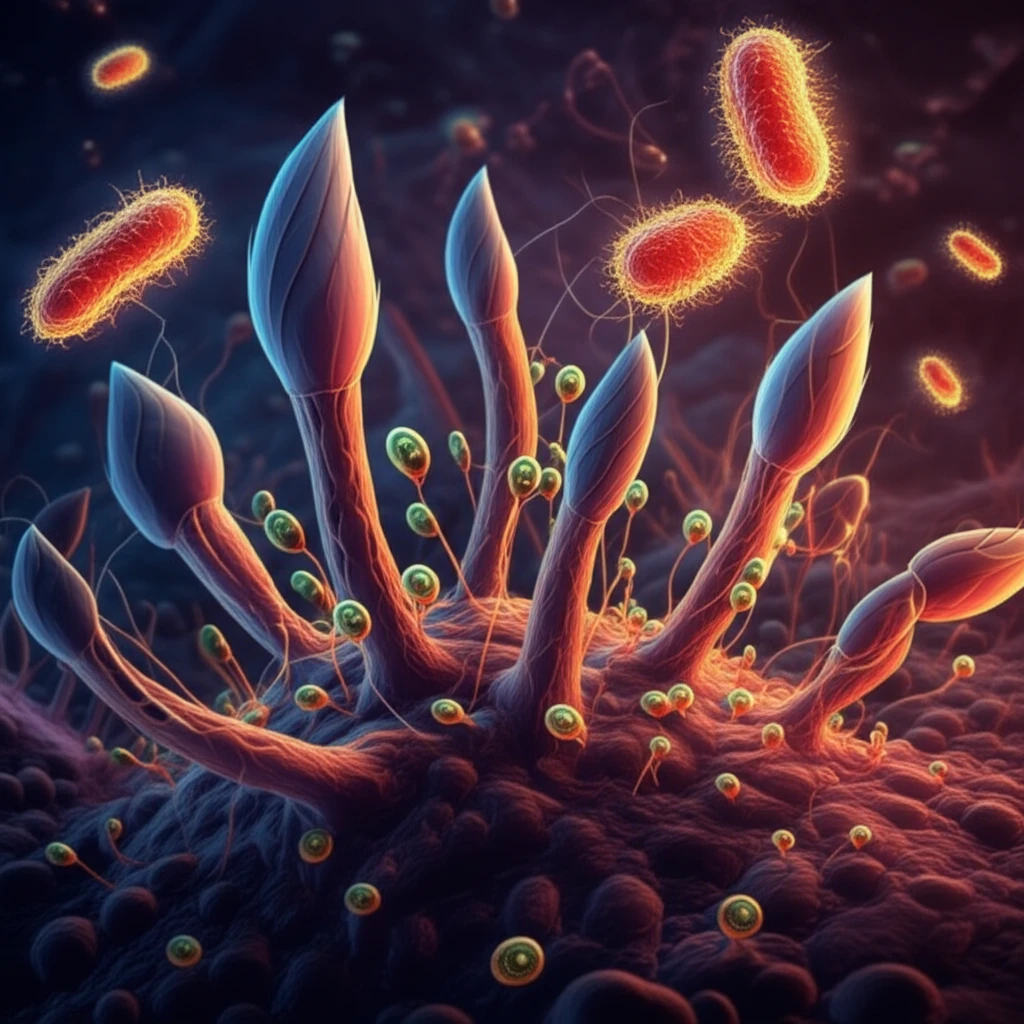
Microscopic battle between Aspergillus fungi and Staphylococcus aureus bacteria, with nidulin molecules providing defense.

Nidulin's New Tricks: How Modified Molds Could Combat Antibiotic Resistance

"Unlock the potential of nidulin derivatives in fighting Gram-positive bacteria and MRSA."


In a world grappling with the rise of antibiotic-resistant bacteria, scientists are constantly seeking novel solutions. One promising avenue involves exploring natural compounds produced by microorganisms. Among these, nidulin, a fungal depsidone derived from Aspergillus species, has garnered attention for its potential antibacterial properties.

Nidulin isn't new to the scene. Researchers have long been aware of its existence and its connection to various biological activities. However, scientists are just beginning to scratch the surface of its full therapeutic potential.

Recent studies have focused on modifying the structure of nidulin to enhance its antibacterial effects. By creating a range of nidulin derivatives, researchers aim to develop more potent drugs that can effectively combat even the most resistant bacterial strains. This approach involves carefully altering the molecule to boost its activity against harmful bacteria, including methicillin-resistant Staphylococcus aureus (MRSA).

Nidulin Derivatives: A New Hope for Antibacterial Treatment?

Microscopic battle between Aspergillus fungi and Staphylococcus aureus bacteria, with nidulin molecules providing defense.

The core of this research lies in the semi-synthesis of nidulin derivatives. This process involves taking the naturally occurring nidulin molecule and chemically modifying it to create new compounds with potentially improved properties. The primary goal is to enhance antibacterial activity, particularly against Gram-positive bacteria, which include some of the most challenging antibiotic-resistant strains.

Researchers focused on specific chemical reactions such as alkylation, acylation, and arylation of nornidulin, a close relative of nidulin. These reactions were carefully controlled to occur at specific sites on the molecule, predominantly at the 8-O position, resulting in a variety of novel derivatives. The strategic modification allowed scientists to fine-tune the properties of the resulting compounds, maximizing their effectiveness against bacteria.

Here’s a quick look at what these modifications entail:
  • Alkylation: Adding alkyl groups (chains of carbon and hydrogen atoms) to the nornidulin molecule.
  • Acylation: Incorporating acyl groups (derived from carboxylic acids) into the structure.
  • Arylation: Attaching aryl groups (containing aromatic rings) to the molecule.
What makes this research particularly exciting is the discovery that many of these semi-synthetic derivatives exhibited significantly greater antibacterial activity compared to the original nidulin. In particular, 8-O-aryl ether derivatives showed remarkable promise, displaying potent activity against Gram-positive bacteria, including MRSA. This suggests that these structural modifications are key to unlocking the full potential of nidulin as an antibacterial agent.

Future Directions: From Lab to Life

The promising results of this study pave the way for future research aimed at further optimizing nidulin derivatives for clinical use. Key areas of focus may include refining the synthesis process to improve yield and scalability, conducting more in-depth studies to elucidate the precise mechanisms of action, and evaluating the safety and efficacy of these compounds in preclinical and clinical trials. While challenges remain, the potential of nidulin derivatives to combat antibiotic-resistant infections offers a beacon of hope in the ongoing fight against these global health threats.

About this Article -

This article was crafted using a human-AI hybrid and collaborative approach. AI assisted our team with initial drafting, research insights, identifying key questions, and image generation. Our human editors guided topic selection, defined the angle, structured the content, ensured factual accuracy and relevance, refined the tone, and conducted thorough editing to deliver helpful, high-quality information.See our About page for more information.

This article is based on research published under:

DOI-LINK: 10.1038/s41429-018-0133-0, Alternate LINK

Title: Semisynthesis And Antibacterial Activities Of Nidulin Derivatives

Subject: Drug Discovery

Journal: The Journal of Antibiotics

Publisher: Springer Science and Business Media LLC

Authors: Masahiko Isaka, Arunrat Yangchum, Sumalee Supothina, Sukitaya Veeranondha, Somjit Komwijit, Souwalak Phongpaichit

Published: 2018-12-17

Everything You Need To Know

1

What is nidulin, and why is it being studied?

Nidulin is a naturally occurring compound, specifically a fungal depsidone, that is produced by Aspergillus species. It has been identified as having antibacterial properties, making it a subject of interest in combating bacterial infections. Its significance lies in its potential to be developed into new antibacterial agents, especially as antibiotic resistance becomes a growing concern. Further research is being done to unlock Nidulin's full therapeutic potential.

2

What are nidulin derivatives, and why is it important to create them?

Nidulin derivatives are modified versions of the original nidulin molecule. These modifications are created through semi-synthesis, where the structure of nidulin is chemically altered to enhance its antibacterial effects. The importance of creating these derivatives is to develop more potent drugs that can effectively combat resistant bacterial strains, such as methicillin-resistant Staphylococcus aureus (MRSA). The implications are significant, as they offer a potential new avenue for treating infections that are increasingly difficult to manage with existing antibiotics.

3

What are alkylation, acylation, and arylation, and why are they used in the context of nidulin research?

The processes of alkylation, acylation, and arylation are chemical reactions used to modify the nornidulin molecule, a close relative of nidulin. Alkylation involves adding alkyl groups (chains of carbon and hydrogen atoms). Acylation involves incorporating acyl groups (derived from carboxylic acids). Arylation involves attaching aryl groups (containing aromatic rings). These processes are important because they allow researchers to fine-tune the properties of the resulting compounds, maximizing their effectiveness against bacteria and enhancing their antibacterial activity. These modifications can lead to the creation of novel derivatives with improved properties.

4

What are 8-O-aryl ether derivatives, and why are they significant?

8-O-aryl ether derivatives are a specific type of nidulin derivative that has shown remarkable promise in combating Gram-positive bacteria, including MRSA. They are created through the arylation of nornidulin at the 8-O position. Their significance lies in their potent antibacterial activity compared to the original nidulin, suggesting that specific structural modifications can greatly enhance the compound's effectiveness. The implication is that these derivatives could potentially serve as a key component in future antibacterial drugs, especially against resistant strains of bacteria.

5

What future research is needed to bring nidulin derivatives closer to real-world use?

Future research should focus on refining the synthesis process of nidulin derivatives to improve yield and scalability, conducting in-depth studies to understand their precise mechanisms of action, and evaluating their safety and efficacy through preclinical and clinical trials. This is crucial to translate the promising results from the lab into practical clinical applications. Successfully navigating these steps could lead to the development of new treatments for antibiotic-resistant infections, addressing a critical global health threat. Addressing these factors is essential for moving Nidulin closer to real world use.

Newsletter Subscribe

Subscribe to get the latest articles and insights directly in your inbox.