
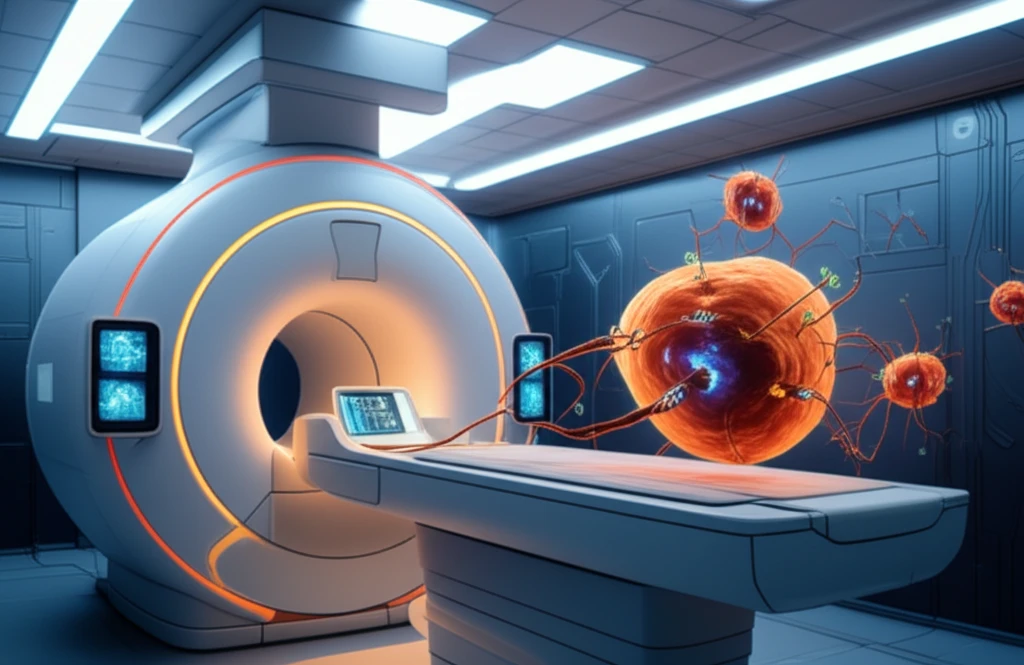
Antibody-labeled nanoparticles targeting prostate cancer cells during an MRI scan.

New Hope for Precision Prostate Cancer Imaging: Antibody-Labeled Nanoparticles

"Scientists are developing innovative contrast agents for MRI to target prostate cancer cells more accurately, potentially revolutionizing diagnosis and treatment monitoring."


Prostate cancer remains a significant health challenge for men worldwide. Early detection and accurate staging are crucial for effective treatment, but current methods often fall short. Traditional screening, primarily relying on prostate-specific antigen (PSA) tests, lacks the specificity needed to differentiate between aggressive and indolent cancers, leading to overtreatment and unnecessary anxiety. The quest for more precise diagnostic tools has driven researchers to explore innovative imaging techniques.

Magnetic resonance imaging (MRI) has emerged as a powerful tool in cancer detection, providing detailed anatomical information. However, standard MRI techniques sometimes struggle to distinguish between cancerous and healthy tissue. To enhance the specificity of MRI, scientists are developing targeted contrast agents that selectively bind to cancer cells, improving the accuracy of imaging and enabling earlier detection.

One promising approach involves engineering super-paramagnetic iron oxide (SPIO) nanoparticles labeled with antibodies that target specific markers on cancer cells. These antibody-labeled nanoparticles act as contrast agents, enhancing the MRI signal and highlighting cancerous tissue. A key target in prostate cancer is the prostate-specific membrane antigen (PSMA), which is overexpressed in prostate cancer cells, making it an ideal candidate for targeted imaging strategies.

How Antibody-Labeled Nanoparticles Enhance MRI Specificity?

Antibody-labeled nanoparticles targeting prostate cancer cells during an MRI scan.

Researchers have developed a novel contrast agent by conjugating a commercially available iron oxide nanoparticle, Molday ION Rhodamine-B Carboxyl (MIRB), with a deimmunized mouse monoclonal antibody (muJ591) that targets PSMA. This innovative approach combines the contrast-enhancing properties of iron oxide nanoparticles with the targeting precision of antibodies, creating a powerful tool for prostate cancer imaging.

The conjugation process involves a two-step carbodiimide reaction, efficiently linking the antibody to the nanoparticle. The resulting complex, muJ591:MIRB, demonstrates high specificity for PSMA-positive cells, as confirmed by immunofluorescence microscopy and flow cytometry. These techniques reveal that the muJ591:MIRB complex selectively binds to LNCaP cells, a PSMA-positive prostate cancer cell line.

  • Targeted Binding: The muJ591 antibody ensures that the nanoparticle specifically binds to PSMA, concentrating the contrast agent at the site of the tumor.
  • Enhanced Contrast: The iron oxide nanoparticle alters the magnetic properties of the surrounding tissue, creating a clear contrast in MRI images.
  • Reduced Toxicity: The deimmunized antibody minimizes the risk of adverse immune reactions, making the contrast agent safer for clinical use.
Beyond imaging enhancement, the muJ591:MIRB complex exhibits anti-tumorigenic properties. Studies have shown that the complex reduces cell adhesion and proliferation in LNCaP cells, and induces apoptosis, suggesting potential therapeutic benefits. These findings highlight the dual role of the muJ591:MIRB complex as both a diagnostic and therapeutic agent.

Future Directions: Clinical Translation and Personalized Medicine

The development of antibody-labeled SPIO nanoparticles represents a significant step forward in precision prostate cancer imaging. The muJ591:MIRB complex offers enhanced specificity and detection capabilities, potentially improving early diagnosis and treatment monitoring. As research progresses, these targeted contrast agents could revolutionize clinical practice, enabling personalized treatment strategies and improving patient outcomes.

About this Article -

This article was crafted using a human-AI hybrid and collaborative approach. AI assisted our team with initial drafting, research insights, identifying key questions, and image generation. Our human editors guided topic selection, defined the angle, structured the content, ensured factual accuracy and relevance, refined the tone, and conducted thorough editing to deliver helpful, high-quality information.See our About page for more information.

Everything You Need To Know

1

How do antibody-labeled super-paramagnetic iron oxide nanoparticles improve prostate cancer diagnosis using MRI?

Antibody-labeled super-paramagnetic iron oxide nanoparticles enhance MRI specificity by acting as targeted contrast agents. These nanoparticles, such as the muJ591:MIRB complex, are designed with antibodies that selectively bind to prostate-specific membrane antigen (PSMA), a marker overexpressed in prostate cancer cells. This targeted binding concentrates the contrast agent at the tumor site, improving the visibility and accuracy of MRI images, which helps in early detection and treatment monitoring. Traditional MRI techniques often struggle to differentiate between cancerous and healthy tissue, which contrasts agents overcomes.

2

What is the role of prostate-specific membrane antigen (PSMA) in the context of targeted prostate cancer imaging?

Prostate-specific membrane antigen (PSMA) is a key target for precise prostate cancer imaging because it is significantly overexpressed in prostate cancer cells compared to normal cells. The muJ591 antibody in the muJ591:MIRB complex is designed to specifically bind to PSMA. By targeting PSMA, contrast agents like antibody-labeled super-paramagnetic iron oxide nanoparticles can selectively accumulate in cancerous tissues, enhancing the MRI signal and allowing for more accurate detection and staging of prostate cancer. This targeted approach minimizes the detection of healthy cells which reduces the possibility of false positives.

3

What are the key components of the muJ591:MIRB complex, and how do they contribute to its function?

The muJ591:MIRB complex consists of two main components: Molday ION Rhodamine-B Carboxyl (MIRB), which is a super-paramagnetic iron oxide nanoparticle, and muJ591, a deimmunized mouse monoclonal antibody. The MIRB nanoparticle enhances the MRI signal, providing a clear contrast in the images. The muJ591 antibody targets prostate-specific membrane antigen (PSMA) on prostate cancer cells, ensuring that the nanoparticle specifically binds to the tumor. The deimmunized nature of the antibody minimizes the risk of adverse immune reactions, making the contrast agent safer for potential clinical use. The conjugation is achieved through a two-step carbodiimide reaction, effectively linking the antibody to the nanoparticle.

4

Beyond imaging, what other potential benefits does the muJ591:MIRB complex offer in prostate cancer treatment?

In addition to its imaging enhancement capabilities, the muJ591:MIRB complex exhibits anti-tumorigenic properties. Studies have shown that it reduces cell adhesion and proliferation in LNCaP cells (a PSMA-positive prostate cancer cell line) and induces apoptosis. These findings suggest that the muJ591:MIRB complex could potentially act as both a diagnostic and therapeutic agent, offering a dual role in prostate cancer management. This could be particularly beneficial in personalized medicine approaches, where diagnosis and therapy are combined.

5

What are the future directions for antibody-labeled SPIO nanoparticles in prostate cancer management, and what impact could they have on clinical practice?

The future directions for antibody-labeled SPIO nanoparticles involve translating the research findings into clinical practice, with the goal of improving early diagnosis, treatment monitoring, and personalized treatment strategies for prostate cancer. As research progresses, targeted contrast agents like the muJ591:MIRB complex could revolutionize clinical practice by enabling more precise imaging, reducing the need for invasive procedures, and tailoring treatment plans based on individual patient characteristics. This could lead to improved patient outcomes and a more effective approach to managing prostate cancer.

Newsletter Subscribe

Subscribe to get the latest articles and insights directly in your inbox.