
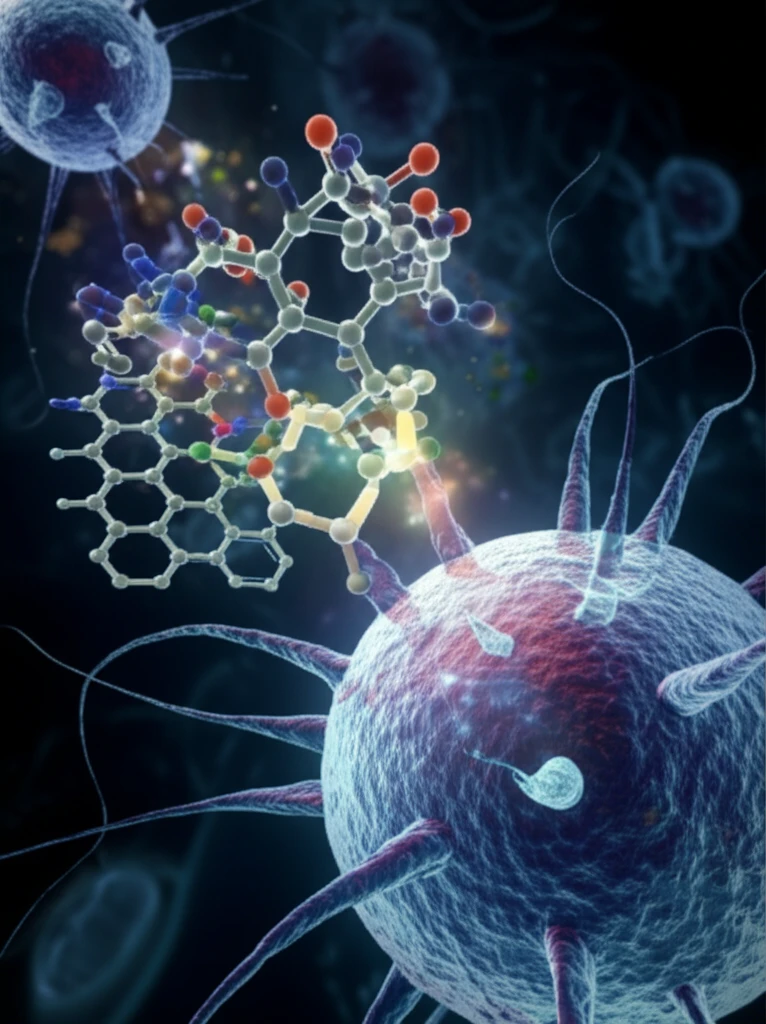
Illustration of a cancer cell targeted by a new medical compound

New Hope for Cancer Patients: Scientists Discover Promising Anti-Tumor Compound

"Groundbreaking research reveals a novel fusidic acid derivative that exhibits potent anti-cancer activity, offering a potential new treatment avenue."


Cancer remains one of the leading causes of death worldwide, affecting millions of people each year. The search for effective treatments is a relentless pursuit, with researchers constantly exploring new avenues to combat this complex disease. Recent advancements in medical research have unveiled a promising new development: a novel derivative of fusidic acid, a well-known antibiotic, has shown remarkable anti-tumor activity.

This groundbreaking discovery, detailed in a new study, highlights the potential of this compound to target and eliminate cancer cells. The research team focused on modifying the structure of fusidic acid, a naturally occurring substance, to enhance its anti-cancer properties. Their efforts have yielded a compound that demonstrates significant effectiveness in laboratory settings and offers a potential new approach to cancer therapy.

This article delves into the details of this exciting research, exploring the compound's mechanism of action, its effectiveness against various cancer cell lines, and the potential implications for future cancer treatments. This is a significant step forward in cancer research, and as we further explore this new treatment, we can offer new hope for those battling this disease.

Unveiling the Power of Fusidic Acid Derivatives: The Science Behind the Discovery

Illustration of a cancer cell targeted by a new medical compound

The foundation of this research lies in the modification of fusidic acid, a bacteriostatic antibiotic known for its ability to disrupt bacterial protein synthesis. Researchers hypothesized that by altering the molecular structure of fusidic acid, they could create compounds with enhanced anti-cancer properties. This approach involved introducing amino-terminal groups at the 3-hydroxyl position of the fusidic acid molecule.

The team synthesized a series of novel fusidic acid derivatives and subjected them to rigorous testing. These derivatives were screened for their ability to inhibit the growth of various cancer cell lines, including Hela (cervical cancer), KBV (multidrug-resistant oral epidermoid carcinoma), U87 (glioma), and MKN45 (gastric cancer).

  • The research team meticulously synthesized a range of fusidic acid derivatives, each with unique structural modifications.
  • These derivatives were then tested against multiple cancer cell lines to assess their anti-tumor activity.
  • The screening process revealed that specific derivatives exhibited significant growth-inhibiting effects on various cancer cells.
  • One compound, in particular, demonstrated superior anti-tumor activity.
The study results were compelling. The novel fusidic acid derivative demonstrated significant anti-tumor activity across multiple cancer cell lines. In laboratory experiments, the compound effectively inhibited the growth and survival of cancer cells, indicating its potential as a promising anti-cancer agent. The results demonstrated the therapeutic potential of the new compound, which could potentially offer new hope for patients and improve quality of life.

A Bright Future in Cancer Treatment

This research marks a significant advancement in the fight against cancer. With promising laboratory results and a clear mechanism of action, this novel fusidic acid derivative represents a potential new weapon in the battle against this devastating disease. Further research, including clinical trials, is essential to fully understand the compound's efficacy and safety in humans. However, the initial findings offer a beacon of hope, suggesting that new and effective cancer treatments may be on the horizon.

About this Article -

This article was crafted using a human-AI hybrid and collaborative approach. AI assisted our team with initial drafting, research insights, identifying key questions, and image generation. Our human editors guided topic selection, defined the angle, structured the content, ensured factual accuracy and relevance, refined the tone, and conducted thorough editing to deliver helpful, high-quality information.See our About page for more information.

This article is based on research published under:

DOI-LINK: 10.1016/j.ejmech.2018.10.059, Alternate LINK

Title: Discovery, Synthesis Of Novel Fusidic Acid Derivatives Possessed Amino-Terminal Groups At The 3-Hydroxyl Position With Anticancer Activity

Subject: Organic Chemistry

Journal: European Journal of Medicinal Chemistry

Publisher: Elsevier BV

Authors: Jingxuan Ni, Mengqi Guo, Yucheng Cao, Lei Lei, Kangli Liu, Binghua Wang, Fangfang Lu, Rong Zhai, Xiangwei Gao, Chunhong Yan, Hongbo Wang, Yi Bi

Published: 2019-01-01

Everything You Need To Know

1

What is the main finding regarding cancer treatment?

The main finding is the discovery of a novel fusidic acid derivative that exhibits potent anti-tumor activity. This suggests it may be a potential new treatment avenue in battling cancer. The research has identified a compound with significant anti-tumor properties through modification of fusidic acid. This could pave the way for new therapies, and offer renewed hope for patients.

2

How was the novel anti-cancer compound developed?

The novel anti-cancer compound was developed through modification of fusidic acid, a bacteriostatic antibiotic known for disrupting bacterial protein synthesis. Researchers altered the molecular structure of fusidic acid, introducing amino-terminal groups at the 3-hydroxyl position of the fusidic acid molecule, to enhance its anti-cancer properties. This process led to the creation of fusidic acid derivatives with enhanced anti-cancer capabilities.

3

Which cancer cell lines showed sensitivity to the fusidic acid derivative?

The novel fusidic acid derivative was tested against multiple cancer cell lines. It demonstrated significant growth-inhibiting effects on various cancer cells, including Hela (cervical cancer), KBV (multidrug-resistant oral epidermoid carcinoma), U87 (glioma), and MKN45 (gastric cancer). These results highlight the potential broad applicability of the compound across different cancer types.

4

What is the potential therapeutic impact of this research on cancer patients?

The therapeutic potential lies in the ability of the novel fusidic acid derivative to effectively inhibit the growth and survival of cancer cells. This could potentially offer new hope for patients and improve their quality of life. However, it's crucial to acknowledge that further research, including clinical trials, is essential to fully understand the compound's efficacy and safety in humans before it can be widely adopted as a cancer treatment.

5

What are the next steps in researching this novel fusidic acid derivative?

The immediate next steps involve extensive further research, with a strong emphasis on clinical trials. These trials are necessary to fully evaluate the efficacy, safety, and optimal dosage of the novel fusidic acid derivative in human subjects. Additionally, researchers will need to investigate potential side effects, long-term impacts, and the compound's effectiveness against a broader spectrum of cancer types. Understanding these aspects is vital before this derivative can become a viable and widely accepted cancer treatment.

Newsletter Subscribe

Subscribe to get the latest articles and insights directly in your inbox.