
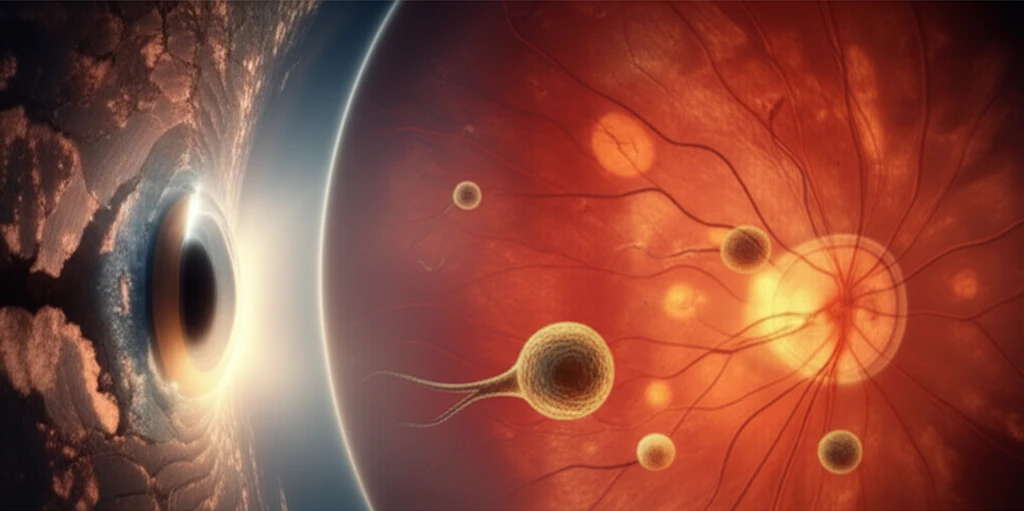
Stem cells repairing damaged retina in macular degeneration treatment.

New Hope for Aging Eyes: Stem Cell Therapies to Combat Macular Degeneration

"Groundbreaking research explores how stem cell treatments could reverse vision loss from age-related macular degeneration, offering a new outlook for millions."


Age-related macular degeneration (AMD) significantly impairs central vision, affecting crucial daily activities, and isolating individuals. With millions affected globally, the advanced stages of AMD present a substantial challenge.

Current treatments for 'wet' AMD, which involve regular injections of anti-VEGF drugs, are not curative and place a significant burden on healthcare systems. Alarmingly, 'dry' AMD, which accounts for 90% of cases, currently has no effective treatments, highlighting a critical unmet need in an aging population.

However, researchers are exploring stem cell-based therapies aimed at replacing damaged retinal pigment epithelium (RPE) cells. This article examines these new therapies, their potential to restore vision, and the challenges that lie ahead in making them widely available.

Revolutionizing Treatment with RPE-Based Therapies

Stem cells repairing damaged retina in macular degeneration treatment.

Given the critical role of RPE cells in AMD, scientists have long considered RPE replacement a promising treatment strategy. Early attempts involved surgical transplantation of autologous RPE, which showed some success but were technically challenging and carried significant risks. Now, the focus has shifted to using exogenous RPE cells derived from stem cells.

Currently, three main groups have reported clinical trials involving pluripotent stem cell-derived RPE transplants for AMD:

  • Ocata Therapeutics (California): Pioneered the transplantation of human embryonic stem cell-derived RPE cells into patients with advanced dry AMD and Stargardt's disease. Early results showed no evidence of rejection or tumor formation, suggesting the potential of HESC as a safe cell source.
  • Riken Centre (Japan): Reported transplanting induced pluripotent stem cell (IPSC)-derived RPE into an AMD patient. This was the first IPSC trial worldwide, using cells derived from the patient's own skin, potentially reducing the risk of immune rejection.
  • London Project to Cure Blindness: Transplanted HESC-derived RPE cells as a monolayer patch on a coated polymer sheet into a patient with recently diagnosed wet AMD. This approach aims to replace Bruch's membrane and support the remaining retinal structure.
Many other research teams are exploring different cell types and techniques for AMD treatment, including cells derived from umbilical cord, fetal brain, and bone marrow. These diverse approaches highlight the broad interest and intensive effort in finding effective stem cell therapies for AMD.

The Future of AMD Treatment: Challenges and Opportunities

While these initial clinical trials are promising, translating stem cell therapies into widespread treatments for AMD faces several challenges. These include navigating complex regulatory pathways, scaling up cell production to meet global demand, and managing the high costs associated with advanced therapy medicinal products (ATMPs).

Stratified medicine, which involves understanding disease subtypes and predicting treatment responses, could also play a key role. In the future, using cells differentiated to photoreceptors in addition to an RPE transplant could also aid patients with photoreceptor loss.

Despite these challenges, the commencement of clinical trials for AMD represents a major milestone in regenerative medicine. With continued research, technological advancements, and the dedicated involvement of patients, stem cell therapies hold immense potential to transform the treatment of AMD and restore sight to millions.

About this Article -

This article was crafted using a human-AI hybrid and collaborative approach. AI assisted our team with initial drafting, research insights, identifying key questions, and image generation. Our human editors guided topic selection, defined the angle, structured the content, ensured factual accuracy and relevance, refined the tone, and conducted thorough editing to deliver helpful, high-quality information.See our About page for more information.

This article is based on research published under:

DOI-LINK: 10.1167/iovs.15-18643, Alternate LINK

Title: Stemming The Tide Of Age-Related Macular Degeneration: New Therapies For Old Retinas

Subject: General Medicine

Journal: Investigative Opthalmology & Visual Science

Publisher: Association for Research in Vision and Ophthalmology (ARVO)

Authors: Conor M. Ramsden, Lyndon Da Cruz, Peter J. Coffey

Published: 2016-04-26

Everything You Need To Know

1

What is age-related macular degeneration (AMD), and why is it a focus of research?

Age-related macular degeneration (AMD) is a condition that primarily affects central vision, which is vital for detailed tasks like reading and recognizing faces. It occurs when the macula, part of the retina, deteriorates. This causes a decline in vision, impacting daily activities and overall quality of life. The article emphasizes AMD because it is a common aging-related condition and a leading cause of vision loss.

2

How do stem cell therapies work to treat AMD?

Stem cell therapies are a promising new approach to treating AMD because they aim to replace damaged retinal pigment epithelium (RPE) cells. The RPE cells are crucial for the health and function of the retina. By replacing these damaged cells with new, healthy cells derived from stem cells, the therapies aim to restore vision that has been lost due to AMD. This is a significant advancement as current treatments for 'dry' AMD, which affects the majority of patients, are currently nonexistent.

3

What are some of the different approaches being used in stem cell trials for AMD?

Several groups are involved in clinical trials using different types of stem cells. Ocata Therapeutics is using human embryonic stem cell-derived RPE cells. The Riken Centre in Japan is using induced pluripotent stem cell (IPSC)-derived RPE cells, which are derived from the patient's own skin cells. The London Project to Cure Blindness is transplanting HESC-derived RPE cells as a monolayer patch. Each group has different approaches, but they all share the goal of replacing damaged RPE cells to combat AMD.

4

What is the significance of using induced pluripotent stem cells (IPSCs) in treating AMD?

The use of induced pluripotent stem cells (IPSCs) in treating AMD is significant because the cells are derived from the patient's own skin. This offers the potential of reducing the risk of immune rejection compared to using cells from other sources. The Riken Centre's trial, using this approach, marks an important step in personalized medicine for AMD.

5

What are the main challenges in bringing stem cell therapies for AMD to a wider audience?

The path to widespread use of stem cell therapies for AMD involves challenges such as navigating regulatory pathways, scaling up cell production to meet global demand, and managing the high costs of these advanced therapy medicinal products (ATMPs). Even though initial clinical trials show promise, overcoming these challenges is crucial to making these treatments accessible to those affected by AMD. Further research and investment are needed to ensure these therapies can be delivered to those who need them.

Newsletter Subscribe

Subscribe to get the latest articles and insights directly in your inbox.