
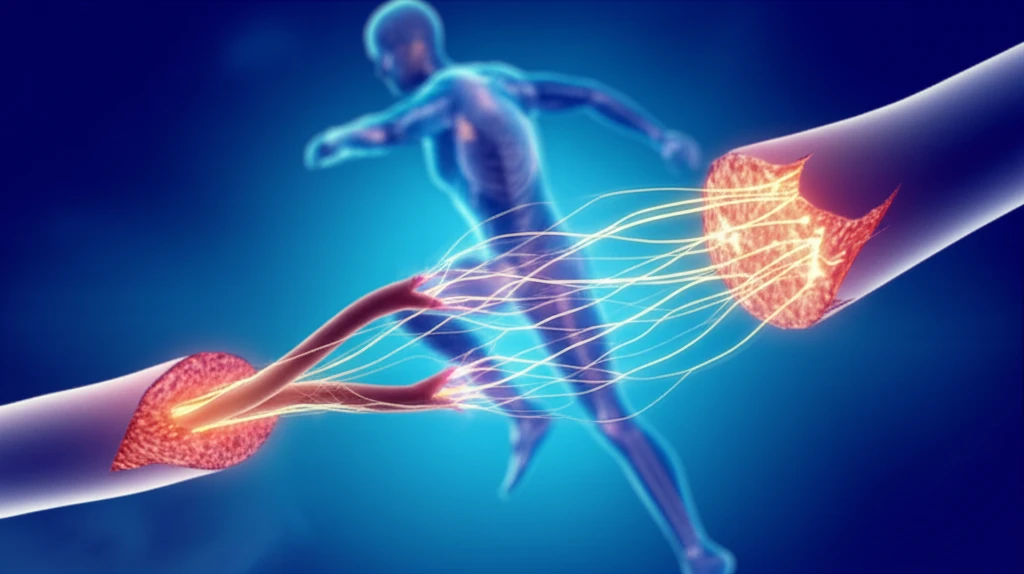
Severed nerve being reconnected with glowing strands

Nerve Repair Breakthrough: Can PEG-Fusion End the Agony of Nerve Damage?

"Discover how PEG-fusion, a revolutionary technique combining nerve repair with special solutions, offers new hope for rapid and dramatic recovery from peripheral nerve injuries."


Peripheral nerve injuries (PNIs), often resulting from accidents, surgeries, or other trauma, affect millions worldwide. These injuries can lead to a cascade of debilitating consequences, including loss of sensation, muscle weakness, chronic pain, and significantly reduced quality of life. Traditional treatments, such as microsurgery (neurorrhaphy), aim to rejoin severed nerves, but natural recovery is often slow, incomplete, and limited by the body's own regenerative capacity.

Now, a groundbreaking technique called PEG-fusion is offering new hope for individuals suffering from PNIs. Unlike traditional methods that simply reconnect the outer sheaths of nerves, PEG-fusion focuses on repairing the nerve fibers (axons) themselves. This innovative approach combines neurorrhaphy with a specifically formulated solution containing polyethylene glycol (PEG), a substance known for its ability to fuse cell membranes.

This article dives into the science behind PEG-fusion, exploring how it works, what benefits it offers over conventional nerve repair techniques, and what the future holds for this promising treatment. We'll examine the research, discuss the potential applications, and address common questions surrounding this exciting development in the field of nerve regeneration.

How Does PEG-Fusion Work Its Nerve-Healing Magic?

Severed nerve being reconnected with glowing strands

PEG-fusion is not just a simple reconnection; it's a sophisticated process designed to promote rapid and complete nerve regeneration. The technique involves a precise sequence of steps, each carefully designed to optimize the environment for nerve repair. Here's a breakdown:

Following are the steps of PEG-fusion:

  • Preparation: The severed nerve ends are carefully trimmed to create clean, smooth surfaces for reconnection.
  • Priming: The surgical area is irrigated with a hypotonic (low-salt) solution to increase the volume of the nerve cells and open the cut ends of the axons.
  • Protection: A solution of methylene blue, an antioxidant, is applied to the cut ends to prevent the formation of damaging free radicals and further protect the nerve cells.
  • Coaptation: The severed nerve ends are brought together and held in close apposition using microsutures, a technique called neurorrhaphy. This provides the mechanical support needed for the fusion process.
  • Fusion: A solution of PEG is applied to the coaptation site. The PEG molecules facilitate the fusion of the axonal membranes, effectively reconnecting the severed nerve fibers.
  • Repair: The area is then irrigated with an isotonic (balanced-salt) solution containing calcium to help seal any remaining holes in the nerve cell membranes.
This multi-step approach is critical to the success of PEG-fusion. Each component plays a vital role in creating the optimal conditions for axonal reconnection and nerve regeneration.

The Future of Nerve Repair: Hope on the Horizon

PEG-fusion represents a significant advancement in the field of nerve repair, offering the potential for faster, more complete, and more reliable recovery from peripheral nerve injuries. While still a relatively new technique, the research is promising, and clinical case studies are beginning to demonstrate its effectiveness in humans.

As research continues and the technique is refined, PEG-fusion could become a standard treatment option for a wide range of nerve injuries, offering hope for improved function and a better quality of life for individuals affected by these debilitating conditions.

The development and application of PEG-fusion underscore the importance of continued investment in scientific research and innovation. By pushing the boundaries of what's possible, we can unlock new treatments and therapies that transform lives and alleviate suffering.

About this Article -

This article was crafted using a human-AI hybrid and collaborative approach. AI assisted our team with initial drafting, research insights, identifying key questions, and image generation. Our human editors guided topic selection, defined the angle, structured the content, ensured factual accuracy and relevance, refined the tone, and conducted thorough editing to deliver helpful, high-quality information.See our About page for more information.

Everything You Need To Know

1

What is PEG-fusion and how does it help in nerve repair?

PEG-fusion is a novel technique used to repair damaged peripheral nerves. It combines the traditional surgical method of neurorrhaphy, where severed nerve ends are rejoined, with the application of polyethylene glycol (PEG). PEG helps fuse the axonal membranes of the nerve fibers themselves, promoting faster and more complete regeneration than traditional methods. The procedure involves several steps, including preparation, priming with a hypotonic solution, protection with methylene blue, coaptation using microsutures, fusion using PEG, and repair with an isotonic solution containing calcium.

2

How does PEG-fusion differ from traditional nerve repair techniques like neurorrhaphy?

Unlike traditional nerve repair methods that primarily focus on reconnecting the outer sheaths of nerves, PEG-fusion aims to repair the axons. This is achieved through a multi-step process involving preparing the nerve ends, priming with a hypotonic solution, protecting with methylene blue, coaptation using microsutures (neurorrhaphy), fusing the axons using polyethylene glycol (PEG), and repairing with an isotonic solution containing calcium. By directly addressing the nerve fibers, PEG-fusion seeks to enhance nerve regeneration and functional recovery.

3

Can you explain the step-by-step process involved in PEG-fusion?

PEG-fusion involves a sequence of carefully designed steps. First, the severed nerve ends are prepared and trimmed. Then, a hypotonic solution primes the area, followed by methylene blue for protection. Neurorrhaphy is then performed to bring the nerve ends together. Polyethylene glycol (PEG) is applied to fuse the axonal membranes. Finally, an isotonic solution containing calcium helps seal any remaining holes. The combination of priming, protection, neurorrhaphy, the fusion properties of PEG, and repair optimizes the environment for reconnection and regeneration.

4

What is the role of methylene blue in PEG-fusion, and why is it important?

Methylene blue is an antioxidant used in the PEG-fusion procedure to prevent the formation of damaging free radicals, protecting the nerve cells. Free radicals are unstable molecules that can cause cellular damage and impede the nerve regeneration process. By mitigating oxidative stress, methylene blue helps ensure a more favorable environment for the axons to fuse and regenerate effectively, contributing to the overall success of the nerve repair.

5

Is PEG-fusion considered a major breakthrough in nerve repair, and what does the future hold for this technique?

PEG-fusion is considered a significant advancement due to its focus on directly repairing axons and its potential for improved nerve regeneration. While research is ongoing, initial clinical case studies suggest that PEG-fusion can lead to faster, more complete, and more reliable recovery from peripheral nerve injuries compared to traditional methods like neurorrhaphy alone. However, the long-term outcomes and broader applicability of PEG-fusion are still under investigation, highlighting the need for continued research and clinical trials.

Newsletter Subscribe

Subscribe to get the latest articles and insights directly in your inbox.