
Navigating the Waves: How Passing Ships Affect Moored Vessels and Port Safety

"Uncover the hidden forces at play when ships pass near moored vessels, and how understanding these dynamics is crucial for safer port operations and infrastructure design."
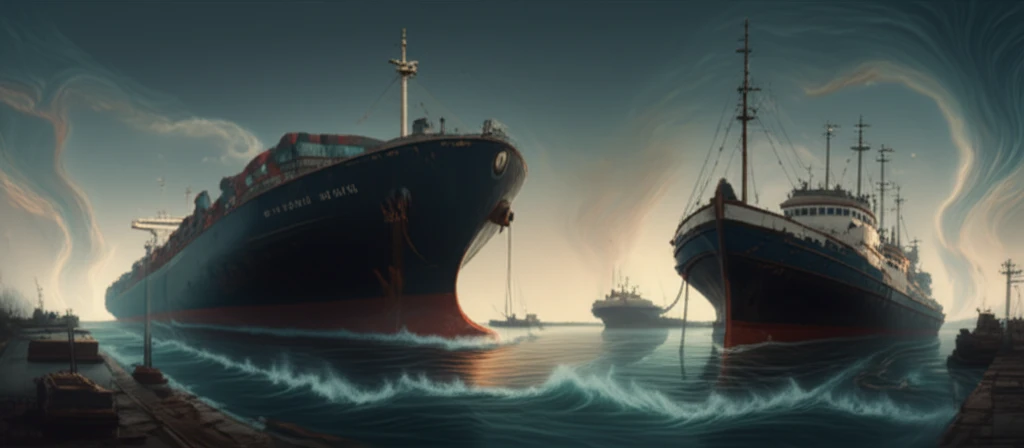
Imagine a calm harbor. A large cargo ship smoothly sails past a docked vessel. What seems like a routine event actually involves complex interactions beneath the surface. When a ship moves through water, it generates hydrodynamic forces that can significantly impact nearby moored vessels, potentially causing them to move, sway, and experience considerable stress.
These interactions are particularly critical in busy ports and narrow waterways, where the proximity of moving and stationary ships is unavoidable. The forces generated by a passing ship can affect a moored vessel's stability and the structural integrity of the mooring system itself. Understanding these forces is essential for designing resilient port infrastructure and ensuring the safety of docked ships.
This article delves into the dynamic response of moored vessels to passing ship phenomena, drawing upon research to explain the underlying forces and their implications for maritime engineering and port management. We'll explore how engineers are modeling these interactions and developing strategies to mitigate potential risks, contributing to safer and more efficient port operations.
The Growing Challenge of Ship Interactions
When large vessels pass near moored ships in ports and waterways, they generate complex hydrodynamic forces that can cause dangerous movements. These ship-to-ship interaction effects have become an increasingly important safety concern as vessel sizes continue to grow. The confined nature of port environments and channels amplifies these forces, creating challenges for mooring operations and vessel safety.
Hydrodynamic Modeling Methods
The hydrodynamic derivatives of marine vehicles are conventionally approximated through least squares fitting method, where fluid forces are measured in model scale tests. The Korean Institute of Ship and Ocean Engineering developed the KVLCC2 as a standard reference vessel for computational and experimental hydrodynamic research. Hydrodynamic models explain the dynamics of ship motion through simultaneous equations relating forces and moment structures. However, alternative methods are needed when data limitations prevent accurate estimation of extreme hydrodynamic forces in offshore design standards.
Foundations of Ship Hydrodynamics
The study of how vessels interact hydrodynamically has evolved significantly over the past century. Early research focused on understanding basic wave-making resistance and added mass effects. Foundation work established mathematical frameworks for predicting forces between vessels in proximity. These discoveries laid the groundwork for modern computational approaches used in port safety analysis.
The Ripple Effect: Understanding Hydrodynamic Forces
When a ship sails, it displaces water, creating waves and pressure changes that radiate outwards. If another ship is moored nearby, it becomes subject to these hydrodynamic interactions. These forces can manifest in several ways:
- Ship Size and Speed: Larger and faster ships generate greater hydrodynamic forces.
- Distance Between Ships: The closer the ships, the stronger the interaction.
- Water Depth: Shallow waters can amplify the effects.
- Hull Shape: The design of both the passing and moored vessels influences the way water flows around them.
Advances in Marine Hydrodynamics Research
Recent advances in marine hydrodynamics encompass theoretical, computational, and experimental contributions to all aspects of the field. Hydrodynamic interactions in maritime environments involve complex forces and motions arising when vessels, fixed structures, and seabed features influence surrounding water flows. A special topic in the field accepted 74 papers following rigorous peer review, demonstrating the breadth of current research activity. These studies address ship hydrodynamics, ship structural mechanics, and fluid-structure interaction challenges.
Limitations and Ongoing Challenges
Despite advances in hydrodynamic modeling, significant challenges remain in predicting ship interaction effects. The complexity of real-world conditions often exceeds the capabilities of current analytical methods. Scale effects between model tests and full-size vessels introduce uncertainties. The dynamic nature of port environments with multiple variables makes accurate prediction difficult.
Comparing Hydrodynamic Approaches
Marine hydrodynamics fundamentals include transport theorem, conservation principles, and Navier-Stokes equations applied to naval architecture. Studies comparing hydrodynamic parameters show that predictions for simple marine structures are very close between different methods. Understanding forces acting on marine structures requires comprehensive mathematical tools and frameworks. CFD simulation bridges theory to practical application for analyzing forces that significantly impact stability and overall vessel performance.
Charting a Safer Course: The Future of Port Design
The research into passing ship phenomena highlights the importance of considering hydrodynamic interactions in port design and operations. By understanding the forces at play, engineers can:
Integrating Hydrodynamic Knowledge
Hydrodynamic analysis of marine propulsion systems encompasses the study of forces and flow phenomena governing propeller, rudder, and auxiliary device performance. Research in hydrodynamic properties of marine structures addresses novel techniques for floaters, offshore wind turbines, and mooring system failures. These studies contribute to improved design and operational practices for maritime safety.
Emerging Trends in Maritime Technology
Marine engineering hydrodynamics is fundamental to marine, coastal, and offshore engineering, with increasing attention due to climate change and ocean engineering development. Autonomous vessels utilizing advanced artificial intelligence and machine learning promise more sustainable and error-free maritime operations. Global maritime trends in 2026 are shaped by stricter climate rules, faster digital adoption including AI and IoT in smart ports, and rising geopolitical risks on key trade routes. These shifts affect freight costs, vessel choice, port delays, and supply chain reliability.
Systemic Maritime Industry Challenges
The maritime industry faces interconnected challenges spanning environmental regulations, technological adoption, and operational demands. Ports must balance efficiency with safety considerations as vessel traffic increases. Infrastructure limitations and capacity constraints create additional pressures on mooring operations. These systemic factors compound the technical challenges of managing hydrodynamic effects in confined waters.
Practical Applications and Lessons Learned
CFD applications in ship and offshore hydrodynamics contribute to validation and consolidation of computational methods, offering insights into accuracy and limitations for practical applications. Real-life incidents demonstrate that hydrodynamic effects create significant challenges, as the intensity and effect of hydrodynamic forces cannot be accurately assessed in confined waters. In overtaking situations, safety guidance recommends maintaining the greatest possible speed difference between vessels. These practical experiences underscore the importance of understanding ship interaction effects for safe port operations.
<ul><li><b>Design more robust mooring systems:</b> Capable of withstanding the dynamic loads imposed by passing ships.</li><li><b>Optimize channel design:</b> Minimizing the interaction forces between vessels.</li><li><b>Implement speed restrictions:</b> Reducing the forces generated by passing ships in sensitive areas.</li></ul>
Ultimately, a proactive approach to managing passing ship effects contributes to safer, more efficient, and more resilient port environments. As maritime traffic increases, continued research and innovation in this area will be essential for ensuring the stability and longevity of our vital port infrastructure.