
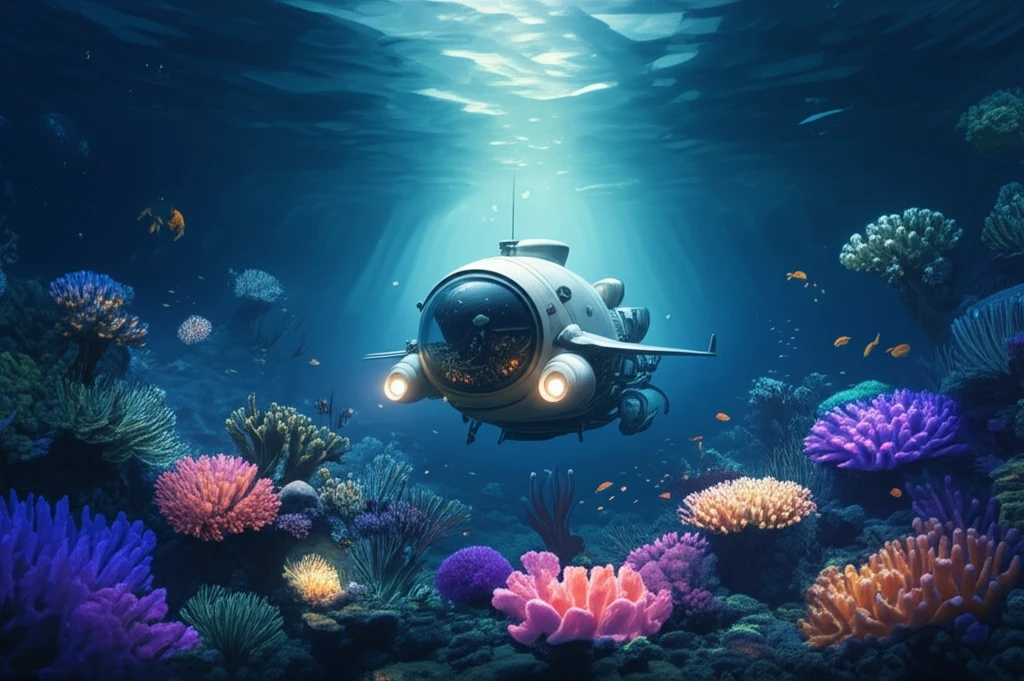
Navigating the Depths: How Ocean Engineering is Shaping Our Future

"Dive into the groundbreaking innovations and ethical considerations driving the next wave of ocean exploration and technology."
The ocean, a realm of immense mystery and untapped potential, is rapidly becoming a focal point for technological innovation and scientific exploration. Ocean engineering, a multidisciplinary field encompassing electrical, mechanical, civil, and chemical engineering principles, is at the forefront of this oceanic revolution. From developing advanced underwater robotics to harnessing the power of ocean waves, ocean engineers are creating solutions to some of the world's most pressing challenges.
This article delves into the groundbreaking research and developments highlighted in the IEEE Journal of Oceanic Engineering, Vol. 43, offering a glimpse into the diverse and impactful projects shaping our relationship with the marine environment. As we venture deeper into the ocean's depths, ethical considerations and sustainable practices become paramount. How do we balance the pursuit of knowledge and resources with the need to protect this fragile ecosystem? Let's explore.
Whether you're a seasoned engineer, a budding scientist, or simply someone captivated by the ocean's allure, this exploration of ocean engineering's latest innovations promises to be an enlightening journey. Join us as we navigate the currents of technological advancement and ethical responsibility in this vital field.
Data-Driven Understanding of Ocean Engineering
Ocean engineering exists within a vast ecosystem of global data collection and analysis. Organizations such as UNCTAD compile statistical indicators across diverse datasets, ensuring comparability that supports evidence-based decision-making in maritime domains. The IEEE Journal of Oceanic Engineering serves as a key quarterly publication disseminating research in the field, while platforms like Statista aggregate data from over 22,500 sources across more than 60,000 topics, enabling researchers and practitioners to contextualize ocean engineering within broader industry and market trends.
Modeling Methods and Their Constraints
Ocean engineering increasingly relies on coupled computational models to simulate complex interactions between structures and the marine environment. One such approach involves a two-way coupled model pairing a Discrete Element Method solver for simulating granular systems with a finite element mooring model based on the discontinuous Galerkin method, used to study mooring line trenching. However, like many engineering disciplines, ocean engineering faces challenges with method heterogeneity and a lack of standardized protocols, which can confound direct comparisons across platforms and limit generalization of results.
Tracing Ocean Engineering's Roots
The historical development of ocean engineering as a formal discipline is intertwined with broader milestones in maritime exploration and technological progress. While detailed records of specific foundational discoveries are scattered across diverse archives, the field's evolution mirrors wider patterns of innovation in marine science and coastal infrastructure development. Documenting these milestones remains an ongoing effort, as historical sources are sometimes retired or no longer actively maintained, making comprehensive retrospective analysis challenging.
Autonomous Underwater Vehicles (AUVs): The Future of Ocean Exploration
Autonomous Underwater Vehicles (AUVs) are revolutionizing how we explore and interact with the ocean. These self-propelled, unmanned robots can perform a wide range of tasks, from mapping the seafloor and monitoring marine life to inspecting underwater infrastructure and searching for lost objects. The IEEE Journal of Oceanic Engineering showcases cutting-edge research in AUV design, navigation, and control.
- Seabed inspection for infrastructure maintenance
- Oceanographic surveys for environmental monitoring
- Search and rescue operations in challenging underwater terrains
Advances in Artificial Reefs and Ocean Health Research
Recent research in ocean engineering focuses significantly on the development of multifunctional artificial reefs, with studies examining structure types designed to optimize flow fields and support ocean engineering protection efforts. Concurrently, researchers warn that unusually warm oceans can fuel stronger storms, trigger harmful algal blooms, reduce seafood supplies, and disrupt coastal livelihoods, underscoring the urgency of engineering interventions. The Volume 6B Ocean Engineering collection on ScienceGate also tracks the latest published papers, reflecting a rapidly expanding body of work across the discipline.
Challenges at the Land-Sea Interface
Engineering hydrologists working at the intersection of land and ocean systems face persistent challenges in managing water from atmospheric precipitation through to its inflow into the oceans. Water resources engineering must account for the full hydrological cycle, including vaporization into the atmosphere, which introduces significant uncertainty into coastal and offshore engineering projects. These complexities highlight the limitations of purely land-based engineering approaches when applied to the dynamic marine environment.
Benchmarking Approaches in Engineering Practice
Comparative analysis platforms such as Versus.com enable side-by-side evaluation of products and technologies across more than 100 categories, using detailed specifications and data visualizations. While such tools are widely used in consumer technology, their application to ocean engineering hardware and methodologies is less established. The challenge of comparing complex ocean engineering systems — which span mechanical, electrical, and civil domains — requires more specialized frameworks than general-purpose comparison platforms currently offer.
The Ethical Imperative
As ocean engineering continues to advance, ethical considerations must remain at the forefront of our endeavors. We have a responsibility to develop and deploy ocean technologies in a manner that minimizes environmental impact, respects marine ecosystems, and promotes sustainable practices. By embracing a holistic approach that integrates technological innovation with ethical responsibility, we can unlock the ocean's vast potential while safeguarding its precious resources for future generations. The journey into the ocean's depths requires not only ingenuity but also a deep commitment to stewardship and sustainability.
Learning from Deep-Sea Exploration Failures
The 2023 Titan submersible failure while visiting the Titanic wreck has become a defining case study for deep-ocean exploration safety. Ocean explorer Victor Vescovo has stated that the mishap could ultimately make future deep-ocean voyages safer by exposing critical design and oversight shortcomings. Ocean engineering expert witnesses, such as those profiled by Cahn Litigation Services, play an increasingly important role in analyzing such incidents and supporting investigations at the intersection of engineering failure and maritime law.
Chemical Innovation and Interdisciplinary Growth
Ocean engineering is fundamentally interdisciplinary, combining mechanical, electrical, civil, acoustical, and chemical engineering techniques with a working knowledge of marine systems. Emerging research highlights the growing role of chemical functions in ocean engineering, from harnessing renewable energy to exploring marine resources. The engineering sector overall contributes over $2 trillion annually in the United States, and as ocean engineering continues to expand, demand for professionals who can bridge multiple disciplines is expected to grow significantly.
Systemic Innovation for Ocean and Environmental Challenges
Addressing systemic challenges in ocean health requires scalable, people-centred engineering approaches, as demonstrated by innovations showcased at the 2025 Africa Prize for Engineering Innovation. Corporate sustainability efforts are also intersecting with ocean engineering; for example, partnerships with organizations like Ocean Bottle fund the collection of ocean-bound plastic while promoting reusable materials. These initiatives illustrate how engineering solutions must extend beyond purely technical fixes to address broader social and environmental systems.
Deploying Ocean Engineering in Commercial and Defense Operations
Deep Water Environment (DWE) systems represent a key area where ocean engineering delivers real-world impact across commercial operations, maritime defense, and scientific research. Case studies demonstrate how these systems are integrated into operational workflows, and new tools such as explore3D Stereo and the DWE SDK are expanding integration possibilities. Advanced 3D visualization and stereo imaging capabilities are increasingly being adopted to support decision-making in complex underwater environments.