
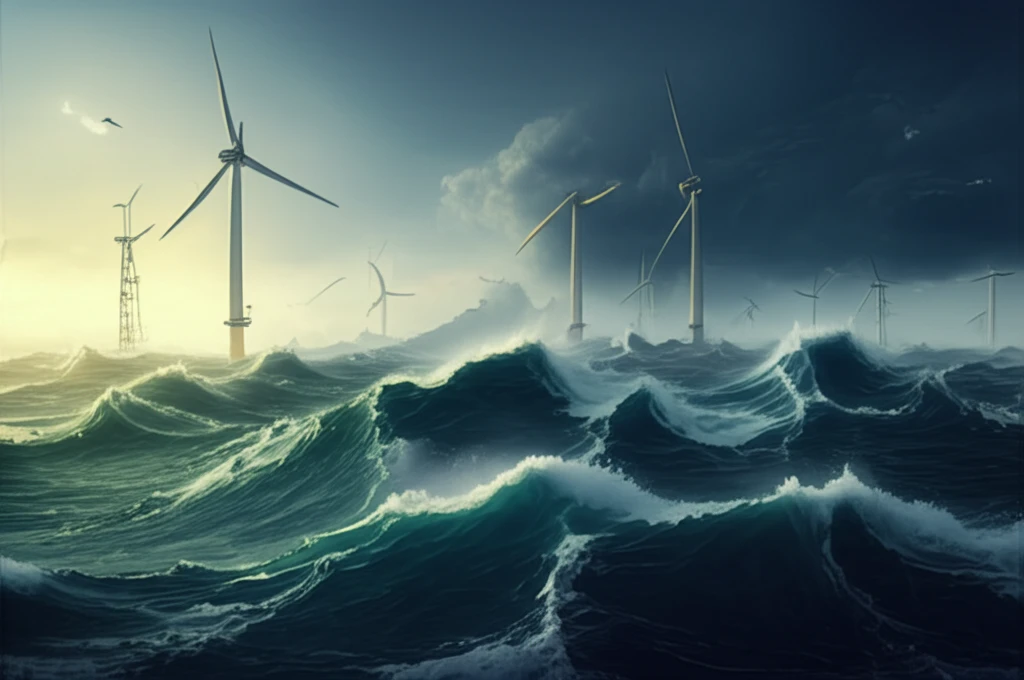
Navigating Extreme Ocean Waves: How Safe Are Offshore Wind Farms?

"A deep dive into the science of predicting rogue waves and their impact on the future of renewable energy infrastructure."
The quest for renewable energy sources has led to increased interest in offshore wind turbine installations. Unlike land-based wind farms, these structures require relatively shallow waters to be economically feasible. The Doggerbank area in the southern North Sea is a prime location, but it presents unique challenges. Water depth varies significantly, from approximately 60 meters in the north to just 20 meters in the south, posing complex engineering problems.
Designing these bottom-fixed wind turbines demands a thorough understanding of environmental forces, especially extreme wave conditions. Predicting these conditions is crucial, but it comes with inherent uncertainties. While wave kinematics and structural loads are important, the ability to forecast the most powerful waves remains paramount for ensuring the safety and longevity of these renewable energy giants.
Reliable metocean data—meteorological and oceanographic information—is essential for accurate predictions. For the North Sea, the Norwegian Meteorological Institute's NORA10 hindcast model provides valuable data. While NORA10 is accurate for deeper waters, its effectiveness in reflecting changing wave conditions in shallower waters (less than 70 meters) is less certain. The model's spatial resolution of 10 km may not fully capture the complexities of wave behavior as water depths decrease.
The Growing Offshore Energy Landscape
Offshore activities encompass operations located away from the shoreline, spanning industries from hydrocarbons to renewable energy. Offshore Magazine reports that the offshore sector now serves oil, gas, and renewable energy industries globally, reflecting a broad and evolving industrial base. Among renewable energy developments, offshore wind farms have emerged as a significant component of the energy transition, situated in marine environments where they face the full force of ocean conditions. Understanding the scale and scope of these operations is essential when evaluating how extreme wave events may affect infrastructure and personnel safety.
Engineering for Extreme Marine Environments
Offshore wind turbines are generally designed using established marine engineering principles that account for wave loading, wind forces, and structural fatigue over decades-long lifespans. Design standards typically incorporate historical wave data and statistical return-period analyses to estimate the maximum conditions a structure may face. However, these standard approaches may have limitations when confronting unprecedented or rapidly changing ocean conditions driven by shifting climate patterns. The gap between design assumptions and real-world extremes remains an area of ongoing concern for the safety and resilience of offshore installations.
Origins of Offshore Development
The term 'offshore' describes activities conducted at a distance from the shore or seaward of the coastline, a concept rooted in centuries of maritime endeavor. Early offshore operations were dominated by resource extraction, with hydrocarbon exploration pushing the boundaries of what was technically feasible in deep water. Over time, the expertise gained from offshore oil and gas construction laid critical groundwork for adapting similar engineering approaches to renewable energy installations. The transition from extractive to sustainable offshore activities represents a significant milestone in humanity's relationship with the ocean environment.
The Science of Extreme Wave Prediction: Unpacking the Models
To address these uncertainties, scientists are comparing NORA10 data with results from SWAN (Simulating Waves Nearshore), a widely used shallow-water hindcast model. SWAN is designed to simulate wave generation, propagation, and dissipation in coastal regions, accounting for factors like wave shoaling and breaking. By comparing the two models, researchers hope to refine their understanding of wave behavior in the variable water depths of the Doggerbank area.
- NORA10: A high-resolution hindcast model providing metocean data from 1957 to present. Known for good agreement with measured data in deep and moderate water depths.
- SWAN (Simulating Waves Nearshore): A shallow-water hindcast model designed to simulate wave processes in coastal areas. Accounts for wave generation, propagation, and dissipation.
- Environmental Contour Concept: A method used to determine extreme sea conditions by analyzing joint probability density functions of significant wave height and peak period.
Evolving Understanding of Wave-Structure Interaction
Research into how extreme ocean waves interact with offshore structures continues to advance, drawing on computational modeling and field measurements from operational wind farms. Studies in this domain generally focus on wave slamming forces, fatigue accumulation, and the performance of turbine foundations under severe sea states. As offshore wind deployments expand into deeper waters and more exposed locations, the demand for refined predictive models is likely to grow. The field remains dynamic, with new findings periodically revising earlier assumptions about structural safety margins.
Challenges and Critiques in Offshore Wind Safety
Some critics argue that the rapid expansion of offshore wind farms may outpace the thoroughness of safety assessments, particularly in regions with limited historical wave data. Structural failures, while relatively rare, have occurred in offshore environments and serve as reminders that extreme events can exceed design expectations. Concerns have also been raised about the adequacy of emergency response protocols for personnel working on turbines during severe storms. These counterarguments highlight the tension between the urgency of energy transition goals and the need for rigorous, evidence-based safety standards.
Offshore Wind Versus Other Marine Industries
The offshore wind industry can draw meaningful comparisons with the oil and gas sector, which has decades of experience managing structural integrity in harsh marine conditions. Offshore hydrocarbon operations have historically faced similar challenges with wave-induced loading and extreme weather exposure, offering a body of lessons learned. However, offshore wind turbines present unique engineering profiles—tall, slender structures with rotating blades—that differ substantially from the more compact platforms typical of oil and gas. These differences mean that direct transfer of safety practices requires careful adaptation rather than simple replication.
Future Directions: Ensuring the Safety of Offshore Wind Farms
Ultimately, this research contributes to safer and more reliable designs for offshore wind turbines. By understanding how extreme wave conditions evolve in shallow water environments, engineers can better protect these structures from potential damage. Further studies, including in-situ measurements and refined modeling techniques, are essential to reduce uncertainties and ensure the long-term viability of offshore wind energy as a key component of our renewable energy future.
Weighing Safety Against Ambition
The safety of offshore wind farms in extreme ocean conditions depends on a complex interplay of engineering design, operational procedures, and the inherent unpredictability of the marine environment. While the broader offshore industry has accumulated considerable expertise in managing ocean-related risks, the specific challenges posed by wind turbine structures in severe wave conditions continue to demand attention. Expert perspectives generally emphasize that no single approach guarantees absolute safety, and a layered defense strategy—combining robust design, monitoring, and emergency preparedness—is considered best practice. The consensus appears to be that offshore wind farms can operate safely, but only with sustained investment in research, monitoring, and adaptive management.
Charting the Path Forward for Offshore Resilience
As offshore wind deployment accelerates worldwide, future efforts will likely focus on improving real-time monitoring of structural health and ocean conditions around turbine sites. Advances in sensor technology, satellite observation, and data analytics may enhance the ability to predict and respond to extreme wave events before they cause damage. The industry may also need to grapple with the implications of climate change on wave climate, which could alter the frequency and intensity of storms in key deployment regions. These emerging frontiers will shape whether the next generation of offshore wind farms can maintain and improve upon current safety records.
Navigating Systemic Risks in the Marine Energy Transition
Offshore wind farms do not exist in isolation; they are part of a broader energy system facing interconnected risks and challenges. Supply chain constraints, regulatory variability across jurisdictions, and the financial pressures of large-scale infrastructure projects can all influence the degree to which safety investments are prioritized. The systemic nature of these challenges means that addressing wave-related safety concerns requires coordination across engineering, policy, and economic domains. Ultimately, the resilience of offshore wind infrastructure will depend not only on technical solutions but also on the institutional frameworks that govern its development and operation.
People on the Front Lines of Offshore Energy
Behind the engineering and statistics are the workers who maintain, repair, and operate offshore wind turbines in some of the most challenging environments on Earth. The safety of these individuals during extreme weather events is a paramount concern, as evacuation and rescue operations at sea carry inherent risks. Offshore Magazine highlights that the human dimension of offshore operations remains central to industry discourse, underscoring that technological advances must translate into tangible protection for personnel. Real-world impact ultimately is measured not just in energy output or structural integrity, but in the wellbeing of the people who make these installations function.