
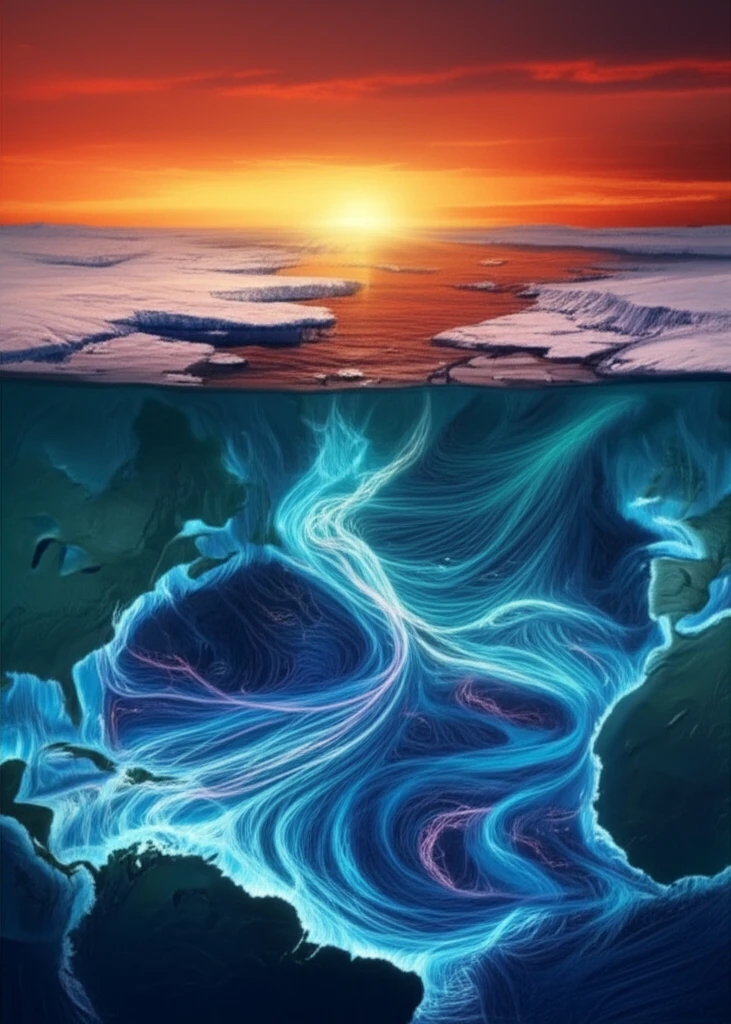
Navigating Climate Change: Unveiling the Secrets of Deep Ocean Currents and Their Impact

"A deep dive into how North Atlantic deep water formation and AMOC are represented in CMIP5 models, revealing critical insights for more accurate climate predictions."
Global climate models are essential for understanding and predicting climate change, yet they often struggle with biases that affect their accuracy. One key area of concern is the representation of deep water formation, a process vital for ocean circulation, carbon and heat uptake, and ultimately, sea level rise.
Deep water formation occurs in regions like Antarctica and the North Atlantic, playing a crucial role in ocean ventilation and the global ocean circulation. In the North Atlantic, this process is closely linked to the Atlantic Meridional Overturning Circulation (AMOC), which transports heat towards the Arctic. This heat influences sea ice melt and the stability of Greenland's glaciers, making the North Atlantic a critical area for evaluating the performance of climate models.
This article explores a detailed comparison of deep water formation in 23 state-of-the-art global climate models from the Climate Model Intercomparison Project phase 5 (CMIP5). By assessing the biases in their representation of deep convection, examining the causes, and estimating the consequences for AMOC and Arctic heat export, we aim to highlight the strengths and weaknesses of current-generation climate models. Understanding these dynamics is essential for realistically forecasting Arctic oceanic warming and its far-reaching impacts.
Deep Convection in Climate Models: Are They Getting It Right?
The study reveals that most climate models struggle to accurately simulate deep convection, a process where surface water sinks due to increased density. Most models tend to simulate convection that is too deep, over too large an area, too frequent, and too far south. This skewed representation highlights the challenges in capturing the complex dynamics of real-world deep water formation.
- Overestimated Convection: Most models simulate deep convection that extends too far, both in depth and geographical area, compared to observational data.
- Inaccurate Location: Many models misplace the location of deep convection, particularly in the subpolar gyre, where convection often occurs too far south.
- Frequency Issues: Models tend to simulate deep convection every year, unlike the real ocean, where it occurs intermittently.
Why Understanding Model Biases Matters for the Future
Ultimately, understanding the dynamical drivers of deep convection and AMOC in climate models is essential for accurately forecasting Arctic oceanic warming. By addressing the biases and limitations in current models, scientists can improve the reliability of climate projections and better prepare for the far-reaching consequences of Arctic change on global ocean circulation, the cryosphere, and marine life. Further model intercomparison efforts and dedicated studies are needed to refine these representations and enhance our predictive capabilities.