
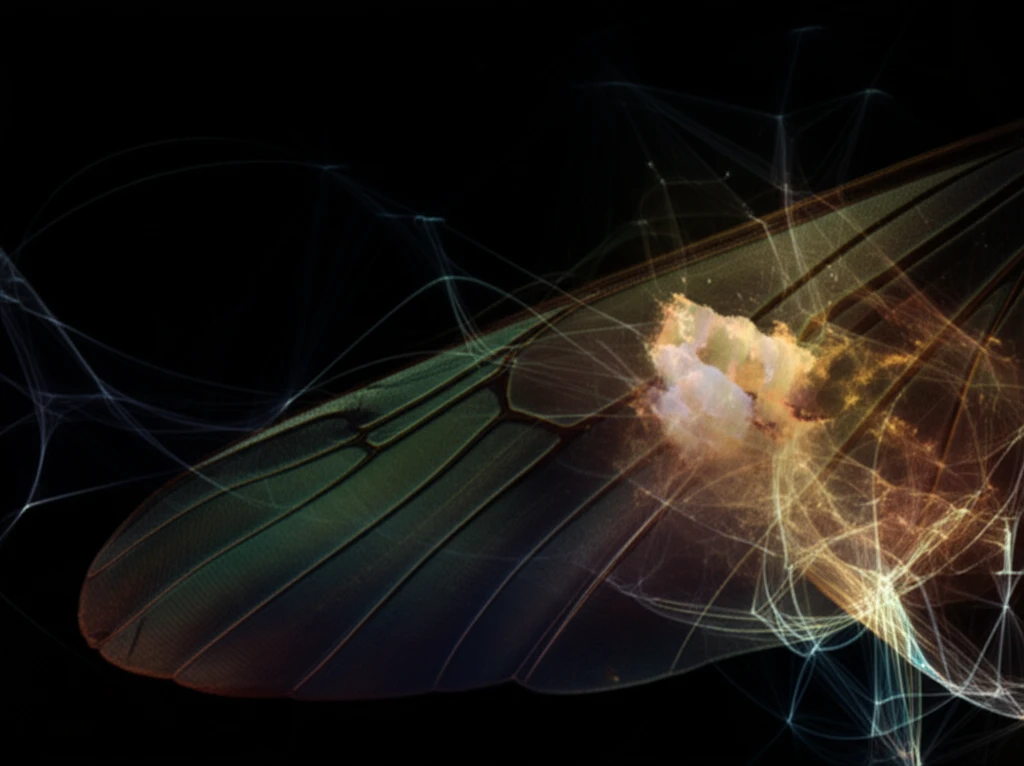
Neural-inspired sensor concept combining insect wing and neural network imagery.

Nature's AI: How Insect Brains Are Inspiring the Next Generation of Smart Sensors

"Unlocking the secrets of insect flight control to revolutionize sensor technology and data processing."


In an era defined by an explosion of data, we often find ourselves overwhelmed by the sheer volume of information. The challenge lies not just in gathering data, but in identifying the crucial signals amidst a sea of noise. Nature, however, has already solved this problem. Flying insects, for instance, possess an uncanny ability to navigate complex environments using a surprisingly small number of sensors. Their secret? Highly efficient, neural-inspired data processing.

New research is uncovering the ingenious strategies insects use to sense their surroundings. By studying how insects like moths and flies process sensory information, scientists are developing innovative sensors that mimic these biological systems. These sensors promise to be far more efficient and robust than traditional designs, opening up new possibilities for a wide range of applications.

This article explores how these neural-inspired sensors work, what makes them so effective, and what potential they hold for the future of technology. We'll delve into the specific example of insect flight control, examining how a few strategically placed sensors can enable remarkable feats of agility and stability.

Decoding the Insect Brain: Lessons in Efficiency

Neural-inspired sensor concept combining insect wing and neural network imagery.

Insects face a unique set of challenges when it comes to sensing their environment. They need to react quickly to changes in airflow, maintain balance, and avoid obstacles, all while operating with limited brainpower. To accomplish this, they've evolved highly specialized sensory systems that prioritize relevant information and filter out noise.

One key adaptation is the use of mechanosensors, which detect mechanical forces and vibrations. These sensors are often located on the wings or other body parts, allowing insects to feel their way through the air. However, these sensors don't just passively report data; they actively process it. Researchers have found that insect mechanosensors perform a kind of built-in temporal filtering, responding selectively to specific patterns of motion over time.

  • Temporal Filtering: Insect sensors respond to changes in forces over time, rather than just instantaneous measurements.
  • Sparse Sensing: Insects use a small number of strategically placed sensors to gather the most important information.
  • Neural Encoding: Sensory information is encoded in a way that is optimized for efficient processing by the nervous system.
This combination of temporal filtering, sparse sensing, and neural encoding allows insects to achieve remarkable feats of sensory processing with minimal resources. It's this efficiency that has inspired scientists to develop new types of neural-inspired sensors.

The Future of Sensing: Bio-Inspired Technologies for a Data-Rich World

As we grapple with the challenges of processing ever-increasing amounts of data, the lessons learned from insect brains offer a promising path forward. By mimicking the efficient sensing and processing strategies of insects, we can develop new technologies that are more robust, energy-efficient, and adaptable. From robotics to environmental monitoring, neural-inspired sensors have the potential to revolutionize a wide range of fields, paving the way for a future where technology works in harmony with nature's ingenuity.

About this Article -

This article was crafted using a human-AI hybrid and collaborative approach. AI assisted our team with initial drafting, research insights, identifying key questions, and image generation. Our human editors guided topic selection, defined the angle, structured the content, ensured factual accuracy and relevance, refined the tone, and conducted thorough editing to deliver helpful, high-quality information.See our About page for more information.

Everything You Need To Know

1

What are neural-inspired sensors, and how are they inspired by insects?

Neural-inspired sensors are a new type of sensor technology that draws inspiration from the way insects process sensory information. Instead of simply gathering data, these sensors mimic the efficient and robust data processing techniques found in insect brains. This involves strategies like temporal filtering, sparse sensing, and neural encoding to prioritize relevant information and filter out noise, allowing for more effective and energy-efficient data processing.

2

Why is temporal filtering important for insect sensory processing, and how can it be applied to new sensor technologies?

Temporal filtering is crucial because it allows insect sensors to respond to changes in forces over time rather than just instantaneous measurements. This is important because insects operate in dynamic environments where conditions are constantly changing. By focusing on temporal patterns, insects can filter out irrelevant noise and prioritize the most important information for navigation, balance, and obstacle avoidance. This same principle can be applied to new sensor technologies to make them more robust and adaptable to real-world conditions.

3

What is sparse sensing, and what are its implications for the development of new sensor systems?

Sparse sensing refers to the strategy of using a small number of strategically placed sensors to gather the most essential information. This is significant because it allows insects to efficiently process sensory data with minimal resources, given their limited brainpower. By carefully selecting sensor locations and prioritizing relevant information, insects can achieve remarkable feats of agility and stability. The implications of sparse sensing for technology include the development of more energy-efficient and cost-effective sensor systems for applications such as robotics and environmental monitoring. Further research into sensor placement is needed.

4

What is neural encoding, and how does it contribute to efficient sensory processing?

Neural encoding refers to how sensory information is translated and optimized for processing by the nervous system. This is important because it determines how efficiently sensory data can be interpreted and acted upon. By studying how insects encode sensory information, scientists can develop new algorithms and hardware architectures that mimic these biological systems. This could lead to more efficient and powerful AI systems that are capable of processing complex data in real-time. Future research may explore new algorithms that allow for faster and better data processing.

5

Why is insect flight control relevant to the development of new sensor technologies?

Insect flight control serves as a model for sensor technology because it demonstrates how a few strategically placed sensors can enable remarkable feats of agility and stability. Insects use mechanosensors on their wings and bodies to detect changes in airflow and maintain balance. By studying how these sensors are arranged and how the information they gather is processed, scientists can develop new sensor systems that mimic these biological systems. This could lead to more robust and adaptable control systems for robots, drones, and other autonomous vehicles. Research is ongoing in creating sensors that replicate insect capabilities.

Newsletter Subscribe

Subscribe to get the latest articles and insights directly in your inbox.