
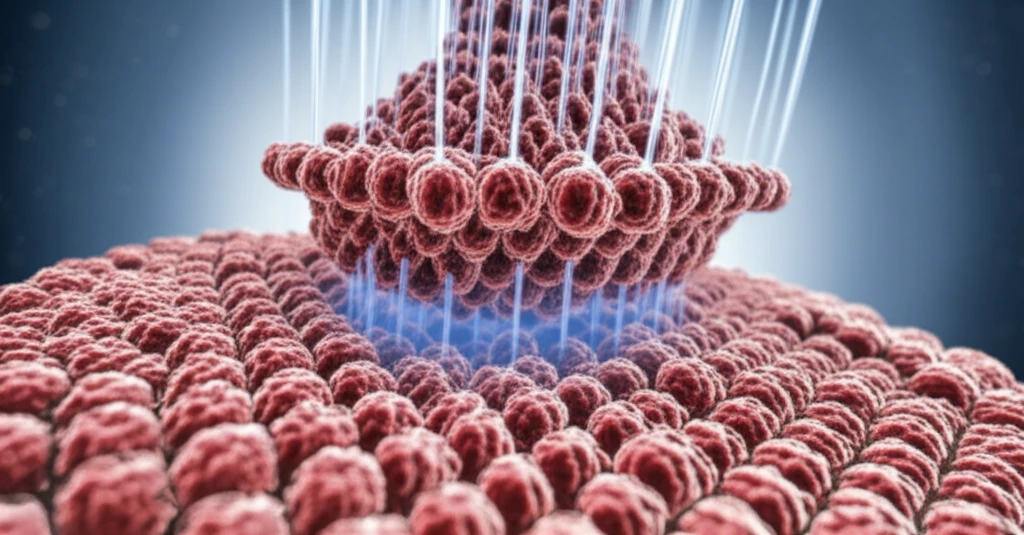
Aggregated mesoporous nanoparticles enhancing light capture in a dye-sensitized solar cell.

Nano-Sized Solar Boost: How Tiny Particles Are Making Solar Cells More Powerful

"Discover the innovative use of aggregated mesoporous nanoparticles in dye-sensitized solar cells, enhancing light scattering and boosting energy conversion efficiency."


Since their emergence in 1991, dye-sensitized solar cells (DSCs) have garnered considerable attention as a promising alternative to traditional silicon-based solar cells. DSCs offer the potential for lower manufacturing costs and simpler production processes, making them an attractive option for renewable energy generation.

A typical DSC comprises several key components, including a sensitizer that absorbs light, a wide band gap metal oxide that transports electrons, a redox mediator that facilitates charge transfer, and a catalytic counter electrode. Among these components, titanium oxide (TiO2) nanoparticles have emerged as a particularly promising material for the photoanode, owing to their excellent optoelectronic properties.

Researchers are exploring ways to enhance the performance of DSCs by modifying the photoanode nanostructure. Effective photoanodes require a large surface area for dye loading, interconnected pores for electrolyte diffusion, efficient electron transfer, and minimal defects to reduce charge recombination energy losses. Balancing these factors is crucial for optimizing DSC efficiency.

The Magic of Mesoporous Nanoparticles: Enhancing Light and Efficiency

Aggregated mesoporous nanoparticles enhancing light capture in a dye-sensitized solar cell.

A promising strategy to boost light harvesting efficiency involves employing light scattering effects to increase the path length of light within the TiO2 film. According to Mie theory, the size of the scattering particles plays a pivotal role in determining the wavelengths of light that are scattered effectively. To leverage this, a bi-layer photoanode structure is often used, featuring a transparent underlayer of small particles and a top layer of larger scattering particles.

Researchers have been working towards hierarchical TiO2 structures, with large dimensions consisting of nanoparticles. These approaches involve synthesizing hierarchically aggregated TiO2 nanoparticles. A new solvothermal approach was used, we are using titanium isopropoxide (TTIP) as a precursor in a solvent mixture containing acetic acid (AA) and ethanol (EtOH).

To synthesize the materials, the team:
  • Used a one-step solvothermal process, simplifying production.
  • Produced TiO2 nanoparticles of approximately 700 nm and 300 nm in diameter.
  • Achieved high surface areas of 138 m² g⁻¹ and 106 m² g⁻¹, enhancing dye loading.
The performance of these materials in DSCs was evaluated against a commercial light scattering layer (WER2-O). The results showed enhanced performance, attributed to the high surface area and efficient electrolyte penetration facilitated by the interconnected mesoporous structure.

Toward a Brighter, More Efficient Future

The use of aggregated TiO2 structures as scattering layers has demonstrated high power conversion efficiency. Sub-micro size hierarchical mesoporous spheres (TiO2-700), comprised of 8.5 nm TiO2 nanoparticles, can provide combined effects of higher dye loading, efficient electrolyte diffusion through highly connected mesoporous structures, and good light-scattering properties. This approach represents a significant step forward in enhancing the performance and accessibility of solar cell technology.

About this Article -

This article was crafted using a human-AI hybrid and collaborative approach. AI assisted our team with initial drafting, research insights, identifying key questions, and image generation. Our human editors guided topic selection, defined the angle, structured the content, ensured factual accuracy and relevance, refined the tone, and conducted thorough editing to deliver helpful, high-quality information.See our About page for more information.

Everything You Need To Know

1

What are dye-sensitized solar cells, and why are they getting so much attention?

Dye-sensitized solar cells, or DSCs, are a type of solar cell that are emerging as a potential substitute for traditional silicon-based solar cells. DSCs hold promise because they could reduce manufacturing costs and simplify the overall production when creating solar cells. While silicon-based solar cells are more established, DSCs offer a pathway to more accessible renewable energy due to the potential for cost-effective production.

2

What are the key parts inside a typical dye-sensitized solar cell?

The main components of a typical dye-sensitized solar cell include a sensitizer that absorbs light, a wide band gap metal oxide that transports electrons, a redox mediator that facilitates charge transfer and a catalytic counter electrode. Among these, titanium oxide (TiO2) nanoparticles are often used for the photoanode due to their excellent optoelectronic properties. The performance of the solar cell relies on each of these parts working efficiently together.

3

How do aggregated mesoporous nanoparticles help improve how well solar cells collect light?

Aggregated mesoporous nanoparticles enhance light harvesting efficiency by increasing the path length of light within the titanium oxide film. This is achieved through light scattering effects. The size of these scattering particles, as described by Mie theory, is critical in determining the wavelengths of light that are effectively scattered. These structures enable higher dye loading, efficient electrolyte diffusion and good light-scattering properties.

4

How did the researchers create the titanium oxide nanoparticles?

Researchers synthesized titanium oxide nanoparticles using a solvothermal process using titanium isopropoxide as a precursor in a solvent mixture containing acetic acid and ethanol. This one-step process produced TiO2 nanoparticles of approximately 700 nm and 300 nm in diameter, achieving high surface areas, which enhances dye loading. The interconnected mesoporous structure facilitated efficient electrolyte penetration.

5

How does using aggregated titanium oxide structures help boost power conversion efficiency?

Using aggregated titanium oxide structures as scattering layers enhances power conversion efficiency in dye-sensitized solar cells. Sub-micro size hierarchical mesoporous spheres, made of titanium oxide nanoparticles, combine higher dye loading, efficient electrolyte diffusion through highly connected mesoporous structures, and good light-scattering properties. These combined effects lead to better solar cell performance.

Newsletter Subscribe

Subscribe to get the latest articles and insights directly in your inbox.