
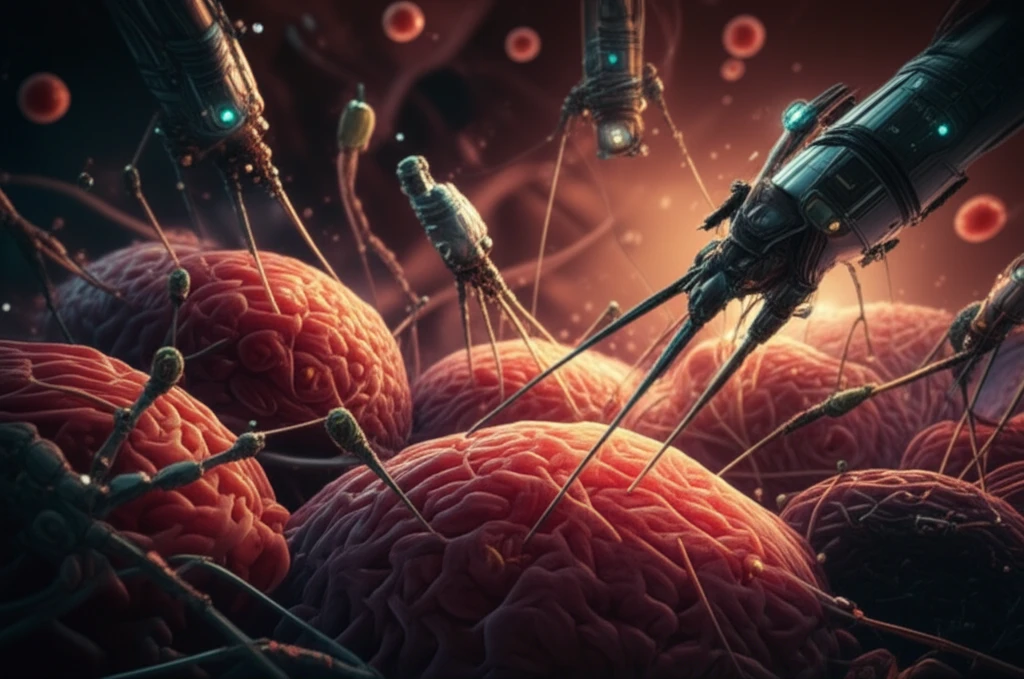
Nano-Revolution: How Tiny Tech Could Transform Your Life

"Exploring the vast potential and applications of nanotechnology across medicine, energy, and everyday life."
In today's rapidly advancing world, technology is not just evolving—it's shrinking. Nanotechnology, the science of manipulating matter at the atomic and molecular level, is emerging as a transformative force with the potential to reshape our lives and industries. This isn't science fiction; it's a rapidly developing field with real-world applications already making an impact.
The term "nanotechnology" was coined in 1971 by Professor Norio Taniguchi at the University of Tokyo, marking the formal inception of a field that has since captured the imagination of scientists, engineers, and entrepreneurs alike. A nanometer is one billionth of a meter, a scale so small that it allows us to engineer materials and devices with unprecedented precision and functionality.
From revolutionizing medicine to creating more sustainable energy solutions, nanotechnology promises to address some of the world's most pressing challenges. This article delves into the exciting world of nanotechnology, exploring its potential applications, benefits, and the future it could unlock.
Current Statistics & Impact
Nanotechnology has become increasingly integrated into daily life and medical applications over recent years. The field of nanomedicine applies nanomaterials to detect, prevent, diagnose, and cure diseases through a multidisciplinary approach combining nanoscience, nanoengineering, and biological sciences. An increasing number of nano-based products and applications have become commercially available across multiple sectors.
Standard Approach, Accepted Methods & Their Limitations
Nanomedicine leverages nanomaterials for targeted drug delivery, improved imaging, and regenerative medicine, transforming contemporary diagnostics and therapeutics. However, safety and regulatory issues for nanomedicines require additional considerations compared to conventional medicines, creating challenges during development and commercialization. The field faces a double-edged dynamic where exceptional advances in individualized treatment approaches coexist with potential risks that demand judicious assessment.
Historical Perspective, Milestones, Foundational Discoveries
The development of nanotechnology's central concepts occurred over a longer period than its recent emergence in scientific research, with the field's modern emergence in the 1980s driven by convergence of experimental advances. Nanomedicine represents the interdisciplinary convergence of nanotechnology with medicine, chemistry, physics, biology, pharmaceuticals, toxicology, computation, industry, regulation, and ethics. Key milestones span from pre-modern nanoscience foundations through modern timeline discoveries in nanomaterials and nanoparticles.
What Can Nanotechnology Do For You?
Nanotechnology is not just a scientific curiosity; it's a practical toolkit with applications spanning numerous sectors. Its ability to manipulate matter at the nanoscale allows for the creation of materials and devices with enhanced properties, leading to breakthroughs in various fields.
- Medicine: Nanotechnology is revolutionizing drug delivery by enabling targeted treatments that minimize side effects. Nanoparticles can be engineered to deliver drugs directly to cancer cells, reducing damage to healthy tissue. It also improves medical diagnostics through highly sensitive nanosensors that can detect diseases at an early stage.
- Energy: Nanotechnology offers solutions for more efficient energy production and storage. Nanomaterials are being used to develop high-performance batteries, solar cells, and fuel cells, making renewable energy sources more viable and sustainable.
- Environment: Nanotechnology plays a crucial role in environmental remediation. Nanoparticles can be used to clean up pollutants in water and air, offering innovative solutions for environmental challenges.
- Materials Science: Nanotechnology enhances the strength, durability, and functionality of materials. Nanocomposites are used in various applications, from lightweight automotive parts to scratch-resistant coatings, improving product performance and longevity.
- Electronics: Nanotechnology drives advancements in electronics by enabling the creation of smaller, faster, and more energy-efficient devices. Nanotransistors and nanowires are key components in next-generation electronic devices.
Latest Research and Reviews
Recent reviews highlight nanotechnology as a revolutionary force in biomedical science, offering innovative solutions for diagnostics, drug delivery, tissue engineering, and disease therapeutics. The enhanced permeability and retention (EPR) effect has facilitated major advancements in targeted drug delivery and individualized therapy. Therapeutic cancer vaccines represent a particularly active area where nanotechnology plays a supporting role in recent progress. Numerous nanomedicines have been developed leveraging these principles.
Counter Arguments and Failures
Despite significant progress since its conception in the 1990s, nanomedicine faces persistent challenges in translating historic nanoscience insights into practical clinical applications. The field ranges from medical applications of nanomaterials and biological devices to nanoelectronic biosensors, yet commercialization hurdles remain substantial. Comprehensive reviews note that while potential applications are vast, the gap between laboratory promise and real-world implementation continues to present obstacles.
Comparative Analysis
Comparative assessments of nanotechnology against conventional approaches reveal both distinctive advantages and persistent limitations across medical applications. While nano-enabled tools offer precision at the biological scale, traditional methods often maintain advantages in regulatory familiarity, manufacturing scalability, and cost-effectiveness. The trade-offs between innovation and practicality continue to shape adoption patterns in clinical settings.
The Future is Nano
Nanotechnology is more than just a buzzword; it's a rapidly evolving field with the potential to reshape our world. As research continues and new applications emerge, nanotechnology promises to drive innovation, improve lives, and address some of humanity's most pressing challenges. From medicine to energy to environmental sustainability, the future is undoubtedly nano.
Synthesis & Expert Commentary
Expert commentary in the field emphasizes both preclinical and clinical research progress alongside persistent roadblocks in translating diverse nanotechnologies into human medicine. Peer-reviewed synthesis highlights the interdisciplinary nature of advances while noting that regulatory, safety, and manufacturing challenges require coordinated solutions. The field's evolution reflects ongoing dialogue between innovation potential and practical implementation constraints.
Future Outlook & Next Frontiers
Emerging research directions suggest continued expansion of nanotechnology into novel therapeutic modalities and diagnostic paradigms. Next-generation applications may leverage advances in molecular nanotechnology and biological machines, though timelines for clinical translation remain uncertain. Interdisciplinary collaboration across computation, materials science, and clinical medicine will likely drive the next wave of breakthroughs.
Broader Context & Systemic Challenges
Systemic challenges including regulatory harmonization, manufacturing standardization, and long-term safety assessment frameworks remain critical for the field's maturation. Economic considerations around cost-effectiveness and healthcare access equity intersect with technical hurdles in scaling nano-enabled solutions. Addressing these broader contextual factors will be essential for realizing nanotechnology's transformative potential across global health systems.
The Human Element & Real-World Impact
Nanomedicine draws on the natural scale of biological phenomena to produce precise solutions for disease prevention, diagnosis, and treatment, already broadening medical tools available to clinicians. Portable nanodiagnostic kits are enabling rural clinics to test for diseases without expensive lab infrastructure, improving access to care in underserved regions globally. Real-world applications span cancer treatment, MRI imaging, and tissue engineering, demonstrating tangible benefits for patient outcomes across diverse healthcare settings.