
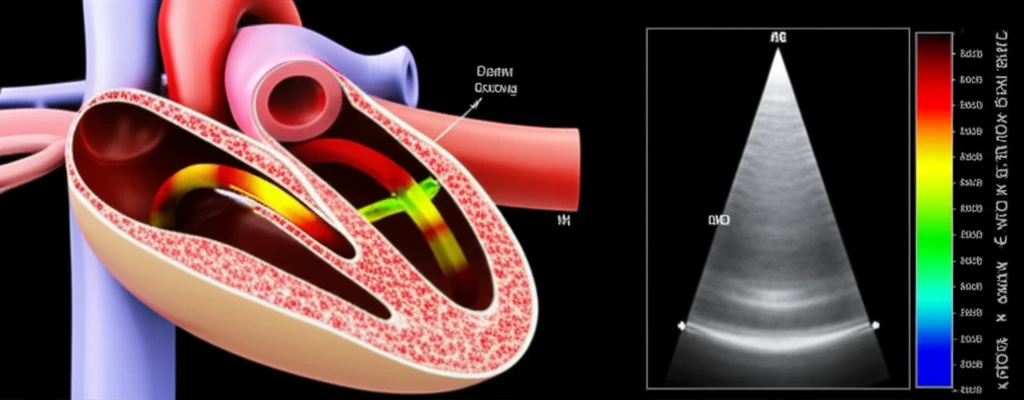
Illustration of myocardial bridging with cFFR overlay.

Myocardial Bridging: Can a New Heart Scan Predict Your Risk?

"CCTA-derived FFR offers a non-invasive way to assess the severity of myocardial bridging and its link to angina, paving the way for better diagnoses and personalized treatment."


Myocardial bridging (MB), where a segment of a coronary artery travels through the heart muscle instead of lying on its surface, is often considered a harmless quirk of anatomy. However, for some, it can lead to chest pain (angina) and other concerning symptoms. Determining who is at risk and how best to manage their condition has been a challenge for cardiologists.

Traditional methods like standard CT scans can visualize the bridge itself, but struggle to assess how much it's impacting blood flow to the heart. This is where a new approach using CCTA (coronary computed tomography angiography)-derived fractional flow reserve (cFFR) comes in. CCTA is a non-invasive heart scan that uses CT technology to create detailed 3D images of the coronary arteries, and can help determine which patients may benefit from further invasive testing.

This article explores how cFFR, calculated from standard CCTA scans, could help doctors better understand the significance of myocardial bridging, predict which patients are likely to experience symptoms like angina, and ultimately guide treatment decisions. We'll break down the research findings, what they mean for you, and why this non-invasive approach could be a game-changer in cardiac care.

CCTA-Derived FFR: A New Way to Assess Myocardial Bridging

Illustration of myocardial bridging with cFFR overlay.

Researchers sought to evaluate whether cFFR, derived from routine CCTA scans, could effectively assess the impact of MB on blood flow and identify factors associated with significant flow abnormalities. The study compared cFFR values in patients with MB to those without, examining relationships between cFFR, anatomical features of the MB, and the presence of chest pain.

The study revealed some key findings:

  • Lower Blood Flow: Patients with MB had lower cFFR values in the bridged segment and in the artery segment beyond the bridge, compared to individuals without MB. This suggests that MB can indeed affect blood flow.
  • Depth Matters: cFFR differences were more pronounced during systole (when the heart muscle contracts) in those with deeper MBs (where the artery is buried further within the heart muscle).
  • Bridge Length and Squeezing: The length of the MB and the degree of artery squeezing (systolic stenosis) were key predictors of abnormal cFFR values. Longer bridges and greater squeezing were linked to more significant flow disturbances.
  • Angina Connection: MB patients with abnormal cFFR values were more likely to experience typical angina symptoms.
These findings suggest that cFFR can provide valuable insights into the functional significance of MB, going beyond simple anatomical descriptions to assess its real-world impact on blood flow. By identifying key anatomical predictors of abnormal cFFR, like bridge length and systolic stenosis, doctors may be able to better risk-stratify patients with MB.

The Future of MB Assessment: Personalization and Prevention

This research indicates that cFFR holds promise as a non-invasive tool to assess the functional significance of myocardial bridging. By identifying patients with MB who are more likely to experience flow disturbances and angina, cFFR could help guide treatment decisions, potentially avoiding unnecessary invasive procedures in those with mild or insignificant bridging.

While these findings are promising, further research is needed to determine the long-term prognostic value of cFFR in MB patients and to compare its accuracy against other diagnostic methods. Studies tracking patients over time, correlating cFFR values with clinical outcomes, will be crucial to validate its role in clinical practice.

The application of cFFR for MB is another step towards personalized medicine, where treatments are tailored to an individual's unique anatomy and physiology. By combining detailed imaging with functional assessment, doctors can move beyond simply identifying the presence of MB to understanding its true impact on each patient's heart health.

About this Article -

This article was crafted using a human-AI hybrid and collaborative approach. AI assisted our team with initial drafting, research insights, identifying key questions, and image generation. Our human editors guided topic selection, defined the angle, structured the content, ensured factual accuracy and relevance, refined the tone, and conducted thorough editing to deliver helpful, high-quality information.See our About page for more information.

This article is based on research published under:

DOI-LINK: 10.1007/s00330-018-5811-6, Alternate LINK

Title: Fractional Flow Reserve Derived From Ccta May Have A Prognostic Role In Myocardial Bridging

Subject: Radiology, Nuclear Medicine and imaging

Journal: European Radiology

Publisher: Springer Science and Business Media LLC

Authors: Fan Zhou, Chun Xiang Tang, U. Joseph Schoepf, Christian Tesche, Maximilian J. Bauer, Brian E. Jacobs, Chang Sheng Zhou, Jing Yan, Meng Jie Lu, Guang Ming Lu, Long Jiang Zhang

Published: 2018-10-30

Everything You Need To Know

1

What is myocardial bridging, and why is it a concern?

Myocardial bridging (MB) is a condition where a coronary artery segment passes through the heart muscle instead of staying on the heart's surface. This anatomical variation is significant because, in some individuals, it can lead to reduced blood flow, especially during the heart's contraction phase (systole). This can cause chest pain, and possibly other symptoms.

2

What is CCTA-derived FFR (cFFR), and why is it important?

CCTA-derived FFR (cFFR) is a non-invasive method using standard CCTA scans to assess the impact of myocardial bridging on blood flow. This is important because traditional methods can visualize the MB, but have difficulty evaluating how it affects blood supply to the heart muscle. By using cFFR, doctors can determine the significance of the MB and assess its real-world impact on blood flow and provide better and more accurate diagnosis. This is a key benefit of this non-invasive tool.

3

What is CCTA, and what role does it play in the assessment of myocardial bridging?

CCTA (coronary computed tomography angiography) is a non-invasive heart scan that uses CT technology. It is a means to create detailed 3D images of the coronary arteries. In the context of myocardial bridging (MB), CCTA can visualize the anatomical structure. It is important to understand the bridge's depth, length and degree of artery squeezing in order to assess the blood flow and identify possible symptoms.

4

Why are the depth, length, and squeezing of the artery significant in the context of myocardial bridging?

The depth and length of the myocardial bridging and the degree of artery squeezing are important because these anatomical features are key predictors of abnormal cFFR values. Deeper and longer bridges, with greater systolic stenosis (squeezing) are linked to more significant flow disturbances. Therefore, by identifying these key anatomical characteristics using CCTA-derived FFR (cFFR), doctors can better stratify patients with MB. This allows them to determine who is at risk and how best to manage their condition, potentially avoiding unnecessary invasive procedures.

5

What is the significance of abnormal cFFR values in patients with myocardial bridging?

The significance of abnormal CCTA-derived FFR (cFFR) values in individuals with myocardial bridging (MB) lies in its association with angina. Patients with MB and abnormal cFFR values were more likely to experience angina symptoms. This is important because it connects the anatomical variation (MB) with a real-world clinical symptom (angina). CFFR is a tool that can help in the diagnosis and the need for potential further invasive testing. It also can help in better treatment decisions.

Newsletter Subscribe

Subscribe to get the latest articles and insights directly in your inbox.