
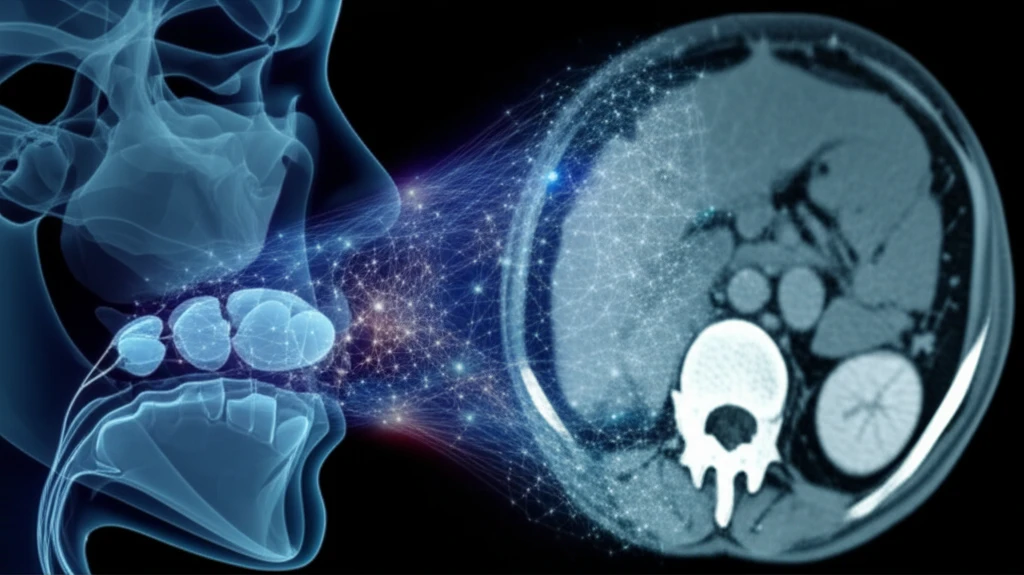
MRI-Only Prostate IMRT: Can AI Deliver Accurate Synthetic CT Images?

"A deep learning U-net model shows promise in generating synthetic CT images from MRI for prostate cancer radiotherapy, potentially streamlining treatment planning and reducing radiation exposure."
Magnetic Resonance Imaging (MRI) has become a cornerstone in radiotherapy, offering superior soft tissue contrast compared to Computed Tomography (CT). This makes MRI ideal for delineating organs. Traditionally, MRI serves as a secondary tool, with images rigidly aligned to simulation CT scans for tumor and organ definition.
However, a fully MRI-guided radiotherapy workflow holds the potential to eliminate image registration uncertainties, reduce radiation exposure, and enhance patient comfort. The key lies in deriving CT-equivalent information, such as electron density distribution, directly from MR images for accurate radiation dose calculation. This data is commonly referred to as pseudo-CT or synthetic-CT (S-CT) images.
Researchers have been exploring various methods to generate S-CT images, including statistical modeling, multi-atlas deformable image registration, random forest-based approaches, and deep learning techniques. This article delves into a recent study investigating the feasibility of training a deep convolutional neural network (ConvNet) from scratch to generate S-CT images from conventional T2-weighted MR images, specifically for prostate cancer treatment planning.
U-Net: A Deep Learning Solution for Synthetic CT Generation
The study, recently published, details the development and evaluation of a U-net based deep learning model for generating synthetic CT images from MRI data in prostate cancer patients. Here’s a breakdown of their approach:
- U-net Architecture: A 2-dimensional U-net, featuring 23 convolutional layers and 25.29 million trainable parameters, was employed. The U-net learns a nonlinear function to map MR image slices to corresponding S-CT slices.
- Evaluation Metrics: The mean absolute error (MAE) of Hounsfield Units (HU) between true CT and S-CT images was used to assess HU estimation accuracy.
- IMRT Planning: Intensity-modulated radiation therapy (IMRT) plans, prescribing a dose of 79.2Gy to the planning target volume (PTV), were created using the true CT images. These plans were then recalculated using the S-CT images.
- Dosimetric Comparison: The dose matrices from the true CT and S-CT-based plans were compared using gamma index analysis and absolute point dose discrepancy measurements.
The Future of MRI-Only Radiotherapy
The study demonstrates the potential of deep learning, specifically the U-net architecture, to generate accurate S-CT images from conventional MR images in seconds. This opens doors for streamlined MRI-only radiotherapy workflows in prostate cancer treatment.
While the U-net model shows promising results, the researchers acknowledge areas for further improvement. These include incorporating more anatomical information into the training data, exploring advanced network architectures like 3D U-nets, and utilizing adversarial training techniques to generate more realistic images.
Despite these limitations, this research represents a significant step toward realizing the full potential of MRI-only radiotherapy, offering a faster, more accurate, and less invasive approach to prostate cancer treatment planning.