
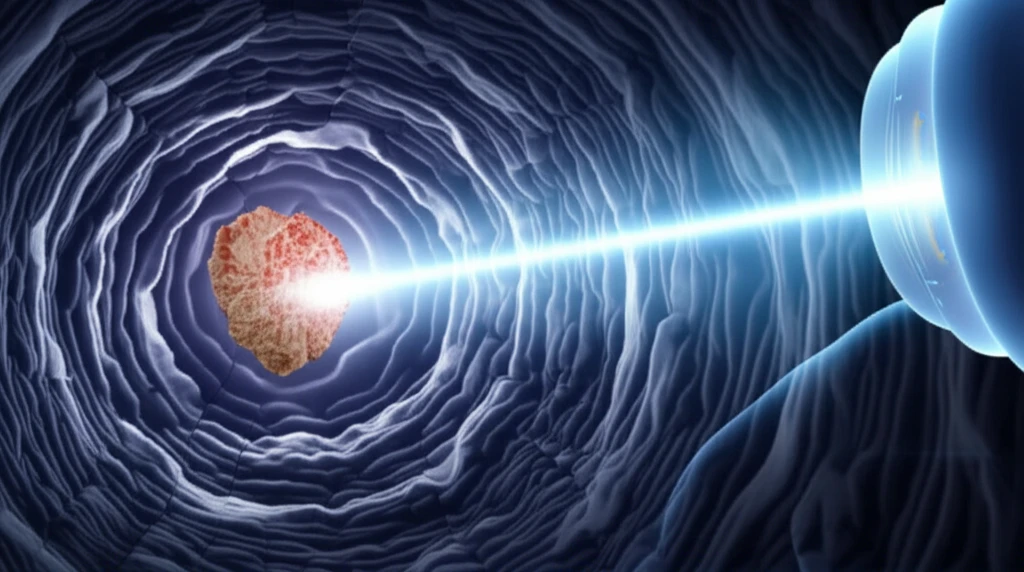
Precise cancer treatment with MRI-guided radiotherapy.

MRI-Guided Radiotherapy: The Future of Precision Cancer Treatment?

"Discover how multi-slice motion modeling enhances real-time target tracking for safer, more effective cancer radiation therapy."


Cancer treatment is constantly evolving, with radiotherapy remaining a cornerstone for many patients. However, traditional radiotherapy faces challenges in accurately targeting tumors due to patient movement. This can lead to damage to surrounding healthy tissue. MRI-guided radiotherapy is transforming the field, offering real-time imaging to track and adjust for motion during treatment.

MRI-guided radiotherapy enhances real-time target tracking during radiotherapy treatments. Multi-slice and volumetric MRI techniques, while powerful, are frame rate limited, which introduces unacceptable latency between the target. Imagine trying to hit a moving target when you can't quite see where it is going – that's the challenge this technology addresses.

Recent research introduces innovative solutions for MRI-guided radiotherapy, focusing on multi-slice motion modeling. These models estimate continuous tissue motion, enhancing target visualization and enabling more precise out-of-slice motion estimation. The goal is to minimize the margin of error, ensuring radiation is delivered exactly where it needs to be.

How Multi-Slice Motion Modeling Works

Precise cancer treatment with MRI-guided radiotherapy.

The technique involves creating motion models from repeated acquisitions of MRI slices. Unlike traditional methods limited by frame rates, multi-slice motion modeling visualizes targets and estimates motion outside the imaging slice. This is crucial for accounting for the tumor movements that can occur during treatment.

A group of researchers conducted a study involving eight healthy volunteers using a 0.35T MRI-guided radiotherapy system. Images were captured at three frames per second across ten adjacent sagittal slice positions, covering 4.5 cm using a balanced steady-state free precession sequence. These studies focused on linear motion models used for MRI-guided radiotherapy gating and external respiratory bellows signals recorded during imaging, estimating motion across all imaged slices.

  • 5D Motion Model: A previously published linear motion model was extended to include multiple slices, using external respiratory bellows signals to estimate motion.
  • Local Linear Embedding (LLE): Used to derive a respiratory surrogate for motion modeling. Manifolds for every slice were aligned during LLE in a group-wise fashion.
  • Modified SGA (mSGA): Enables motion estimation outside the current imaged slice using a motion model.
  • Leave-One-Out Approach: The multi-slice motion model was evaluated in a single slice with each newly acquired image.
The research team evaluated out-of-slice motion estimates and measured model-generated gating decision accuracy. They reported beam-on positive predictive value and the median and 95th percentile distance between model and ground truth target centroids. These metrics quantified how well the models could predict and track motion, ensuring accurate radiation delivery.

The Future is Precision

MRI-guided radiotherapy, enhanced by multi-slice motion modeling, represents a significant leap forward in cancer treatment. By providing real-time imaging and precise motion tracking, this approach minimizes damage to healthy tissue, leading to safer, more effective outcomes for patients. As technology advances, expect MRI-guided radiotherapy to become even more integral in cancer care, revolutionizing how we target and treat tumors.

About this Article -

This article was crafted using a human-AI hybrid and collaborative approach. AI assisted our team with initial drafting, research insights, identifying key questions, and image generation. Our human editors guided topic selection, defined the angle, structured the content, ensured factual accuracy and relevance, refined the tone, and conducted thorough editing to deliver helpful, high-quality information.See our About page for more information.

Everything You Need To Know

1

What is the main advantage of MRI-guided radiotherapy over traditional radiotherapy?

The primary advantage of MRI-guided radiotherapy is its ability to provide real-time imaging, enabling precise tracking and adjustment for patient motion during treatment. This contrasts with traditional radiotherapy, which faces challenges in accurately targeting tumors due to movement, potentially leading to damage to healthy tissue. The MRI guidance minimizes this risk, delivering radiation with greater precision.

2

How does multi-slice motion modeling improve the accuracy of MRI-guided radiotherapy?

Multi-slice motion modeling enhances the precision of MRI-guided radiotherapy by creating motion models from repeated MRI slice acquisitions. These models estimate continuous tissue motion and allow for the visualization of targets and motion estimation even outside the currently imaged slice. This is a significant improvement over traditional methods limited by frame rates. The goal is to minimize the margin of error, ensuring radiation is delivered exactly where it needs to be.

3

Can you explain how 5D Motion Models are utilized within multi-slice motion modeling?

5D Motion Models, previously published, are extended to include multiple slices within the multi-slice motion modeling approach. They leverage external respiratory bellows signals to estimate motion. This is a crucial component, offering insights into the complex movements of the patient's body during treatment. The external respiratory bellows signals provide a means to correlate the patient's breathing cycle with the movement of the tumor, allowing the system to adjust the radiation beam in real-time.

4

What specific techniques were used in the study involving healthy volunteers to evaluate multi-slice motion modeling?

The study utilized several techniques: The first was the 5D Motion Model, extending a previously published linear motion model using external respiratory bellows signals. Secondly, Local Linear Embedding (LLE) was used to derive a respiratory surrogate for motion modeling, aligning manifolds for every slice. Then, Modified SGA (mSGA) enabled motion estimation outside the current imaged slice using a motion model. Finally, the Leave-One-Out Approach evaluated the multi-slice motion model in a single slice with each new image acquisition. These methods were assessed to measure model accuracy.

5

How does MRI-guided radiotherapy, combined with multi-slice motion modeling, affect the future of cancer treatment?

MRI-guided radiotherapy, enhanced by multi-slice motion modeling, signifies a significant advancement in cancer treatment. This approach minimizes damage to healthy tissue by offering real-time imaging and precise motion tracking, leading to safer and more effective outcomes. This technology anticipates a future where radiation therapy is even more precise, personalized, and integral in cancer care, thus transforming how we target and treat tumors. It represents a move toward maximizing therapeutic impact while minimizing side effects, improving patient outcomes.

Newsletter Subscribe

Subscribe to get the latest articles and insights directly in your inbox.