
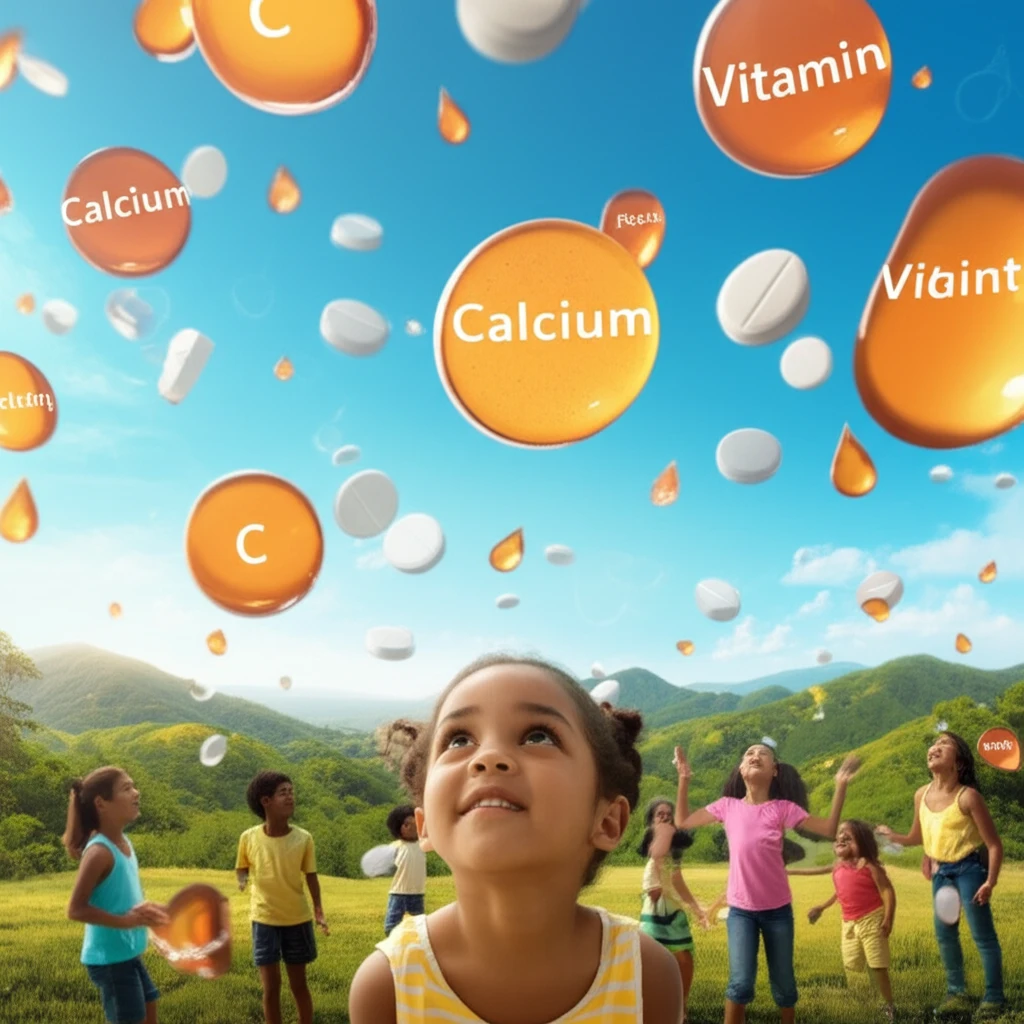
Illustration of a Puerto Rican landscape with children, with floating vitamins and minerals representing the need for micronutrients in kids' diets.

Micronutrient Mystery: Why Kids in Puerto Rico Need a Dietary Boost

"Unpacking the Hidden Nutrient Deficiencies Affecting Young Islanders and How to Help"


Imagine a child's body as a finely tuned engine. To run smoothly, it needs the right fuel and, equally important, the right mix of micronutrients. These tiny but mighty vitamins and minerals are crucial for everything from building strong bones to supporting a healthy immune system. Now, picture this engine sputtering: what happens when it's consistently missing vital components? That's the reality for many children in Puerto Rico, according to a recent study.

The study, published in the International Journal of Vitamin and Nutrition Research, examined the dietary habits of 732 twelve-year-olds in Puerto Rico. The results painted a concerning picture: many children were falling short of the recommended daily intake of several key micronutrients. This lack of essential vitamins and minerals could have a significant impact on their health and development.

This article breaks down the study's findings, exploring which nutrients are lacking, and why. We'll also look at how multivitamin-multimineral supplements (MVMMs) can help. Furthermore, we will discuss how public health measures can improve the nutritional intake of children living in Puerto Rico.

The Micronutrient Deficit: What's Missing in Puerto Rican Children's Diets?

Illustration of a Puerto Rican landscape with children, with floating vitamins and minerals representing the need for micronutrients in kids' diets.

The study revealed that the diets of the 12-year-olds in the sample were deficient in several key nutrients. Specifically, the researchers found that the children's intake of calcium, magnesium, pantothenic acid, and vitamins A, D, E, and K were below the recommended levels. These deficiencies are particularly concerning because these nutrients play critical roles in children's growth and overall health. For instance, calcium and vitamin D are vital for bone health, while vitamins A and E are essential for vision, immune function, and cell protection.

Digging deeper into the findings, the study also looked at differences between genders. Boys, in particular, had higher intakes of several micronutrients compared to girls. These included thiamin, niacin, riboflavin, pyridoxine, pantothenic acid, and folate. The study also found that girls had lower levels of folate compared to what is recommended. This highlights the need for gender-specific nutritional interventions.

  • Calcium: Crucial for strong bones and teeth.
  • Magnesium: Supports muscle and nerve function, as well as regulating blood sugar levels.
  • Vitamin A: Essential for vision, immune function, and cell growth.
  • Vitamin D: Aids calcium absorption, bone health, and immune function.
  • Vitamin E: Acts as an antioxidant, protecting cells from damage.
  • Vitamin K: Important for blood clotting and bone health.
  • Folate: Critical for cell growth and development.
The study underscores a critical need for children in Puerto Rico to enhance their nutritional intake. This is crucial not only for their immediate well-being but also for building a strong foundation for their future health.

A Path Forward: Improving Micronutrient Intake in Puerto Rican Children

This study offers critical insights into the nutritional challenges facing children in Puerto Rico. The good news is that interventions, such as encouraging a balanced diet and education on the proper use of supplements, can make a difference. By addressing these deficiencies, we can pave the way for healthier, more vibrant futures for the children of Puerto Rico.

About this Article -

This article was crafted using a human-AI hybrid and collaborative approach. AI assisted our team with initial drafting, research insights, identifying key questions, and image generation. Our human editors guided topic selection, defined the angle, structured the content, ensured factual accuracy and relevance, refined the tone, and conducted thorough editing to deliver helpful, high-quality information.See our About page for more information.

This article is based on research published under:

DOI-LINK: 10.1024/0300-9831/a000252, Alternate LINK

Title: Micronutrient Intake Among Children In Puerto Rico: Dietary And Multivitamin-Multimineral Supplement Sources

Subject: Nutrition and Dietetics

Journal: International Journal for Vitamin and Nutrition Research

Publisher: Hogrefe Publishing Group

Authors: Andrea Lopez-Cepero, Roxana Torres, Augusto Elias, Milagros C. Rosal, Cristina Palacios

Published: 2015-12-01

Everything You Need To Know

1

What specific micronutrient deficiencies were identified in the diets of children in Puerto Rico, according to the study?

The study revealed that many 12-year-olds in Puerto Rico had diets deficient in calcium, magnesium, pantothenic acid, vitamin A, vitamin D, vitamin E, and vitamin K. These micronutrients are essential for various bodily functions, including bone health, immune function, and cell protection. Addressing these deficiencies is vital for their overall well-being and development. Although the study did not focus on other potential deficiencies like iron or zinc, these are also important to consider in a comprehensive nutritional assessment.

2

Why are calcium and vitamin D specifically important for children's health, as highlighted in the study?

Calcium and vitamin D are crucial for children's bone health. Calcium is a building block for strong bones and teeth, while vitamin D aids in calcium absorption. Without adequate intake of these micronutrients, children may be at risk for impaired bone development, increasing their susceptibility to fractures and bone-related issues later in life. The study also touched on other micronutrients, but these two play a particularly important role in skeletal health during growth. It's also important to consider weight-bearing exercise that can affect bone density.

3

How did the micronutrient intake differ between boys and girls in the study, and why is this significant?

The study found that boys, on average, had higher intakes of several micronutrients, including thiamin, niacin, riboflavin, pyridoxine, pantothenic acid, and folate, compared to girls. Girls had lower levels of folate compared to recommendations. This is significant because it highlights the potential need for gender-specific nutritional interventions to address these disparities. Differences in dietary habits, growth spurts, and physiological needs may contribute to these variations. Further research could explore the reasons behind these gender-based differences.

4

Besides diet and supplements, what other public health measures can be implemented to improve the nutritional intake of children in Puerto Rico?

Beyond diet and supplements, several public health measures can be implemented to improve the nutritional intake of children in Puerto Rico. These include nutrition education programs for children and parents, school-based interventions such as providing access to healthy meals and snacks, fortification of staple foods with essential micronutrients, and policies to promote healthier food choices. Further, community-based agriculture programs can improve access to fresh and nutritious produce. These measures, combined with addressing socioeconomic factors that influence food choices, can contribute to long-term improvements in the nutritional status of children.

5

What are MVMMs and what role do they play in addressing micronutrient deficiencies according to this research?

MVMMs, or multivitamin-multimineral supplements, are dietary supplements containing a combination of various vitamins and minerals. The research suggests that MVMMs can play a role in addressing micronutrient deficiencies by providing a concentrated source of essential nutrients that may be lacking in the diet. While MVMMs can help bridge the gap, they should not be considered a replacement for a balanced and nutritious diet. The long-term effectiveness of MVMMs depends on factors like the specific formulation, individual needs, and adherence to recommended dosages. More broadly, relying solely on MVMMs without addressing underlying dietary patterns is not a sustainable approach.

Newsletter Subscribe

Subscribe to get the latest articles and insights directly in your inbox.