
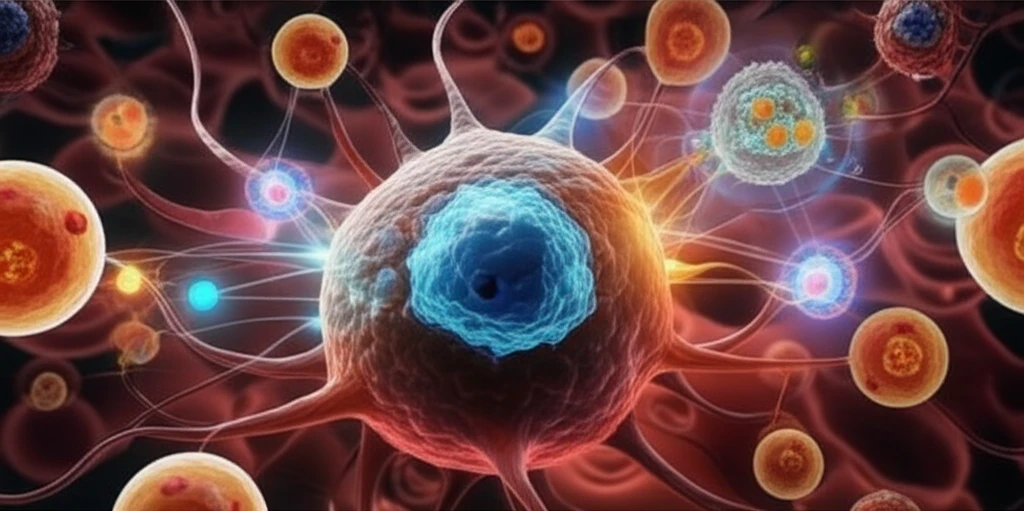
Illustration of melanoma cells interacting with bone marrow adipocytes in the bone marrow microenvironment.

Melanoma's Secret Weapon: How Cancer Cells Recruit Fat Cells to Thrive

"Unveiling the Complex Relationship Between Melanoma, Bone Marrow, and Adipocytes"


Cancer, a formidable adversary, continues to challenge medical science with its relentless ability to adapt and spread. Among the deadliest forms, melanoma, a skin cancer, often metastasizes to the bone, a process that is complex and not fully understood. However, recent research sheds light on a surprising player in this drama: bone marrow adipocytes, or fat cells. These cells, once thought to be merely storage units, are now recognized as active participants in the tumor microenvironment, influencing cancer's behavior in ways we're only beginning to comprehend.

This article delves into the intricate relationship between melanoma cells and bone marrow adipocytes. We'll explore how these cells interact, the signals they exchange, and the impact this interplay has on melanoma's ability to thrive and spread. By understanding these interactions, we can uncover new therapeutic targets to combat this aggressive cancer.

This article is inspired by recent research, including a study published in the Journal of Visualized Experiments, that provides a detailed protocol for studying these interactions. We aim to translate complex scientific findings into an accessible and engaging narrative, highlighting the significance of this research for both scientific understanding and the potential development of new treatments.

The Hidden Role of Adipocytes in Bone Marrow

Illustration of melanoma cells interacting with bone marrow adipocytes in the bone marrow microenvironment.

Bone marrow, the soft tissue inside bones, is a complex ecosystem where blood cells are produced. Within this environment, adipocytes, or fat cells, play a crucial role. Beyond energy storage, they support the growth and spread of tumors. These adipocytes can influence cancer cell behavior by secreting various factors and impacting the local environment.

Melanoma cells, known for their aggressive nature, often seek out the bone marrow, making bone metastasis a common and devastating outcome. The presence of adipocytes in the bone marrow creates a favorable microenvironment for melanoma cells. These fat cells don't just passively exist; they actively interact with cancer cells, influencing their behavior and contributing to their survival.

  • Metastasis: Melanoma cells spread to the bone marrow.
  • Microenvironment: Adipocytes create a favorable environment.
  • Interaction: Adipocytes and cancer cells exchange signals.
  • Growth and Survival: This interplay fuels cancer growth and survival.
The research indicates that the tumor-derived factors can promote adipocyte differentiation and affect the biological behavior of cancer cells. Moreover, the interplay between bone marrow adipocytes and cancer cells with osteotropism is significant for an understanding of bone metastasis. This 2D coculture model remains a classic, reliable, and easy technique for quickly scanning candidate molecules and the phenotypes changed in either adipocytes or cancer cells in vitro.

Looking Ahead: New Avenues for Cancer Therapy

The study of melanoma's interaction with bone marrow adipocytes opens up new avenues for cancer therapy. By understanding the complex signaling pathways and the role of adipocytes in tumor progression, researchers can develop targeted treatments. These could disrupt the communication between cancer cells and fat cells, or alter the tumor microenvironment to inhibit cancer growth. With this knowledge, we move closer to more effective strategies to combat melanoma and improve patient outcomes.

About this Article -

This article was crafted using a human-AI hybrid and collaborative approach. AI assisted our team with initial drafting, research insights, identifying key questions, and image generation. Our human editors guided topic selection, defined the angle, structured the content, ensured factual accuracy and relevance, refined the tone, and conducted thorough editing to deliver helpful, high-quality information.See our About page for more information.

This article is based on research published under:

DOI-LINK: 10.3791/57329, Alternate LINK

Title: Dual Effects Of Melanoma Cell-Derived Factors On Bone Marrow Adipocytes Differentiation

Subject: General Immunology and Microbiology

Journal: Journal of Visualized Experiments

Publisher: MyJove Corporation

Authors: Juan Wang, Jin Wen, Xiao-Xiang Chen, Guang-Liang Chen

Published: 2018-08-23

Everything You Need To Know

1

Why is melanoma's metastasis to the bone marrow so challenging to treat?

Melanoma's spread to the bone marrow is particularly challenging because the bone marrow microenvironment, enriched with bone marrow adipocytes, actively supports cancer cell survival and growth. These adipocytes aren't passive; they interact directly with melanoma cells, influencing their behavior through complex signaling pathways. This interplay creates a favorable environment for the cancer, making it more difficult to eradicate. Furthermore, the exact mechanisms of this interaction are complex and not fully understood, hindering the development of effective treatments. Future therapies may need to target the interactions between melanoma and bone marrow adipocytes.

2

What role do bone marrow adipocytes play in melanoma's progression, and how does this differ from their previously understood function?

Bone marrow adipocytes, once primarily considered fat storage units, are now recognized as active contributors to the tumor microenvironment. They secrete various factors that influence the behavior of melanoma cells, fostering their growth, survival, and spread within the bone marrow. This is a significant departure from their previously understood role, highlighting the complexity of the bone marrow ecosystem and the active role of bone marrow adipocytes in supporting cancer progression. Understanding this interaction is crucial for devising targeted therapies that disrupt this support system.

3

How can understanding the communication between melanoma cells and bone marrow adipocytes lead to new cancer therapies?

By deciphering the specific signaling pathways through which melanoma cells and bone marrow adipocytes communicate, researchers can develop targeted treatments that disrupt this interaction. These therapies could prevent adipocytes from supporting melanoma growth or alter the tumor microenvironment to make it less hospitable for cancer cells. This approach may involve inhibiting specific molecules or receptors involved in the signaling process, ultimately leading to more effective strategies to combat melanoma and improve patient outcomes. Such treatments might also impact osteotropism.

4

What is the significance of the 2D co-culture model mentioned, and how does it contribute to melanoma research?

The 2D co-culture model is a valuable in vitro technique used to study the interactions between bone marrow adipocytes and cancer cells. Its significance lies in its simplicity and reliability, allowing researchers to quickly screen candidate molecules and observe phenotypic changes in both adipocytes and melanoma cells. This model facilitates a rapid assessment of potential therapeutic targets and helps elucidate the complex mechanisms driving melanoma progression and bone metastasis, making it an essential tool in preclinical research. It is important to remember that this is a starting point, and in vivo studies will be needed to confirm if the same is true in a living organism.

5

Besides direct cell-to-cell communication, what other factors might contribute to the favorable microenvironment that bone marrow adipocytes create for melanoma cells?

Beyond direct signaling, bone marrow adipocytes may influence the tumor microenvironment through several mechanisms. These include the secretion of cytokines, growth factors, and extracellular matrix components that alter the local immune response, promote angiogenesis (blood vessel formation), and modify the physical structure of the bone marrow. These factors can collectively create a supportive niche for melanoma cells, shielding them from immune attack and providing them with the nutrients and resources needed to thrive and metastasize. Further research is needed to fully characterize all elements of this complex microenvironment.

Newsletter Subscribe

Subscribe to get the latest articles and insights directly in your inbox.