
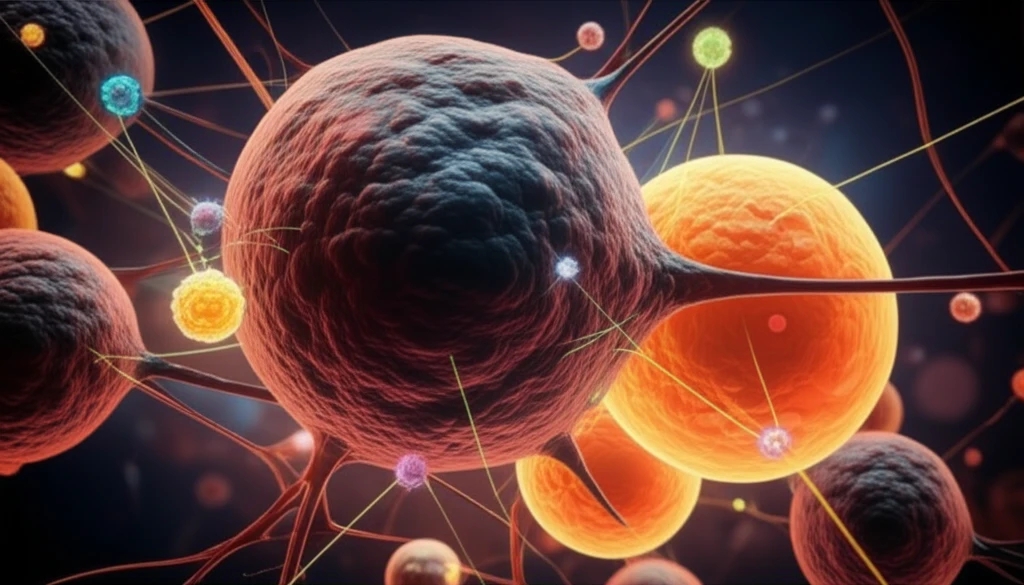
Illustration of melanoma cells interacting with bone marrow adipocytes.

Melanoma's Secret Weapon: How Cancer Cells Manipulate Bone Marrow

"Uncover the surprising ways melanoma cells interact with bone marrow adipocytes, impacting metastasis and opening new avenues for targeted therapies."


Bone metastasis remains a significant challenge in advanced cancer care. While research has focused on the direct spread of cancer cells, a growing body of evidence highlights the critical role of the tumor microenvironment—specifically, the interplay between cancer cells and bone marrow adipocytes (BMAs), the fat cells residing within bone marrow.

BMAs are no longer viewed as simply energy storage units. Instead, scientists recognize them as active participants in the progression of cancer, especially in bone metastasis. These fat cells can influence cancer cell behavior, providing support for tumor growth, altering metabolism, and even promoting resistance to therapy. Understanding this complex dialogue is crucial for developing more effective treatments.

Traditionally, researchers have used a variety of methods to study cell interactions, including two-dimensional (2D) and three-dimensional (3D) culture systems. While 3D cultures offer a more physiologically relevant environment, 2D transwell coculture systems remain a valuable, reliable, and easy-to-implement tool for initial investigations of cell-cell communication. This article will delve into a detailed protocol for using a 2D coculture system to examine the effects of melanoma cells on bone marrow adipocytes.

Decoding the Dialogue: How Melanoma Hijacks Bone Marrow Fat Cells

Illustration of melanoma cells interacting with bone marrow adipocytes.

The study by Wang, J., Wen, J., Chen, X.X., and Chen, G.L., published in the Journal of Visualized Experiments, sheds light on the dual effects of melanoma cell-derived factors on bone marrow adipocyte differentiation. The researchers employed a 2D coculture system to observe how melanoma cells influence the behavior of BMAs, revealing a complex interaction with potential implications for metastasis.

The researchers found that melanoma cells can exert two distinct effects on bone marrow adipocytes, depending on the context:

  • Tumor-Derived Factors Promote Adipocyte Differentiation: Melanoma cells secrete factors that encourage the differentiation of bone marrow stromal cells into mature adipocytes. This suggests that cancer cells can manipulate the bone marrow environment to create a supportive niche for their growth.
  • Tumor Burden Induces Adipocyte De-differentiation: When melanoma cells are present in high numbers, they can trigger the de-differentiation of mature adipocytes. This means the fat cells lose their specialized characteristics and potentially release stored energy, further fueling tumor growth. In essence, the tumor microenvironment undergoes changes in response to the increased presence of cancer cells.
These findings suggest that bone marrow adipocytes are not passive bystanders but rather dynamic regulators of the tumor microenvironment. The ability of melanoma cells to both promote and reverse adipocyte differentiation highlights the complexity of the interaction and its potential for therapeutic intervention.

The Future of Cancer Treatment: Targeting the Tumor Microenvironment

The study underscores the importance of considering the tumor microenvironment in cancer treatment strategies. By understanding how cancer cells interact with and manipulate their surroundings, researchers can identify new therapeutic targets that disrupt the supportive niche and prevent metastasis. Future research should focus on further elucidating the signaling pathways involved in the melanoma-adipocyte crosstalk and developing targeted therapies that specifically inhibit the harmful effects of this interaction. This will pave the way for more effective and personalized cancer treatments.

About this Article -

This article was crafted using a human-AI hybrid and collaborative approach. AI assisted our team with initial drafting, research insights, identifying key questions, and image generation. Our human editors guided topic selection, defined the angle, structured the content, ensured factual accuracy and relevance, refined the tone, and conducted thorough editing to deliver helpful, high-quality information.See our About page for more information.

Everything You Need To Know

1

What role do bone marrow adipocytes (BMAs) play in melanoma progression?

Bone marrow adipocytes (BMAs) are not passive bystanders but active participants in melanoma progression, particularly in bone metastasis. They influence cancer cell behavior by providing support for tumor growth, altering metabolism, and potentially promoting resistance to therapy. Melanoma cells interact with BMAs, influencing their differentiation and impacting the tumor microenvironment. Understanding this interaction is crucial for developing effective treatments.

2

How do melanoma cells influence the differentiation of bone marrow adipocytes?

Melanoma cells can exert two distinct effects on bone marrow adipocytes (BMAs), depending on the context. Firstly, melanoma cells secrete factors that promote the differentiation of bone marrow stromal cells into mature adipocytes, creating a supportive niche. Secondly, when melanoma cells are present in high numbers, they can trigger the de-differentiation of mature adipocytes, potentially releasing stored energy to fuel tumor growth. These actions highlight the complex and dynamic interplay between melanoma cells and BMAs within the tumor microenvironment.

3

What are the key findings from the study by Wang, J., Wen, J., Chen, X.X., and Chen, G.L. regarding melanoma and BMAs?

The study by Wang, J., Wen, J., Chen, X.X., and Chen, G.L., published in the Journal of Visualized Experiments, revealed that melanoma cells have dual effects on bone marrow adipocyte differentiation using a 2D coculture system. The researchers found that melanoma cells secrete factors to promote bone marrow stromal cells to differentiate into mature adipocytes, creating a supportive niche for melanoma growth. Conversely, when melanoma cells are present in high numbers, they can trigger the de-differentiation of mature adipocytes. This complex interaction highlights the dynamic role of BMAs in the tumor microenvironment.

4

What are the implications of targeting the tumor microenvironment in melanoma treatment?

Targeting the tumor microenvironment, particularly the interaction between melanoma cells and bone marrow adipocytes (BMAs), offers promising avenues for cancer treatment. By understanding how melanoma cells manipulate their surroundings, researchers can identify new therapeutic targets. This approach aims to disrupt the supportive niche created by BMAs, prevent metastasis, and potentially improve treatment outcomes. Future research should focus on elucidating the signaling pathways involved in the melanoma-adipocyte crosstalk and developing targeted therapies to inhibit the harmful effects of this interaction, leading to more effective and personalized cancer treatments.

5

What are the different research methods to study melanoma interactions with bone marrow adipocytes?

Researchers utilize various methods to study cell interactions, including 2D and 3D culture systems. While 3D cultures offer a more physiologically relevant environment, 2D transwell coculture systems remain valuable, reliable, and easy-to-implement tools for initial investigations of cell-cell communication. The study by Wang et al. employed a 2D coculture system to examine the effects of melanoma cells on bone marrow adipocytes, which allowed them to observe the complex interplay and its implications for metastasis.

Newsletter Subscribe

Subscribe to get the latest articles and insights directly in your inbox.