
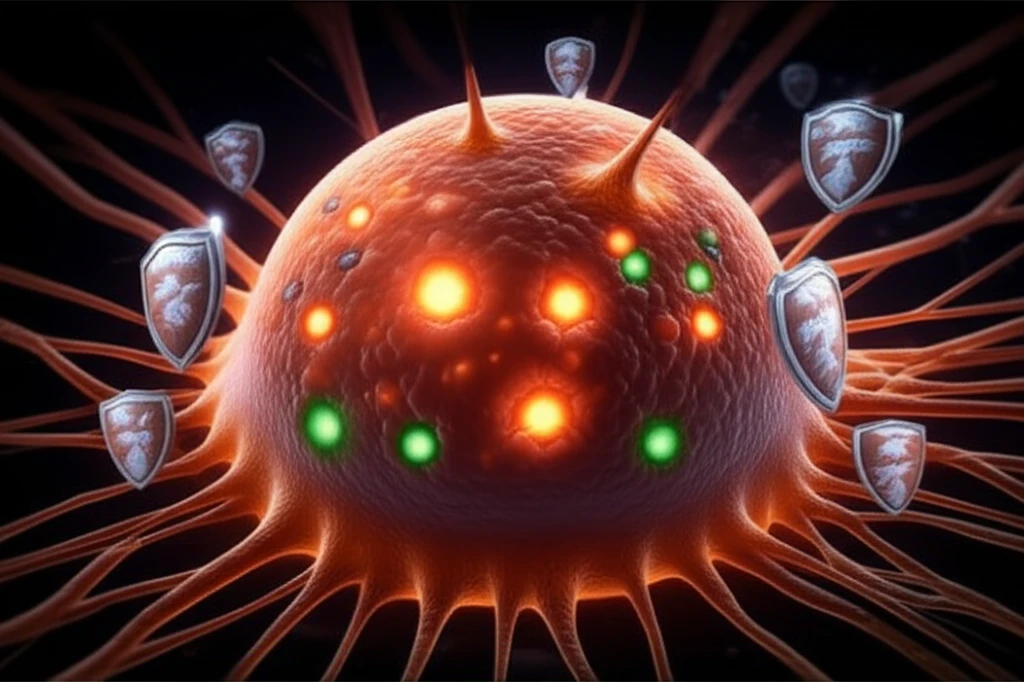
Melanoma cell transformation with MMP-9 markers and BRAF inhibitors.

Melanoma Breakthrough: Can MMP-9 Predict Response to BRAF Inhibitors?

"New research identifies MMP-9 as a potential marker for predicting how melanoma patients with BRAFV600E mutations respond to targeted therapies, offering hope for more personalized treatment strategies."


For many years, treating melanoma, the deadliest form of skin cancer, was a daunting task. However, recent advancements in targeted therapies, particularly BRAF and MEK inhibitors, have revolutionized the landscape, significantly improving survival rates for patients. These drugs work by targeting specific mutations in cancer cells, effectively shutting down pathways that fuel tumor growth.

Despite these remarkable successes, a significant challenge remains: not all patients respond to these therapies, and some develop resistance over time. This has spurred researchers to seek out biomarkers – measurable indicators that can predict a patient's response to treatment and help guide clinical decision-making.

One promising avenue of investigation involves circulating-free DNA (cfDNA), which carries genetic information from tumors and can be easily accessed through a blood test. Scientists are exploring whether analyzing cfDNA for specific mutations and other markers can provide valuable insights into treatment response. Now, a new study investigates the potential of matrix metalloproteinase-9 (MMP-9), a protein involved in tumor invasiveness, as a marker for predicting response to BRAF inhibitors in melanoma patients with BRAFV600E mutations.

Decoding MMP-9: What This Marker Reveals About Melanoma Treatment

Melanoma cell transformation with MMP-9 markers and BRAF inhibitors.

The study, published in Frontiers in Pharmacology, explored the role of MMP-9 in melanoma patients with the BRAFV600E mutation, a common genetic alteration found in about half of all melanomas. This mutation leads to uncontrolled cell growth and is a prime target for BRAF inhibitors. The research team hypothesized that MMP-9, known for its role in breaking down the extracellular matrix surrounding cells, might be linked to treatment response.

To investigate this, the researchers conducted experiments on melanoma cell lines, both sensitive and resistant to dabrafenib, a BRAF inhibitor. They found that:

  • MMP-9 expression decreased in melanoma cells treated with dabrafenib: This suggests that the drug effectively targets the pathway involving MMP-9.
  • Resistant cells showed higher MMP-9 levels: Melanoma cells that were resistant to dabrafenib had elevated levels of MMP-9, indicating a potential mechanism of resistance.
These in vitro findings were then validated in a cohort of 28 melanoma patients treated with BRAF inhibitors, either alone or in combination with MEK inhibitors. The researchers measured MMP-9 levels in the patients' serum and analyzed their cfDNA for the BRAFV600E mutation. Key findings from the patient data included:

The Future of Melanoma Treatment: Personalized Approaches

This study provides compelling evidence that MMP-9 could serve as a valuable biomarker for predicting response to BRAF inhibitors in melanoma patients with the BRAFV600E mutation. By combining MMP-9 levels with cfDNA analysis, clinicians may be able to identify patients who are most likely to benefit from these therapies and tailor treatment strategies accordingly. However, further research is needed to validate these findings in larger patient cohorts and to explore the underlying mechanisms by which MMP-9 influences treatment response and resistance. This knowledge may lead to the development of novel therapeutic strategies to overcome resistance and improve outcomes for all melanoma patients.

About this Article -

This article was crafted using a human-AI hybrid and collaborative approach. AI assisted our team with initial drafting, research insights, identifying key questions, and image generation. Our human editors guided topic selection, defined the angle, structured the content, ensured factual accuracy and relevance, refined the tone, and conducted thorough editing to deliver helpful, high-quality information.See our About page for more information.

Everything You Need To Know

1

What is the significance of BRAFV600E mutations in melanoma treatment?

The BRAFV600E mutation is a common genetic alteration found in about half of all melanomas. It's crucial because it leads to uncontrolled cell growth, making it a prime target for BRAF inhibitors. These inhibitors are designed to specifically target and shut down the pathways driven by this mutation, thereby slowing or stopping tumor growth. Identifying the presence of the BRAFV600E mutation is a key step in determining if a patient is eligible for treatment with BRAF inhibitors.

2

How do BRAF inhibitors work in treating melanoma, and why aren't they always effective?

BRAF inhibitors are targeted therapies designed to specifically attack cancer cells with BRAFV600E mutations. These drugs work by blocking the BRAF protein, which is part of a pathway that promotes cell growth. By inhibiting BRAF, the drugs effectively shut down this pathway, leading to a reduction in tumor size and spread. However, not all patients respond to these inhibitors. Some patients develop resistance over time, which is why researchers are seeking biomarkers to predict treatment response and tailor treatment strategies.

3

What role does MMP-9 play in melanoma, and how is it related to treatment with BRAF inhibitors?

MMP-9 is a protein involved in tumor invasiveness, specifically breaking down the extracellular matrix that surrounds cells. Research indicates that MMP-9 levels may be linked to a patient's response to BRAF inhibitors. Studies show that MMP-9 expression decreases in melanoma cells that respond to dabrafenib (a BRAF inhibitor), suggesting the drug effectively targets the pathway involving MMP-9. Conversely, melanoma cells resistant to dabrafenib show elevated MMP-9 levels, indicating a potential mechanism of resistance. This suggests that MMP-9 could be a valuable biomarker for predicting who will benefit from BRAF inhibitors.

4

How can MMP-9 and cfDNA analysis improve the treatment of melanoma?

MMP-9 and circulating-free DNA (cfDNA) analysis offer a more personalized approach to melanoma treatment. By measuring MMP-9 levels alongside cfDNA analysis (looking for BRAFV600E mutations), clinicians can better predict which patients are most likely to respond to BRAF inhibitors. This combined approach helps tailor treatment strategies. For instance, patients with low MMP-9 levels and the BRAFV600E mutation might be strong candidates for BRAF inhibitor treatment. Conversely, those with high MMP-9 levels might require alternative therapies or combination treatments to overcome potential resistance. This approach allows for more effective and targeted use of available treatments.

5

What are the next steps in utilizing MMP-9 as a biomarker for melanoma treatment?

The current study provides promising evidence for MMP-9 as a biomarker, but more research is needed. Future steps include validating these findings in larger patient cohorts to confirm the reliability of MMP-9 as a predictor of treatment response. Researchers also need to explore the mechanisms by which MMP-9 influences treatment response and resistance to fully understand its role. This will help develop novel therapeutic strategies to overcome resistance and improve outcomes. Further research could involve combining MMP-9 analysis with other biomarkers to enhance the accuracy of treatment predictions and create more effective, personalized treatment plans for all melanoma patients.

Newsletter Subscribe

Subscribe to get the latest articles and insights directly in your inbox.