
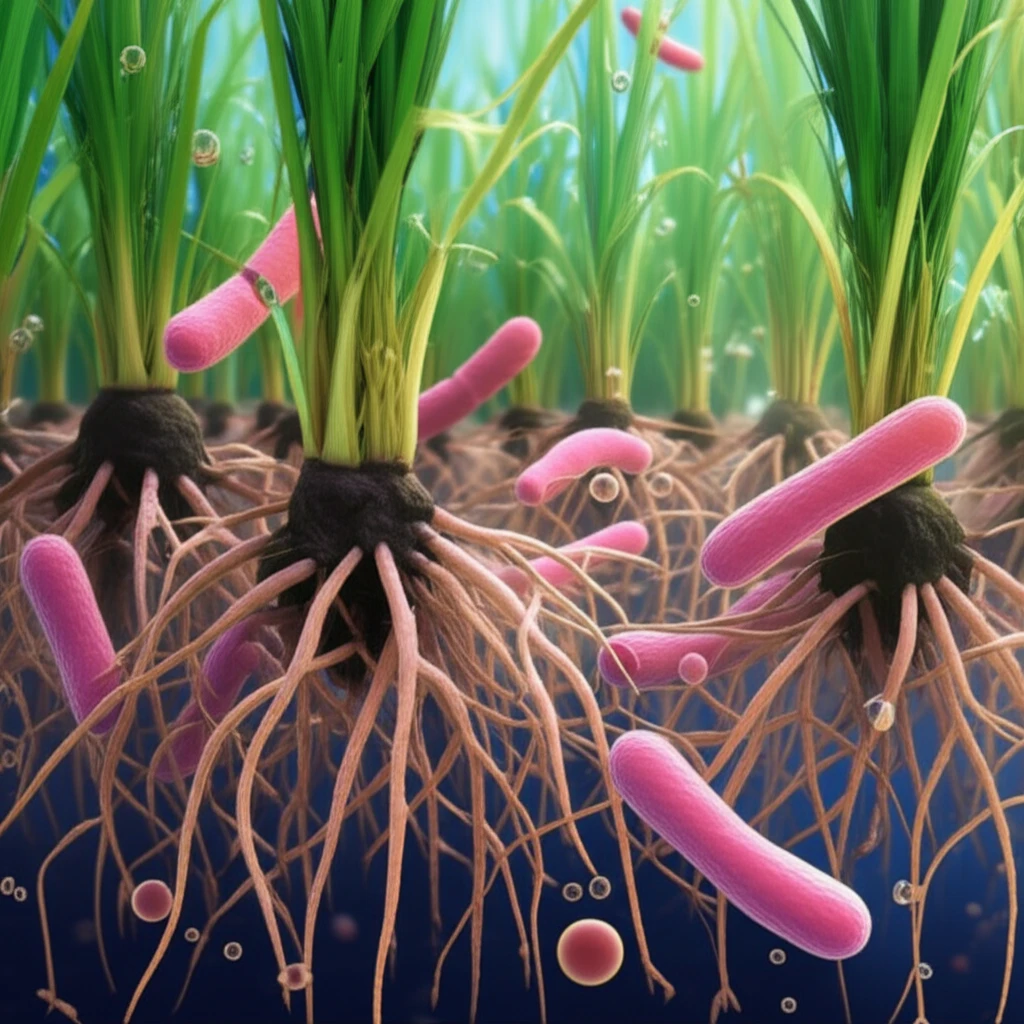
Microscopic view of Methylocucumis oryzae bacteria in a rice paddy.

Meet Methylocucumis oryzae: The Tiny Organism with a Big Impact on Rice Fields

"Scientists rename and reclassify a novel methanotroph, unlocking new insights into methane oxidation in rice ecosystems."


Rice fields, seemingly serene landscapes, are actually bustling hubs of microbial activity. Among these microscopic residents are methanotrophs, organisms that consume methane, a potent greenhouse gas. Understanding these methane-munchers is crucial for mitigating climate change, as rice paddies contribute significantly to global methane emissions.

Recently, scientists focused on a particular methanotroph originally designated as Candidatus Methylocucumis oryzae strain Sn10-6, isolated from an Indian rice field. This bacterium, a Gram-negative, pale pink, motile organism, presented challenges in preservation, hindering its formal classification.

Now, after overcoming preservation hurdles and successfully depositing the strain in multiple international culture collections, Candidatus Methylocucumis oryzae has been officially renamed and reclassified as Methylocucumis oryzae gen. nov., sp. nov. This article explores the significance of this reclassification and its implications for understanding methane cycling in rice ecosystems.

Unlocking the Secrets of Methylocucumis oryzae: Why Reclassification Matters

Microscopic view of Methylocucumis oryzae bacteria in a rice paddy.

The initial designation of Methylocucumis oryzae as a Candidatus species stemmed from difficulties in preserving the original strain. The scientific community uses the term Candidatus when an organism cannot be fully characterized due to limitations such as the inability to maintain it in a culture collection. For Methylocucumis oryzae, standard preservation techniques proved ineffective, preventing its deposition in more than one international culture collection.

Preservation is paramount for validating new species. Type strains, which serve as the definitive example of a species, must be accessible for study and comparison. The inability to reliably preserve Methylocucumis oryzae initially prevented its formal recognition.

  • The breakthrough came with the discovery that adding dimethyl sulfoxide (DMSO) as a cryopreservative agent significantly improved the strain's survival during freezing.
  • This allowed researchers to deposit Methylocucumis oryzae in the Japan Collection of Microorganisms (JCM), in addition to its existing preservation in the Korean Collection for Type Cultures (KCTC) and the National Centre for Microbial Resources in India.
  • The successful deposition in multiple recognized culture collections cleared the way for formal reclassification.
With the preservation challenges resolved, scientists could confidently propose Methylocucumis oryzae as a novel genus and species. This reclassification provides the scientific community with a validated reference point for future research, enabling more accurate identification and study of this important methanotroph.

Methylocucumis oryzae: A Key Player in Methane Mitigation

Methylocucumis oryzae's reclassification underscores its significance within the complex microbial communities of rice fields. As a Type I methanotroph, it utilizes a specific biochemical pathway (the ribulose monophosphate pathway) to consume methane.

Understanding the activity and distribution of Methylocucumis oryzae can inform strategies to enhance methane oxidation in rice paddies, potentially reducing their contribution to greenhouse gas emissions. Future research may focus on optimizing conditions to favor the growth and activity of this beneficial bacterium.

The story of Methylocucumis oryzae highlights the importance of microbial diversity and the ongoing effort to classify and understand the roles of microorganisms in various ecosystems. By formally recognizing this novel methanotroph, scientists have opened new avenues for exploring methane mitigation strategies in agriculture.

About this Article -

This article was crafted using a human-AI hybrid and collaborative approach. AI assisted our team with initial drafting, research insights, identifying key questions, and image generation. Our human editors guided topic selection, defined the angle, structured the content, ensured factual accuracy and relevance, refined the tone, and conducted thorough editing to deliver helpful, high-quality information.See our About page for more information.

This article is based on research published under:

DOI-LINK: 10.1007/s10482-018-01218-8, Alternate LINK

Title: Renaming Of ‘Candidatus Methylocucumis Oryzae’ As Methylocucumis Oryzae Gen. Nov., Sp. Nov., A Novel Type I Methanotroph Isolated From India

Subject: Molecular Biology

Journal: Antonie van Leeuwenhoek

Publisher: Springer Science and Business Media LLC

Authors: Pranitha S. Pandit, Monali C. Rahalkar

Published: 2018-12-15

Everything You Need To Know

1

What is *Methylocucumis oryzae* and why is it significant?

*Methylocucumis oryzae* is a newly classified bacterium, specifically a methanotroph, found in rice fields. It's a Gram-negative, pale pink, and motile organism. Its significance lies in its ability to consume methane, a potent greenhouse gas, thus playing a crucial role in mitigating climate change. The reclassification from *Candidatus Methylocucumis oryzae* to *Methylocucumis oryzae* gen. nov., sp. nov. allows for more accurate identification and study of this important methanotroph.

2

Why was the reclassification of *Methylocucumis oryzae* necessary?

The reclassification of *Methylocucumis oryzae* is important because it validates the existence of this bacterium as a distinct species. Initially, its classification as *Candidatus* indicated that it couldn't be fully characterized due to preservation issues. The successful preservation using dimethyl sulfoxide (DMSO) allowed for its deposition in multiple culture collections like JCM, KCTC, and the National Centre for Microbial Resources in India. This validation provides a reliable reference point for future research, allowing scientists to study *Methylocucumis oryzae* more effectively and understand its role in methane cycling within rice ecosystems.

3

What are methanotrophs and why are they important?

Methanotrophs are organisms like *Methylocucumis oryzae* that consume methane. They are crucial in mitigating climate change because rice paddies are significant contributors to global methane emissions. By consuming methane, these organisms reduce the amount of this potent greenhouse gas released into the atmosphere. *Methylocucumis oryzae*, being a Type I methanotroph, utilizes the ribulose monophosphate pathway to metabolize methane, highlighting its specific role in this process.

4

What are the implications of the reclassification of *Methylocucumis oryzae*?

The implications of the reclassification are far-reaching. It allows scientists to more accurately identify and study *Methylocucumis oryzae* and its role in methane oxidation within rice fields. This enables a better understanding of methane cycling in these ecosystems and potential strategies to mitigate methane emissions. Furthermore, the validated classification allows for comparative studies with other methanotrophs and a deeper understanding of microbial communities in rice paddies.

5

What were the challenges in classifying *Methylocucumis oryzae*?

The challenges in classifying *Methylocucumis oryzae* stemmed from difficulties in preserving the original strain. The inability to preserve the bacterium using standard techniques prevented it from being deposited in multiple international culture collections, a critical step for formal classification. The breakthrough came with the discovery that adding dimethyl sulfoxide (DMSO) as a cryopreservative agent significantly improved the strain's survival during freezing. This facilitated its successful deposition in multiple culture collections, clearing the way for its formal reclassification as *Methylocucumis oryzae* gen. nov., sp. nov.

Newsletter Subscribe

Subscribe to get the latest articles and insights directly in your inbox.