
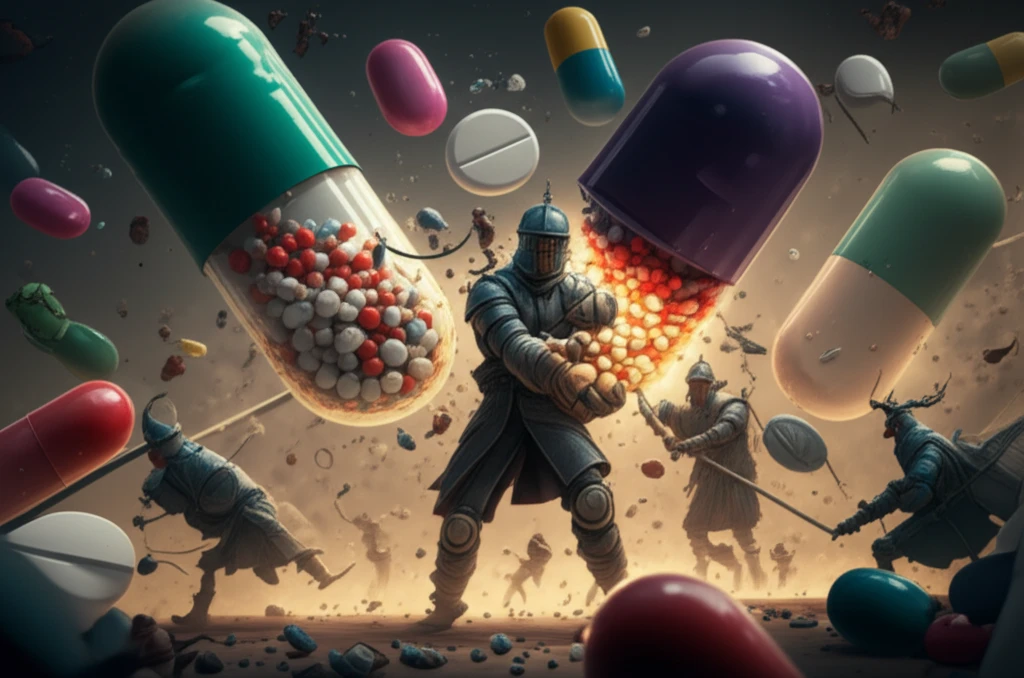
Surreal illustration of drug interactions.

Medication Interactions: Are Your Drugs Fighting Each Other?

"Understanding drug interactions, contraindications, and the role of Drug Utilization Review (DUR) in ensuring medication safety."


Imagine this: a 67-year-old woman, diligently taking medication to prevent a stroke, suddenly experiences debilitating muscle pain and weakness. Her liver enzymes are sky-high, and her urine turns an alarming shade of brown. The culprit? A dangerous interaction between her prescribed statin and another medication she was taking for a skin condition.

This scenario, while unsettling, highlights a critical aspect of healthcare: the potential dangers of drug interactions. When medications are combined, their effects can be amplified, diminished, or altered in unexpected ways, leading to adverse reactions and potentially serious health consequences. This article explores the complexities of drug interactions, contraindications, and the vital role of Drug Utilization Review (DUR) in safeguarding your health.

Drug interactions occur when one drug affects the way another drug works. This can happen in several ways, altering the absorption, distribution, metabolism, or elimination of a drug within the body. Alternatively, drugs can interact by affecting the same receptors or systems in the body, either enhancing or counteracting each other's effects. The more medications a person takes, the higher the risk of experiencing a drug interaction.

Unpacking the Types of Drug Interactions

Surreal illustration of drug interactions.

Drug interactions are generally classified into two main categories: pharmacokinetic and pharmacodynamic.

Pharmacokinetic interactions affect what the body does to a drug, influencing its concentration in the bloodstream. These interactions can occur during:

  • Absorption: One drug can alter the way another is absorbed from the gut. For instance, medications that change stomach acidity can affect the absorption of other drugs.
  • Distribution: Some drugs bind to proteins in the blood. If two drugs compete for the same binding sites, the levels of the unbound, active form of one drug can increase, leading to a stronger effect or potential toxicity.
  • Metabolism: The liver is the primary site of drug metabolism, and certain drugs can either speed up or slow down the breakdown of other drugs by liver enzymes. This can lead to either reduced effectiveness or increased toxicity.
  • Elimination: Some drugs affect kidney function or other elimination pathways, altering how quickly other drugs are cleared from the body.
Pharmacodynamic interactions occur when two drugs affect the same systems in the body, regardless of their concentrations. This can result in additive, synergistic, or antagonistic effects. For example, combining alcohol and sedatives can have an additive effect, leading to excessive drowsiness. Conversely, one drug might block the effects of another.

The Importance of Drug Utilization Review (DUR)

Given the potential risks of drug interactions, it's crucial to have systems in place to prevent them. That's where Drug Utilization Review (DUR) comes in. DUR is a structured process that evaluates medication use patterns to ensure appropriateness, safety, and effectiveness.

DUR programs can be prospective (evaluating prescriptions before they are dispensed), concurrent (reviewing medication use during treatment), or retrospective (analyzing past medication use patterns). These reviews help identify potential drug interactions, inappropriate dosages, therapeutic duplication, and other medication-related problems.

By implementing effective DUR programs, healthcare systems can minimize the risk of adverse drug events, improve patient outcomes, and reduce healthcare costs. As patients, we can also play an active role in medication safety by maintaining an accurate medication list, informing our doctors and pharmacists about all medications and supplements we are taking, and asking questions about potential drug interactions.

About this Article -

This article was crafted using a human-AI hybrid and collaborative approach. AI assisted our team with initial drafting, research insights, identifying key questions, and image generation. Our human editors guided topic selection, defined the angle, structured the content, ensured factual accuracy and relevance, refined the tone, and conducted thorough editing to deliver helpful, high-quality information.See our About page for more information.

This article is based on research published under:

DOI-LINK: 10.5124/jkma.2012.55.5.484, Alternate LINK

Title: The Contraindication Of Comedication Drugs And Drug Utilization Review

Subject: General Medicine

Journal: Journal of the Korean Medical Association

Publisher: Korean Medical Association (KAMJE)

Authors: Ji-Young Park, Kun-Woo Park

Published: 2012-01-01

Everything You Need To Know

1

What exactly happens when medications interact with each other in my body?

Drug interactions occur when one medication affects the way another medication works in the body. This can alter absorption, distribution, metabolism, or elimination of a drug, or by affecting the same receptors or systems, either enhancing or counteracting effects. The risk increases with the number of medications a person takes.

2

What are contraindications, and how do they relate to potential drug interactions?

Contraindications are specific situations where a medication should not be used because the risk outweighs the benefit. While not explicitly detailed, contraindications are implicitly connected to drug interactions. When a potential drug interaction presents an unacceptable risk, that combination becomes contraindicated. Understanding contraindications are as important as understanding drug interactions.

3

Could you explain pharmacokinetic interactions? What aspects of how my body handles medication do they impact?

Pharmacokinetic interactions affect what the body does to a drug, influencing its concentration in the bloodstream. These occur during absorption (how a drug enters the body), distribution (how it spreads), metabolism (how it's broken down, primarily by the liver), and elimination (how it's removed from the body, often via the kidneys).

4

What are pharmacodynamic interactions, and how do the terms additive, synergistic, and antagonistic effects fit into that?

Pharmacodynamic interactions occur when two drugs affect the same systems in the body, leading to additive, synergistic, or antagonistic effects, irrespective of the drug concentrations. Additive effects enhance the overall impact, while synergistic effects create a greater impact than the sum of individual drug effects. Antagonistic effects diminish or block the effects of another drug.

5

What is Drug Utilization Review (DUR), and why is it important in preventing medication-related problems?

Drug Utilization Review (DUR) is a structured process evaluating medication use to ensure appropriateness, safety, and effectiveness. While not detailed here, DUR systems often involve pharmacists reviewing prescriptions for potential drug interactions, dosage errors, or other problems before a medication is dispensed to a patient. DUR is crucial in preventing adverse drug events and optimizing medication therapy.

Newsletter Subscribe

Subscribe to get the latest articles and insights directly in your inbox.