
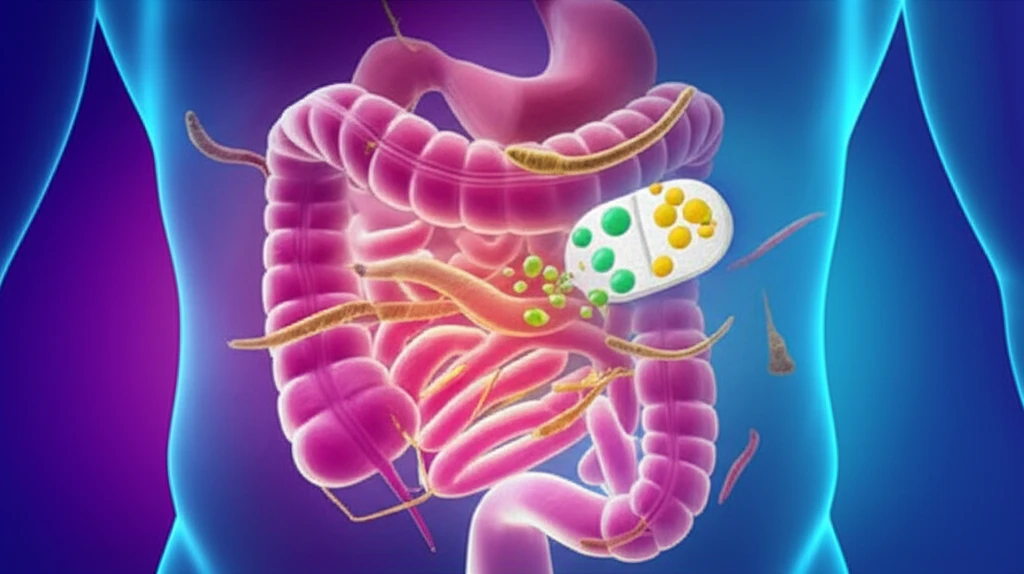
Mebendazole Revolution: Faster Tablets for a Healthier Gut?

"New research optimizes the formulation of mebendazole tablets for faster disintegration and improved drug delivery, potentially revolutionizing treatment for parasitic infections."
Intestinal worm infections are a global health concern, affecting millions worldwide. Mebendazole (MBZ) is a widely used medication to combat these infections, but its effectiveness can be limited by its poor solubility and absorption in the body.
MBZ's low bioavailability means that a significant portion of the drug doesn't reach the targeted areas, impacting its ability to eliminate parasites, especially in hard-to-reach areas like the liver or brain. This is especially concerning for extraintestinal helminthic infections (EIHs), where higher drug concentrations are needed.
Recognizing these limitations, researchers are exploring new ways to improve MBZ's performance. The focus is on creating fast-disintegrating tablets that dissolve quickly in the mouth, potentially leading to better absorption and faster relief. Let's dive into a recent study that tackles this challenge head-on, seeking a more effective way to deliver this essential medication.
The Science of Speed: How to Make Mebendazole Work Faster
The key to unlocking MBZ's full potential lies in enhancing its solubility. A recent study explored the use of nicotinamide (NIC), a form of vitamin B3, as a hydrotropic agent. Hydrotropy is a process that uses certain substances to increase the solubility of poorly soluble drugs in water. The researchers discovered that NIC significantly boosts MBZ's solubility, making it more readily available for absorption.
- Crospovidone: A superdisintegrant that helps the tablet break down rapidly.
- Microcrystalline Cellulose (MCC): A binder that provides structural integrity to the tablet.
- Mannitol (MNTL): A sugar alcohol that improves the tablet's taste and dissolution.
A New Era for Mebendazole and Parasitic Infection Treatment?
This research paves the way for a new generation of MBZ tablets that dissolve faster, absorb better, and ultimately provide more effective treatment for parasitic infections. The use of nicotinamide to boost solubility, combined with carefully selected excipients, holds promise for improved patient outcomes.
While further research is needed to confirm these findings in clinical trials, the potential benefits are clear. Faster-acting MBZ tablets could lead to:
<ul><li>Improved treatment outcomes for intestinal and extraintestinal helminthic infections.</li><li>Reduced dosing frequency and fewer side effects.</li><li>Increased patient compliance, especially among children and those who have difficulty swallowing pills.</li></ul>