
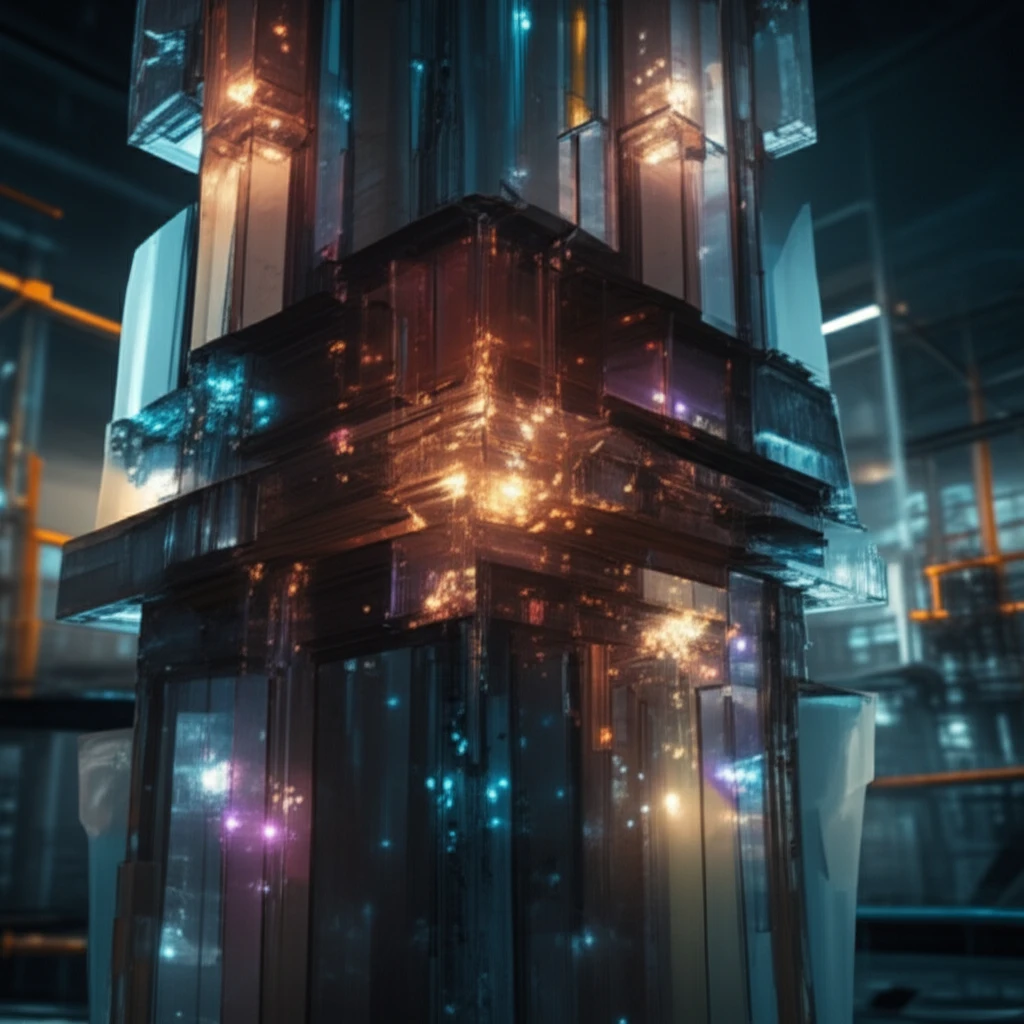
MAX Phase Materials: Unlocking the Secrets to Radiation Resistance

"Researchers are exploring how the atomic structure of MAX phases impacts their ability to withstand extreme radiation, paving the way for safer nuclear applications."
In the relentless pursuit of safer, more durable materials for extreme environments like nuclear reactors, scientists are increasingly turning to a fascinating class of compounds known as MAX phases. These materials, characterized by their layered, hexagonal structure, exhibit a unique combination of metallic and ceramic properties, making them promising candidates for applications requiring high radiation resistance.
Recent research has focused on understanding how the atomic-level structure of MAX phases influences their ability to withstand irradiation without losing their crystalline structure. Unlike many materials that become amorphous and degrade under intense radiation, certain MAX phases demonstrate remarkable resilience, accommodating point defects and maintaining their integrity.
A new study compares two MAX phases, Zr2AlC and Cr2AlC, using advanced computational methods to simulate their behavior under irradiation. By examining the formation energies of various point defects – vacancies, interstitials, and antisite pairs – the researchers are uncovering the key factors that determine a MAX phase's susceptibility to disorder and amorphization.
Decoding Radiation Tolerance: How Defects Shape Material Stability
The key to a MAX phase's radiation tolerance lies in its ability to manage the formation and migration of point defects. When a material is bombarded with radiation, atoms are knocked out of their ideal positions, creating vacancies (empty spaces) and interstitials (atoms squeezed into non-ideal locations). The ease with which these defects form, and how they interact, dictates whether the material remains crystalline or becomes amorphous.
- Vacancy: An empty space where an atom should be.
- Interstitial: An atom located in an unusual position in the crystal structure.
- Antisite Pair: When two atoms switch position.
- Frenkel Defect: A vacancy-interstitial combination.
The Future of MAX Phases: Designing Radiation-Resistant Materials
This research provides valuable insights into the factors governing radiation tolerance in MAX phases, paving the way for the design of more durable materials for nuclear applications. By understanding how different atomic structures and bonding characteristics influence defect formation and migration, scientists can tailor MAX phases to withstand extreme radiation environments.
The findings suggest that Zr2AlC, with its weaker, more ionic bonding, may offer a greater ability to 'recrystallize' defects and maintain its crystalline structure under irradiation compared to Cr2AlC. This makes Zr2AlC a promising candidate for further investigation and development.
While computational studies provide valuable insights, further experimental validation is crucial to confirm these findings and explore the long-term behavior of MAX phases under real-world irradiation conditions. As research progresses, MAX phases hold the potential to revolutionize nuclear materials and other applications requiring exceptional radiation resistance.