
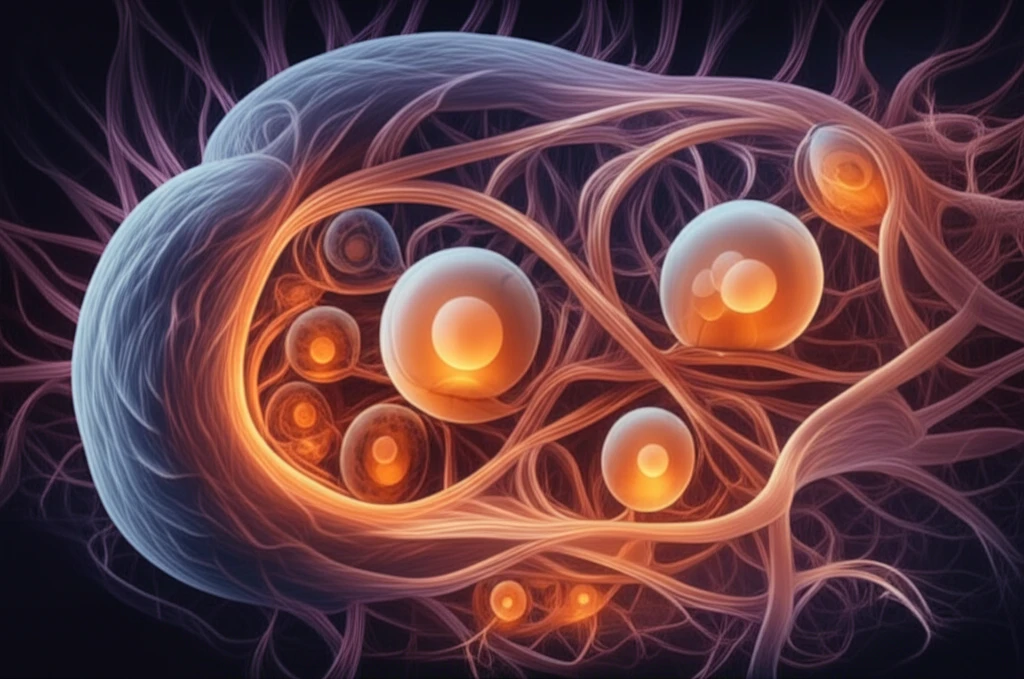
Abstract illustration of a mare's ovary highlighting follicular development and collagen interaction during the estrous cycle.

Mare Reproductive Health: Optimizing Cycles for Breeding Success

"Understanding the intricate dance between follicles and stroma in the mare ovary can unlock new strategies for improving fertility and breeding outcomes."


For equine breeders, understanding the mare's reproductive cycle is paramount. Unlike other farm animals, the mare presents unique challenges in gamete manipulation, in vitro fertilization, and embryo transfer. Recent research has focused on unraveling the complexities of the mare's ovarian environment to improve breeding outcomes.

Macroscopic observations and advanced techniques now allow researchers to delve deeper into the mare's ovarian physiology, pinpointing the critical interactions that influence oocyte development and overall reproductive success. A key area of focus is the microenvironment within the ovary, specifically the relationship between follicles (the structures containing the developing oocytes) and the surrounding stromal tissue.

This article explores the dynamic interplay between follicles and stroma in the mare ovary throughout the reproductive cycle. We'll examine how factors like collagen composition and hormonal fluctuations affect ovarian function, providing insights that can potentially optimize equine breeding practices and address common fertility challenges.

Decoding the Follicle-Stroma Connection in Mare Ovaries

Abstract illustration of a mare's ovary highlighting follicular development and collagen interaction during the estrous cycle.

The equine ovary undergoes significant changes during the estrous cycle, a period lasting approximately 20-23 days. This cycle is characterized by distinct phases: estrus (heat), lasting about 6 days, and diestrus, lasting about 15 days. Ovulation, the release of the egg, typically occurs towards the end of estrus. Researchers have meticulously examined ovaries during these phases, noting the number and size of follicles and corpora lutea (the structure that forms after ovulation).

A key element in ovarian function is the extracellular matrix (E.M.), a complex network of proteins and other molecules surrounding cells. Collagen, a major component of the E.M., exists in different types (I and III) with distinct roles. Collagen I provides structural support, while Collagen III is associated with tissue remodeling and repair. The balance between these collagen types within the ovarian stroma is crucial for proper follicular development and function.

  • Estrus Phase: Characterized by a dominant follicle (46 ± 4mm) surrounded by a stroma containing both Collagen I and III. Towards the end of estrus, a hemorrhagic follicle may appear, alongside smaller follicles.
  • Diestrus Phase: Features a corpus luteum (43-60 mm) and a few antral follicles. Collagen I forms strands within the corpus luteum and predominates in the surrounding stroma.
Hormonal fluctuations play a crucial role in regulating collagen dynamics. Estrogens are associated with a higher proportion of Collagen III in the ovarian stroma, while progesterone is linked to increased Collagen I. These hormonal influences suggest a complex interplay between the endocrine system and the structural components of the ovary.

Implications for Equine Breeding and Fertility

Understanding the dynamic relationship between follicles, stroma, and collagen within the mare ovary provides a foundation for optimizing breeding practices. By recognizing the influence of hormones on collagen composition, breeders and veterinarians can potentially manipulate the ovarian environment to improve follicular development and increase the chances of successful ovulation and conception.

Further research into the specific mechanisms regulating collagen remodeling within the ovary could lead to the development of targeted therapies for mares experiencing fertility issues. For example, treatments aimed at balancing Collagen I and III levels could enhance follicular growth and improve oocyte quality.

By taking a deeper look into the cellular communication within the ovarian microenvironment, scientists are poised to unlock more effective methods for managing mare reproduction and tackling the challenges associated with equine fertility.

About this Article -

This article was crafted using a human-AI hybrid and collaborative approach. AI assisted our team with initial drafting, research insights, identifying key questions, and image generation. Our human editors guided topic selection, defined the angle, structured the content, ensured factual accuracy and relevance, refined the tone, and conducted thorough editing to deliver helpful, high-quality information.See our About page for more information.

This article is based on research published under:

DOI-LINK: 10.4067/s0717-95022010000300007, Alternate LINK

Title: Follicular-Stromal Interaction In Mare Ovary During The Reproductive Cycle

Subject: Anatomy

Journal: International Journal of Morphology

Publisher: SciELO Agencia Nacional de Investigacion y Desarrollo (ANID)

Authors: Carolina Smok S, Mariana Rojas R

Published: 2010-09-01

Everything You Need To Know

1

What are the key phases of the mare's reproductive cycle, and what happens during each?

The equine ovary's estrous cycle, lasting 20-23 days, is divided into estrus (heat, ~6 days) and diestrus (~15 days). Ovulation happens near the end of estrus. Estrus features a dominant follicle and a stroma with both Collagen I and III. Diestrus sees a corpus luteum and Collagen I dominating the stroma. Understanding these phases is vital for breeding management.

2

What is the role of the extracellular matrix (E.M.) and collagen in the mare's ovary?

The extracellular matrix (E.M.) is a network of proteins and molecules surrounding cells. Collagen is a major component, with types I and III. Collagen I offers structural support, while Collagen III is involved in tissue remodeling. The balance of these collagens, within the ovarian stroma, is crucial for proper follicular development and overall ovarian function. This balance is influenced by hormonal fluctuations during the mare's estrous cycle.

3

How does the stroma composition change during estrus, and what is the significance?

During estrus, the stroma contains both Collagen I and III. Estrogens are associated with a higher proportion of Collagen III. This helps with tissue remodeling and is influenced by hormonal fluctuations, and is important for follicular development. These changes reflect the dynamic nature of the mare's ovarian environment and highlight the importance of understanding how hormonal influences impact the structural components of the ovary.

4

How do hormones affect collagen within the mare's ovary?

Hormones significantly influence collagen dynamics in the mare ovary. Estrogens are linked to increased Collagen III, while progesterone is associated with increased Collagen I. These hormonal effects on the stroma and its collagen composition show a complex interplay between the endocrine system and the ovarian structure. This understanding is crucial for optimizing breeding practices.

5

How can understanding the follicle-stroma connection improve equine breeding practices?

By understanding how the follicles, stroma, and collagen interact within the mare ovary, breeders can improve breeding practices. For example, by recognizing how hormones affect collagen, breeders can potentially manipulate the ovarian environment. This could lead to better follicular development, more successful ovulations, and ultimately, a higher chance of conception, helping to address common fertility challenges.

Newsletter Subscribe

Subscribe to get the latest articles and insights directly in your inbox.