
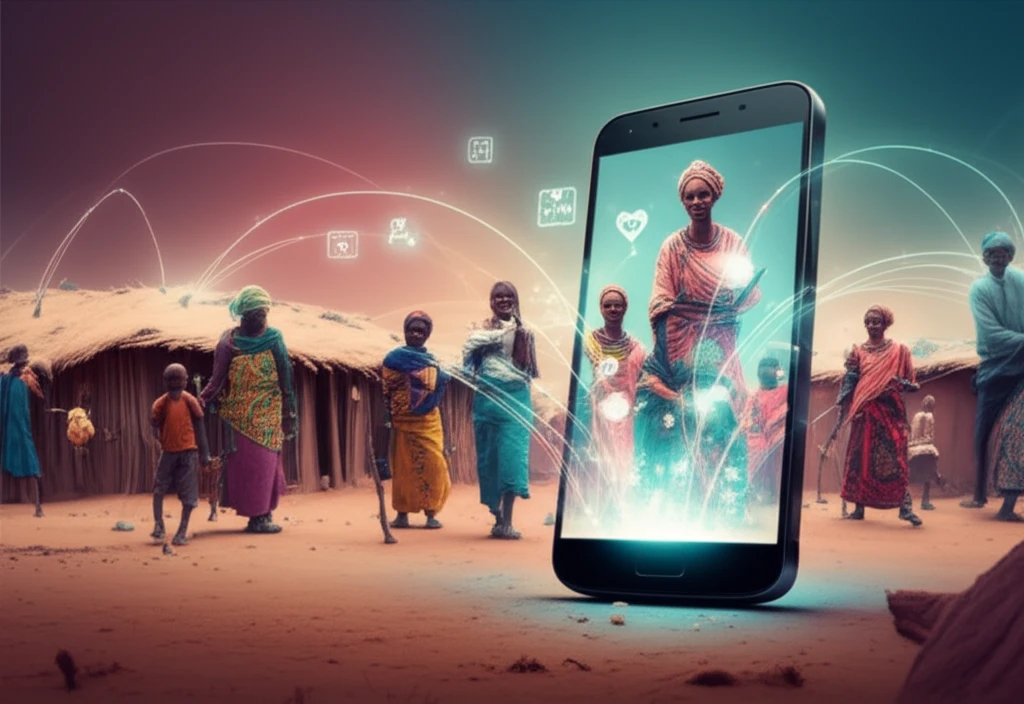
M-Health's Promise: How Mobile Tech Is Revolutionizing Healthcare in Developing Nations

"From basic SMS reminders to complex diagnostic tools, mobile health (m-health) is transforming healthcare in resource-scarce environments."
In an era defined by rapid technological advancements, mobile health (m-health) has emerged as a beacon of hope in developing countries. As smartphones and mobile devices become increasingly accessible, m-health offers a promising solution to address critical healthcare challenges in resource-limited settings. This article dives into the transformative potential of m-health, exploring how it is reshaping healthcare delivery and improving health outcomes in developing nations.
The application of mobile technologies in healthcare is not just a trend; it's a revolution. From simple text message reminders about medication to complex diagnostic tools and remote patient monitoring systems, m-health is proving to be a versatile and cost-effective approach. It's particularly impactful in regions where access to traditional healthcare is limited due to geographical barriers, lack of infrastructure, or economic constraints.
This exploration delves into the core components of m-health, the benefits it provides, the challenges it faces, and its potential impact on communities. We will explore real-world examples, examine the science behind the technology, and assess its future implications. The goal is to provide a comprehensive understanding of how m-health is transforming healthcare in developing nations.
The Rise of Mobile Health
Mobile health (mHealth) represents a rapidly expanding sector, with widespread adoption of health-related mobile applications among smartphone users globally. In the United States, hospitals utilizing mobile devices for healthcare data collection demonstrate significantly higher efficiency compared to those relying solely on traditional methods. The global mHealth market continues to grow, driven by increased smartphone penetration and consumer demand for accessible health management tools.
Challenges in Evaluating mHealth Effectiveness
Evaluating mHealth interventions presents unique methodological challenges, particularly when deployed in developing country contexts. While randomized controlled trials are traditionally considered the gold standard for determining intervention effectiveness, recent literature has identified significant limitations when applying this methodology to mHealth evaluation. Standardized criteria for assessing mHealth app quality have emerged, addressing concerns around privacy, security, and limited quality control, yet the lack of universally accepted evaluation frameworks continues to hinder the field's maturation.
Two Decades of mHealth Evolution
Mobile health emerged as a transformative concept in the early 2000s, coinciding with the introduction of third-generation (3G) communications and the dawn of mobile internet. For nearly two decades, mHealth was hailed as the most innovative area for digital healthcare transformation globally, though this vision became somewhat diluted with smartphone market dominance. The combination of mobile technology and healthcare has proven particularly valuable for developing countries, where traditional healthcare infrastructure faces numerous pressures, establishing mHealth as a critical tool for bridging healthcare access gaps.
The Core Components of M-Health: Tools and Technologies
The m-health landscape encompasses a wide array of technologies, all aimed at improving healthcare delivery and patient outcomes. At its core, m-health leverages the power of mobile devices, wireless communication, and innovative software applications. These components work in concert to provide accessible, efficient, and often life-saving healthcare solutions.
- SMS and Text Messaging: Often the simplest form of m-health, SMS is used for appointment reminders, medication adherence support, and health information dissemination.
- Mobile Apps: Sophisticated applications for a variety of purposes, from patient monitoring and health education to diagnostic support.
- Wearable Sensors: Devices like smartwatches and fitness trackers that collect real-time health data, such as heart rate and activity levels.
- Remote Patient Monitoring (RPM): Systems that allow healthcare providers to monitor patients remotely using connected devices.
- Telemedicine: The use of telecommunications technologies to provide healthcare services, such as consultations, diagnosis, and treatment, from a distance.
Contemporary mHealth Evidence and Implementation
Recent systematic reviews demonstrate that mHealth interventions show promise across diverse health outcomes, though conclusions drawn from lower-quality studies require cautious interpretation. Real-world implementation studies reveal both opportunities and challenges for integrating mobile health solutions into clinical practice, particularly regarding patient safety considerations. Advanced mHealth technologies are positioned to support universal health coverage goals, potentially enabling standardized, high-quality medical services regardless of geographic or economic barriers.
Barriers to Successful mHealth Adoption
Despite their potential, mHealth apps face significant adoption challenges, with only approximately 40-50% of adults using health apps in some capacity. Many applications suffer from serious usability and functionality issues, as documented through large-scale analysis of user reviews and market performance data. Critically, successful large-scale implementation of mHealth interventions in low and middle-income countries remains sporadic, with most projects停留在 pilot stages without evidence of sustainable, widespread deployment.
mHealth Within the Digital Health Ecosystem
Mobile health operates as a distinct subset within the broader digital health landscape, primarily differentiated by its exclusive use of mobile devices such as smartphones and tablets to deliver healthcare services. While sharing overlapping objectives with eHealth, telehealth, and telemedicine, mHealth's mobile-centric approach offers unique advantages for accessibility and real-time health monitoring. The competitive landscape includes numerous platforms vying for market position, though the most impactful applications tend to focus on specific clinical use cases rather than generic wellness tracking.
The Future of M-Health: Challenges and Opportunities
The journey of m-health is not without its challenges. Implementing and sustaining m-health initiatives requires careful planning, adequate resources, and consideration of local contexts. However, the potential for m-health to transform healthcare in developing nations is undeniable. By addressing the specific needs of communities, leveraging the power of technology, and fostering innovation, m-health has the capacity to create a healthier, more equitable world for all.
Bridging Expert and User Perspectives
Research examining health apps reveals notable discrepancies between expert evaluations and user experiences, with implications for how mobile health solutions should be assessed and validated. Experts emphasize the importance of user autonomy in health management, though tensions exist between professional recommendations for control and users' perceived ability to make independent health decisions. These gaps suggest that future mHealth development should prioritize participatory design approaches that meaningfully incorporate both clinical expertise and patient perspectives.
Emerging Directions in Mobile Health
The convergence of artificial intelligence with mobile health platforms presents significant opportunities for personalized health interventions and predictive analytics. Wearable device integration with smartphone ecosystems continues to expand, creating more comprehensive health monitoring capabilities. However, realizing mHealth's full potential will require addressing persistent infrastructure challenges, establishing clearer regulatory frameworks, and ensuring solutions are designed with the specific needs and constraints of underserved populations in mind.
Systemic Barriers to Equitable mHealth Access
Successfully implementing mHealth at scale requires navigating complex systemic barriers that extend beyond technological capabilities. Healthcare system fragmentation, workforce capacity limitations, and regulatory inconsistencies across regions pose significant obstacles to widespread adoption. Additionally, ensuring equitable access necessitates addressing digital literacy gaps and connectivity infrastructure disparities that disproportionately affect rural and low-resource settings.
From Pilot Projects to Clinical Practice
While mHealth demonstrates promising benefits including increased patient engagement and potential cost reductions, structural implementation in routine clinical practice remains less common than experimental studies suggest. Case studies of real-world implementations reveal the importance of careful planning, stakeholder engagement, and adaptation to local healthcare contexts. AI-powered digital mental health interventions have shown immediate and sustained improvements in user mood and stress levels, demonstrating mHealth's potential to deliver measurable health outcomes when properly implemented.