
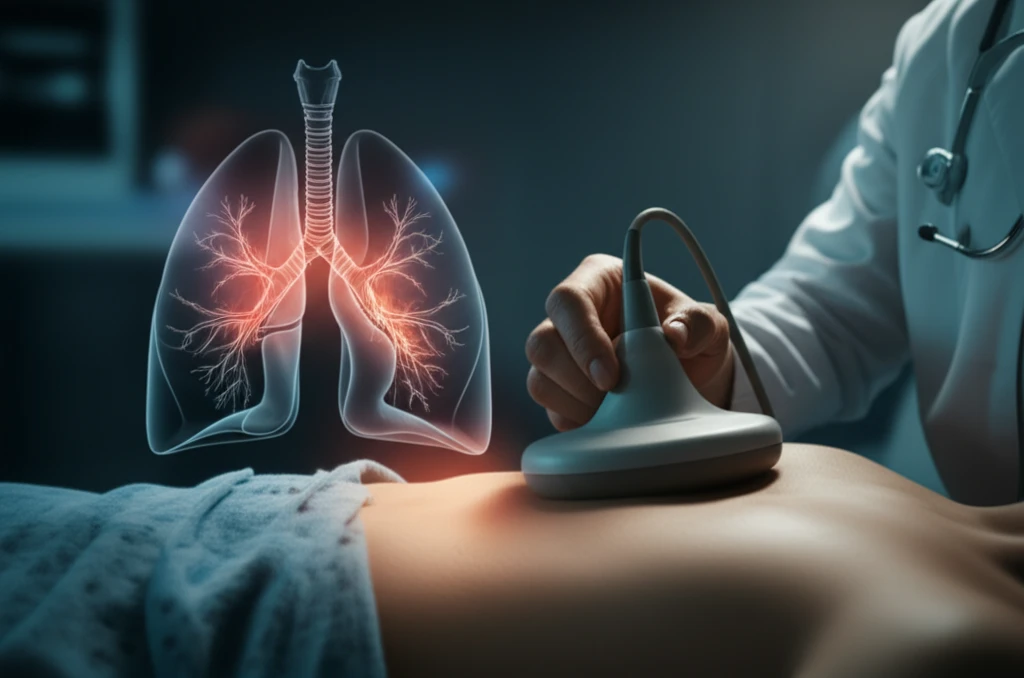
Doctor using ultrasound to examine a patient's lungs.

Lung Ultrasound: A Clearer Picture for Pneumonia?

"How ultrasound is changing the way doctors diagnose and treat complex lung infections, offering a non-invasive alternative to traditional methods."


In modern medicine, ultrasound has become an indispensable diagnostic tool, with applications expanding across numerous fields. Its versatility allows for use in diverse settings, from dedicated labs to bedside patient care, emergency rooms, operating theaters, and even at home with portable devices.

Over recent years, there's been a growing interest in using thoracic ultrasound, both in pulmonology and emergency medicine, even though its potential remains underexplored. While many are familiar with ultrasound's ability to easily detect pleural effusions—often noted as an incidental finding during abdominal or cardiac scans—its capabilities extend much further.

Compared to chest X-rays, ultrasound offers several advantages for assessing pleural effusions. It can detect even small fluid collections that might be missed on X-rays, especially when patients are examined lying down. Ultrasound also provides valuable information about the nature of the effusion, helping to distinguish between different types of fluids and identify signs of infection or inflammation. Furthermore, it enhances the safety of thoracentesis by providing real-time guidance.

Seeing Beyond the X-Ray: How Ultrasound Detects Necrotizing Areas

Doctor using ultrasound to examine a patient's lungs.

Beyond pleural effusions, thoracic ultrasound can also detect pulmonary consolidations, especially when they involve the visceral pleura. In cases of pleuropneumonia, ultrasound helps differentiate between consolidation and concurrent pleural effusion. On ultrasound, pulmonary consolidation appears as a liver-like area with air bronchograms inside.

However, distinguishing between infectious consolidation and atelectasis can be challenging, as both conditions can present similarly on ultrasound. Atelectasis is more likely if the air bronchograms are parallel and non-branching, or if liquid bronchograms are present. In cases of atelectasis caused by pleural effusion, the extent of the effusion helps determine the degree of lung compression.

Here are the key benefits of using lung ultrasound:
  • Detects small fluid collections missed by X-rays.
  • Distinguishes fluid types within effusions.
  • Enhances safety during fluid drainage procedures.
  • Identifies lung consolidations and differentiates them from effusions.
  • Monitors changes in lung condition over time.
The following case illustrates the utility of ultrasound in managing pneumonia.

The Future of Lung Care: Why Ultrasound Matters

This case confirms the value of thoracic ultrasound as a vital tool in diagnosing and treating pleuropulmonary diseases, commonly encountered in internal medicine. For internists, lung ultrasound represents an important diagnostic resource, enhancing their ability to provide effective patient care.

About this Article -

This article was crafted using a human-AI hybrid and collaborative approach. AI assisted our team with initial drafting, research insights, identifying key questions, and image generation. Our human editors guided topic selection, defined the angle, structured the content, ensured factual accuracy and relevance, refined the tone, and conducted thorough editing to deliver helpful, high-quality information.See our About page for more information.

Everything You Need To Know

1

What exactly is lung ultrasound and why is it becoming so popular in medical diagnosis?

Lung ultrasound is a non-invasive imaging technique that uses sound waves to create real-time images of the lungs and surrounding structures. Unlike traditional methods like X-rays, lung ultrasound doesn't involve radiation, making it a safer option, especially for repeated examinations. It allows doctors to visualize conditions such as pleural effusions, pulmonary consolidations, and can aid in differentiating between various lung pathologies. Its utility extends from initial diagnosis to monitoring treatment progress, providing a comprehensive assessment of lung health.

2

What are pleural effusions, and how does lung ultrasound help in their detection and characterization?

Pleural effusions are accumulations of fluid in the space between the lung and the chest wall. Lung ultrasound is particularly effective at detecting even small pleural effusions that might be missed by X-rays. Additionally, it helps to characterize the fluid, distinguishing between different types such as transudative or exudative effusions, and identifying signs of infection or inflammation. This is significant because accurate identification and characterization of pleural effusions are crucial for determining the underlying cause and guiding appropriate treatment strategies, such as thoracentesis.

3

What is pulmonary consolidation, and how can lung ultrasound help in identifying and understanding it?

Pulmonary consolidation refers to the replacement of air in the lung tissue with fluid, inflammatory exudates, or other substances. Lung ultrasound can detect pulmonary consolidations, especially when they involve the visceral pleura. On ultrasound, it appears as a liver-like area with air bronchograms inside. Distinguishing between infectious consolidation and atelectasis can be challenging. Consolidation suggests conditions like pneumonia, while atelectasis indicates lung collapse, influencing treatment decisions.

4

How does lung ultrasound improve the safety and effectiveness of procedures like thoracentesis?

Thoracentesis is a procedure to remove fluid from the pleural space. Lung ultrasound enhances the safety of thoracentesis by providing real-time guidance during the procedure. This allows doctors to precisely locate the fluid collection and avoid puncturing nearby structures, reducing the risk of complications such as pneumothorax or injury to blood vessels. Real-time visualization ensures accurate needle placement and efficient fluid drainage, improving patient outcomes.

5

What role does lung ultrasound play in the day-to-day practice of internal medicine?

Lung ultrasound has become an invaluable diagnostic resource for internists in managing pleuropulmonary diseases. Its versatility allows for rapid assessment at the bedside, in emergency rooms, and other settings, providing immediate insights into the patient's condition. By enhancing the ability to diagnose and monitor lung pathologies, lung ultrasound enables internists to provide more effective and timely patient care. Its integration into internal medicine practice improves diagnostic accuracy and treatment outcomes for common respiratory conditions.

Newsletter Subscribe

Subscribe to get the latest articles and insights directly in your inbox.