
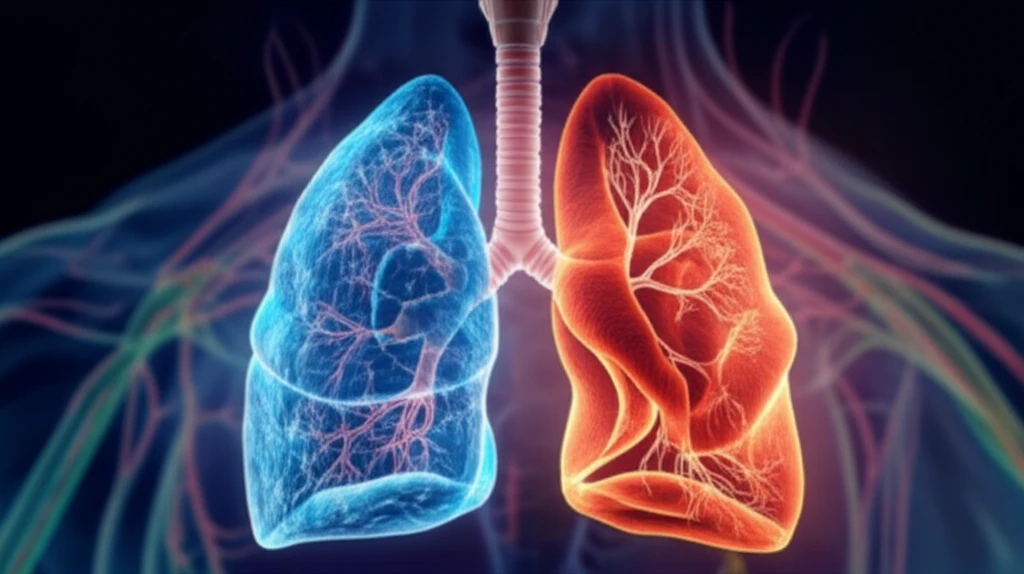
Lung Cancer Survival: New Hope with Personalized Radiotherapy

"A groundbreaking study reveals how tailoring postoperative radiotherapy based on lymph node analysis can significantly improve survival rates for non-small cell lung cancer patients."
Lung cancer remains a formidable health challenge, with non-small cell lung cancer (NSCLC) accounting for the vast majority of cases. For patients with node-positive NSCLC, the risk of cancer recurrence after surgery is high, emphasizing the need for effective post-operative treatments. Postoperative radiotherapy (PORT) has been a topic of debate, with some studies questioning its overall benefit.
However, a recent study published in the Journal of Thoracic Oncology offers a promising new perspective. Researchers have developed a novel prognostic scoring model that uses the lymph node ratio (LNR) – the ratio of positive to resected lymph nodes – to predict survival outcomes in patients with resected N2 NSCLC who receive PORT. This approach allows for more personalized treatment strategies, potentially maximizing the benefits of radiotherapy while minimizing unnecessary exposure for patients less likely to benefit.
This innovative research combines prognostic scoring models with heat mapping techniques to visualize survival probabilities, providing clinicians with a powerful tool to estimate a patient's 3-, 5-, and 10-year overall survival (OS) probabilities. By understanding these probabilities, doctors can make more informed decisions about treatment plans and follow-up care, significantly improving the quality of life and extending the lifespan of lung cancer patients.
How Does Lymph Node Ratio (LNR) Predict Survival in Lung Cancer?
The lymph node ratio (LNR) is a crucial indicator in predicting survival outcomes for various cancers. It reflects the extent of cancer spread to the lymph nodes, which are key components of the immune system. In the context of NSCLC, LNR helps assess the aggressiveness of the disease and the likelihood of recurrence.
- Data Source: Surveillance, Epidemiology, and End Results (SEER) database.
- Patient Group: Patients with N2 NSCLC who had surgery and PORT.
- Timeframe: 2000-2014.
- Methods: Cox regression, heat maps, recursive partitioning analysis.
The Future of Lung Cancer Treatment: Personalized Approaches
The study underscores the importance of personalized treatment strategies in lung cancer. By incorporating LNR into prognostic scoring models and utilizing heat mapping techniques, clinicians can gain a more nuanced understanding of individual patient risks and tailor treatment plans accordingly. This approach not only improves survival outcomes but also minimizes unnecessary treatment exposure, enhancing the overall quality of life for patients with resected N2 NSCLC.