
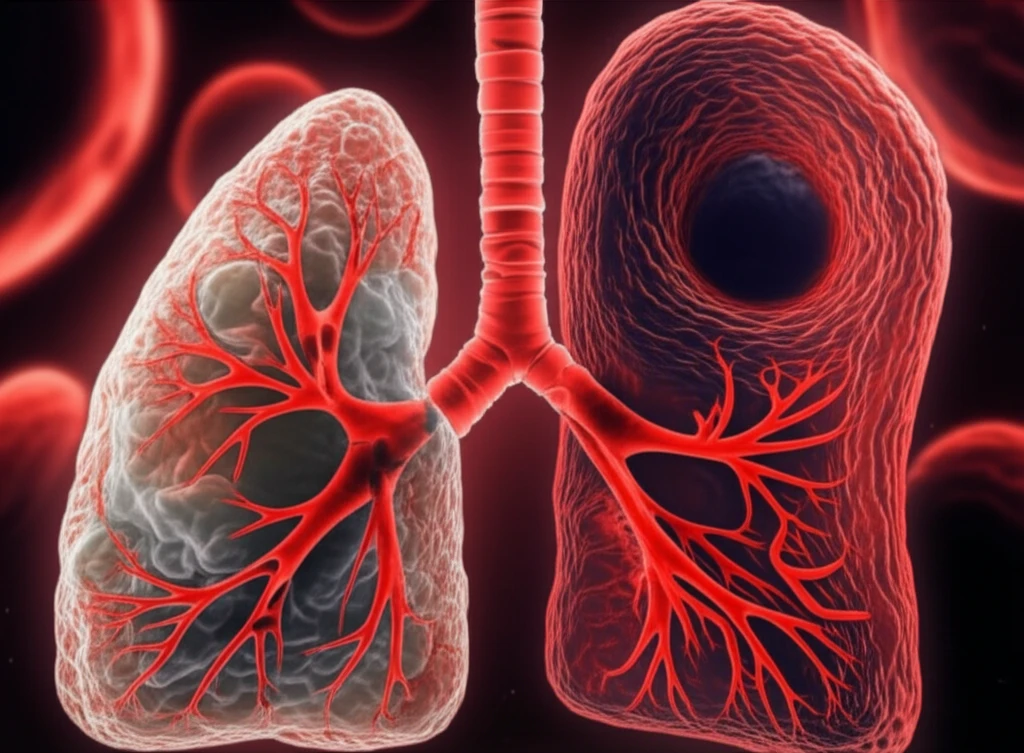
Illustration of lung cancer cells with varying blood flow patterns.

Lung Cancer Blood Flow: How CT Perfusion Distinguishes Adenocarcinoma and Squamous Cell Carcinoma

"New research reveals that CT perfusion can differentiate between adenocarcinoma and squamous cell carcinoma in lung cancer patients, potentially improving treatment strategies."


The development of tumors, known as tumorigenesis, relies on angiogenesis—the formation of a complex, often disorganized network of blood vessels that feed the tumor. Understanding these vascular patterns, especially how they change over time, is crucial for characterizing different types of tissue. This is where CT perfusion (CTp) comes in; this advanced imaging technique has gained traction for its ability to provide both high-resolution spatial and temporal data.

CT perfusion works by tracking the journey of a contrast agent as it reaches the tumor, generating time concentration curves (TCCs). By analyzing these curves, doctors can compute perfusion parameters that offer insights into the tumor's blood supply. One particularly valuable parameter is blood flow (BF), which shows a strong link to microvessel density (MVD), a key tissue biomarker. Measuring BF typically involves monitoring the first pass of the contrast medium, which keeps the examination time short and minimizes radiation exposure for the patient.

Using blood flow (BF) information obtained at the time of diagnosis can significantly aid in lesion characterization, particularly for patients who aren't eligible for surgery and need non-surgical treatment plans. What's more, higher baseline BF values in individuals with advanced lung carcinoma may suggest a more favorable response to therapy. The ability to differentiate between responders and non-responders based on BF values highlights the importance of characterizing tumors' hemodynamic profiles, which includes considering different cancer subtypes. By understanding the perfusion characteristics of non-small cell lung cancer (NSCLC), clinicians can gain useful insights into the tumor's status, particularly regarding its degree of hypoxia, which greatly influences how it responds to treatment.

Differentiating Lung Cancer Subtypes: The Role of Blood Flow

Illustration of lung cancer cells with varying blood flow patterns.

Research has indicated that adenocarcinoma (AC) tends to have a significantly lower degree of hypoxia compared to squamous cell carcinoma (SCC). Further studies have explored differences in perfusion parameters among lung cancer subtypes, with some showing conflicting results. To interpret these discrepancies, it’s important to consider potential sources of error in BF computation, such as respiratory motion, CTp artifacts, and tumor location, all of which can affect the reliability of BF values.

Tumor location, in particular, is often overlooked in CTp studies. However, research has demonstrated that central carcinomas tend to have significantly lower perfusion compared to peripheral ones, due to variations in vessel recruitment. Additionally, anatomical structures within the lesion, such as vessels and bronchi, can interfere with perfusion analyses.

  • The main aim of the research was to assess and evaluate lung tumors at diagnosis.
  • New research was conducted to study the significant differences in perfusion between AC and SCC, the two predominant NSCLC phenotypes.
  • To further improve the characterization of AC and SCC perfusion, caused by a high measurement variability, stemming from clinical and physiological factors as well as external causes (e.g., patient movements and artefacts), two methods were used.
To reduce variability, unreliable perfusion values were detected and removed automatically. Furthermore, lesions' position, central or peripheral, and their proximity to large vessels were examined, studying whether and how this external factor could artificially affect histotype perfusion. Finally, for each histotype the less representative lesions were analyzed, whose perfusion values are shifted to the group mean value characterizing the other histotype.

Implications for Treatment Planning

This study highlights the importance of understanding blood flow characteristics in different NSCLC subtypes, particularly adenocarcinoma and squamous cell carcinoma. By employing advanced imaging techniques like CT perfusion and carefully analyzing the data to remove artifacts and account for tumor location, clinicians can gain valuable insights into tumor behavior. These insights can inform treatment planning, potentially leading to more effective and personalized approaches, especially with anti-angiogenic therapies.

About this Article -

This article was crafted using a human-AI hybrid and collaborative approach. AI assisted our team with initial drafting, research insights, identifying key questions, and image generation. Our human editors guided topic selection, defined the angle, structured the content, ensured factual accuracy and relevance, refined the tone, and conducted thorough editing to deliver helpful, high-quality information.See our About page for more information.

Everything You Need To Know

1

What is CT perfusion (CTp) and how is it used to analyze lung tumors?

CT perfusion (CTp) is an advanced imaging technique that tracks the journey of a contrast agent through a tumor to generate time concentration curves (TCCs). Analyzing these curves allows doctors to compute perfusion parameters, especially blood flow (BF), which provides insights into the tumor's blood supply and microvessel density (MVD). CTp is valuable because it provides both high-resolution spatial and temporal data, helping to characterize different types of tissue and understand tumor behavior.

2

How does blood flow (BF) measured by CT perfusion help in distinguishing between adenocarcinoma (AC) and squamous cell carcinoma (SCC)?

Blood flow (BF) information, obtained through CT perfusion, plays a crucial role in differentiating between adenocarcinoma (AC) and squamous cell carcinoma (SCC) because it helps in characterizing tumors' hemodynamic profiles. Research indicates that adenocarcinoma (AC) typically has a significantly lower degree of hypoxia compared to squamous cell carcinoma (SCC). By measuring and analyzing BF, clinicians can gain valuable insights into the tumor's status, especially regarding its degree of hypoxia, which influences treatment response and may suggest different therapeutic strategies.

3

Why is tumor location relevant in CT perfusion (CTp) studies?

Tumor location is relevant in CT perfusion (CTp) studies because it significantly impacts perfusion characteristics. Research has shown that central carcinomas tend to have lower perfusion compared to peripheral ones due to variations in vessel recruitment. Therefore, accounting for tumor location is crucial to interpret BF values accurately. Also, the proximity of the tumor to anatomical structures like vessels and bronchi can interfere with perfusion analyses, potentially affecting the reliability of the results.

4

How can the understanding of blood flow (BF) characteristics in different NSCLC subtypes improve treatment planning?

Understanding blood flow (BF) characteristics in different NSCLC subtypes, specifically adenocarcinoma (AC) and squamous cell carcinoma (SCC), is vital for improving treatment planning. By employing advanced imaging techniques like CT perfusion and carefully analyzing data while considering factors like tumor location, clinicians can gain insights into tumor behavior. This understanding can inform more effective and personalized approaches, especially regarding anti-angiogenic therapies. For example, higher baseline BF values in patients with advanced lung carcinoma might suggest a more favorable response to therapy, thus guiding the choice of treatment.

5

What are the main challenges in CT perfusion (CTp) and how are they addressed to improve the accuracy of lung tumor analysis?

The main challenges in CT perfusion (CTp) involve measurement variability stemming from clinical and physiological factors, such as respiratory motion, CTp artifacts, and tumor location. To improve the accuracy of lung tumor analysis, several methods are employed. One approach is to reduce variability by automatically detecting and removing unreliable perfusion values. Another is to account for the tumor's position (central or peripheral) and its proximity to large vessels. Analyzing the less representative lesions whose perfusion values are shifted towards the other histotype's group mean can also enhance the reliability of the analysis. These steps help ensure more accurate characterization of adenocarcinoma and squamous cell carcinoma, thereby leading to better treatment planning.

Newsletter Subscribe

Subscribe to get the latest articles and insights directly in your inbox.