
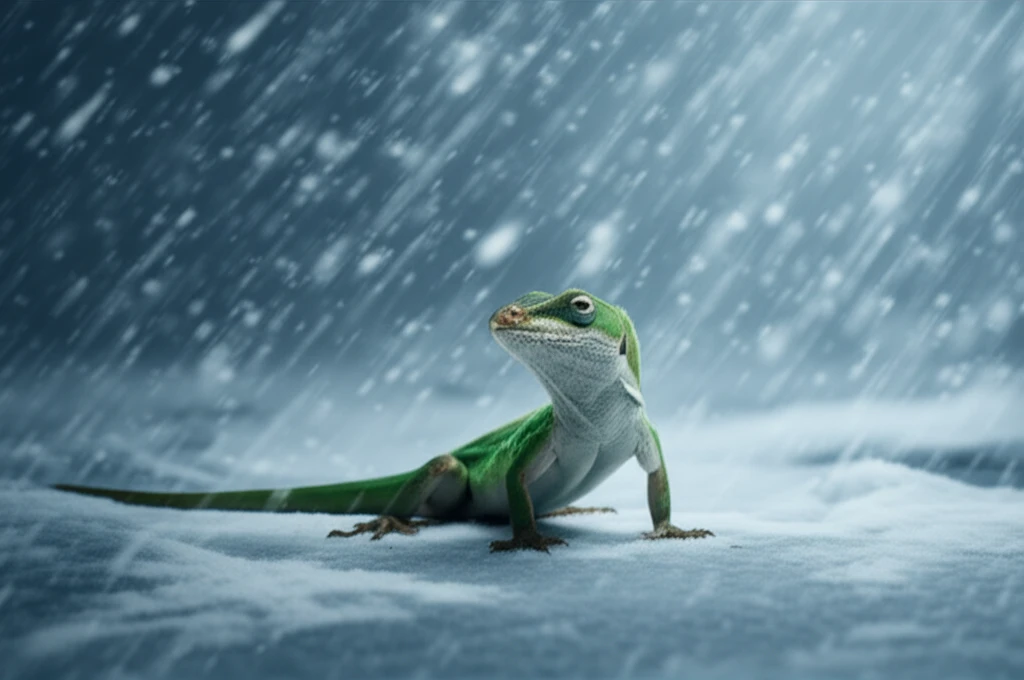
Lizard Resilience: How Winter Storms are Reshaping Green Anole Populations

"Discover how extreme weather events are driving rapid evolution in green anole lizards, revealing nature's surprising adaptability."
Nature often presents us with unexpected events that can dramatically alter the course of life. One such event occurred during the winter of 2013-2014 when the southeastern United States experienced unusually harsh weather conditions. This extreme cold served as a real-world experiment, allowing scientists to observe the direct impacts of natural selection on wildlife populations.
A team of researchers focused on the green anole lizard (Anolis carolinensis) to investigate how these extreme weather events influence survival and adaptation. They examined various aspects, including the lizards' physical traits, gene activity, and overall genetic structure, across different locations.
The study revealed that the cold weather led to significant increases in cold tolerance among lizard populations, especially in the southernmost areas. This remarkable shift suggests that extreme weather events can act as potent drivers of evolution, leading to rapid changes in the genetic and biological characteristics of a species.
Unveiling the Secrets of Cold Tolerance
The scientists began their investigation by measuring a critical trait: cold tolerance. This is the minimum temperature at which lizards lose their coordination. They assessed lizard populations at five different locations along a north-south line in August 2013, before the severe winter struck.
- The southernmost population experienced the most significant increase in days below their cold tolerance limit.
- Populations farther north also faced increased cold stress, though to a lesser extent.
Adapting to a Changing World
This research underscores how quickly natural selection can act, especially when triggered by extreme environmental events. The green anole lizard's rapid adaptation to colder temperatures provides a compelling example of nature's resilience.
Understanding the mechanisms behind these adaptations is crucial, especially as extreme weather events are predicted to become more frequent due to climate change. By studying how species like the green anole respond, we can gain insights into the broader impacts of climate change on biodiversity and ecosystem stability.
Further research is needed to explore the long-term consequences of these rapid evolutionary shifts. However, this study highlights the remarkable capacity of species to adapt and survive in the face of environmental challenges, offering a glimmer of hope in a rapidly changing world.