
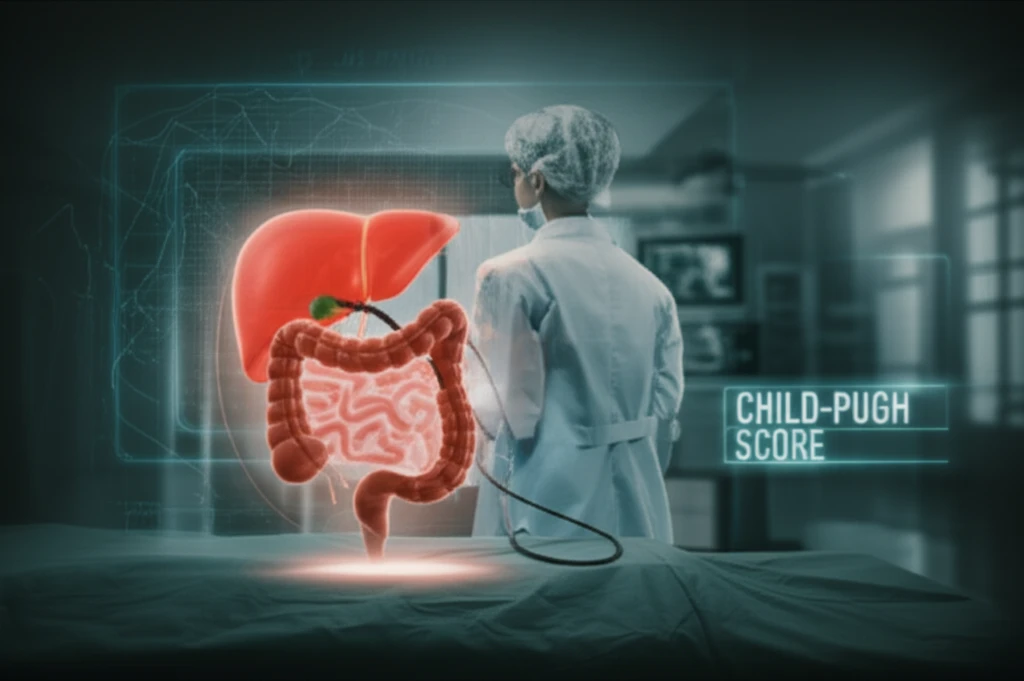
Illustration of a colonoscopy procedure with the liver and Child-Pugh score highlighted, representing patient care and medical advancement.

Liver Health Under the Microscope: How a Simple Score Can Change Everything

"Unveiling the Unexpected: The Child-Pugh Score and Its Link to Post-Polypectomy Bleeding in Liver Cirrhosis"


Colonoscopies are a cornerstone of modern healthcare, helping to detect and prevent colorectal cancer. However, for individuals with liver cirrhosis, this common procedure carries unique risks. Recent research shines a light on the connection between the Child-Pugh score, a tool used to assess liver health, and the likelihood of bleeding after colonoscopic polypectomy. This finding is crucial for understanding and managing the potential complications of this important screening and treatment method.

Liver cirrhosis, a condition characterized by the scarring of the liver, affects millions worldwide. The severity of the condition varies greatly, and doctors use various assessment tools to gauge its impact on a patient's overall health. One such tool is the Child-Pugh score, which helps clinicians determine the stage of liver disease and predict outcomes. This score considers factors like bilirubin levels, albumin levels, prothrombin time, and the presence of ascites or hepatic encephalopathy. But its importance extends far beyond this primary function.

This article delves into the surprising link between the Child-Pugh score and post-polypectomy bleeding. We'll explore the findings of a recent study that highlights the increased risk for individuals with more severe liver disease. By understanding this connection, both patients and healthcare providers can make more informed decisions, ultimately improving the safety and effectiveness of colonoscopic procedures.

The Child-Pugh Score: More Than Just a Liver Health Assessment

Illustration of a colonoscopy procedure with the liver and Child-Pugh score highlighted, representing patient care and medical advancement.

The Child-Pugh score isn't just a number; it's a window into the overall health of the liver. It helps doctors assess the severity of liver disease, which can be caused by various conditions, including hepatitis, alcohol abuse, and non-alcoholic fatty liver disease. The score ranges from class A (least severe) to class C (most severe), reflecting the liver's ability to perform its critical functions. But beyond its primary role, the Child-Pugh score can also provide vital information about the risk of bleeding during colonoscopic procedures.

The recent study included patients with liver cirrhosis who underwent colonoscopy. Researchers analyzed the relationship between the Child-Pugh score and the occurrence of immediate post-polypectomy bleeding (IPPB). The results were striking: patients with Child-Pugh class B or C cirrhosis had a significantly higher risk of experiencing bleeding after polypectomy compared to those with class A or without liver disease. This finding underscores the importance of this simple score in assessing procedure risks.

  • Risk Stratification: The Child-Pugh score helps categorize patients based on the severity of their liver disease, aiding in risk assessment.
  • Bleeding Risk: Patients with higher Child-Pugh scores (B or C) face a greater risk of immediate bleeding after polypectomy.
  • Informed Decisions: This knowledge allows healthcare providers to make informed decisions, balancing the benefits of the procedure with potential risks.
  • Patient Safety: By understanding these risks, clinicians can take extra precautions to ensure patient safety.
These findings highlight that the Child-Pugh score can be a useful tool in assessing the likelihood of complications. Recognizing that patients with more severe liver disease, as indicated by a higher Child-Pugh score, are at greater risk for bleeding, allows medical professionals to adjust their approach accordingly. This could mean more careful monitoring during and after the procedure, different techniques, or the involvement of other specialists. All of these measures are aimed at ensuring that colonoscopies, a crucial tool for cancer prevention, are as safe as possible for all patients, especially those with existing health challenges.

Empowering Patients, Enhancing Care

The research emphasizes the importance of a comprehensive approach to patient care, particularly for those with chronic conditions. By understanding the relationship between liver health and procedural risks, both patients and healthcare providers can work together to make informed decisions. This knowledge can lead to more effective and safer care, enabling the early detection and treatment of conditions like colorectal cancer. Moving forward, further research will continue to refine our understanding of this complex interplay, contributing to improved patient outcomes and enhanced quality of life.

About this Article -

This article was crafted using a human-AI hybrid and collaborative approach. AI assisted our team with initial drafting, research insights, identifying key questions, and image generation. Our human editors guided topic selection, defined the angle, structured the content, ensured factual accuracy and relevance, refined the tone, and conducted thorough editing to deliver helpful, high-quality information.See our About page for more information.

This article is based on research published under:

DOI-LINK: 10.3349/ymj.2014.55.5.1281, Alternate LINK

Title: Child-Pugh Score Is An Independent Risk Factor For Immediate Bleeding After Colonoscopic Polypectomy In Liver Cirrhosis

Subject: General Medicine

Journal: Yonsei Medical Journal

Publisher: Yonsei University College of Medicine

Authors: Sangheun Lee, Soo Jung Park, Jae Hee Cheon, Tae Il Kim, Won Ho Kim, Dae Ryong Kang, Sung Pil Hong

Published: 2014-01-01

Everything You Need To Know

1

What is the Child-Pugh score and why is it important for individuals with liver cirrhosis?

The Child-Pugh score is a tool used to assess the severity of liver disease in individuals with liver cirrhosis. It considers factors like bilirubin levels, albumin levels, prothrombin time, and the presence of ascites or hepatic encephalopathy to classify liver disease into stages, from class A (least severe) to class C (most severe). It's crucial because it helps predict outcomes and, importantly, can indicate the risk of complications such as bleeding after procedures like colonoscopic polypectomy. It's used to gauge the impact on a patient's overall health.

2

How does the Child-Pugh score relate to the risk of bleeding after a colonoscopy with polypectomy?

Research indicates a significant connection between the Child-Pugh score and the risk of immediate post-polypectomy bleeding (IPPB). Patients with Child-Pugh class B or C cirrhosis have a considerably higher risk of experiencing bleeding after polypectomy compared to those with class A or without liver disease. This suggests that the Child-Pugh score can be a valuable tool in assessing and anticipating potential complications associated with colonoscopies in individuals with liver cirrhosis.

3

What can healthcare providers do to ensure patient safety during colonoscopies, considering the Child-Pugh score?

Recognizing that patients with higher Child-Pugh scores (B or C) are at greater risk for bleeding, medical professionals can adjust their approach. This may involve more careful monitoring during and after the procedure, utilizing different techniques, or consulting with other specialists. The goal is to balance the benefits of colonoscopies for cancer prevention with the potential risks associated with liver disease, ultimately ensuring the procedure is as safe as possible for all patients.

4

What factors contribute to the Child-Pugh score, and how do they reflect liver function?

The Child-Pugh score incorporates several key indicators of liver function: bilirubin levels (reflecting the liver's ability to process waste), albumin levels (indicating the liver's protein synthesis capacity), prothrombin time (assessing the liver's production of clotting factors), and the presence of ascites (fluid accumulation in the abdomen) or hepatic encephalopathy (brain dysfunction due to liver failure). These factors provide a comprehensive view of the liver's overall health and its ability to perform essential functions. The presence of ascites indicates the body's fluid management and hepatic encephalopathy indicates the liver's ability to remove toxic substances.

5

Beyond bleeding risk during colonoscopies, what other implications does the Child-Pugh score have for managing patients with liver cirrhosis?

While the Child-Pugh score is valuable for assessing bleeding risk during procedures like colonoscopies, it also offers broader insights into the prognosis and management of patients with liver cirrhosis. It helps clinicians determine the stage of liver disease, predict survival rates, and guide treatment decisions, such as the need for liver transplantation. Furthermore, it can inform decisions regarding medication dosages and other interventions, ensuring a more tailored and effective approach to care. The Model for End-Stage Liver Disease (MELD) score is another more precise method. The MELD score uses a formula incorporating serum bilirubin, serum creatinine, and international normalized ratio (INR) for prothrombin time to predict survival in patients with end-stage liver disease. Further research will continue to refine our understanding of this complex interplay, contributing to improved patient outcomes and enhanced quality of life.

Newsletter Subscribe

Subscribe to get the latest articles and insights directly in your inbox.