
Level Up Your Skills: How VR Training is Revolutionizing the Oil Industry

"Ditch the textbook, grab a headset. Virtual reality is transforming oil and gas training, making it safer, cheaper, and more effective. Find out how."
The oil and gas industry, known for its high-stakes operations and complex processes, has always demanded rigorous training. However, traditional training methods often fall short, struggling to replicate real-world scenarios effectively and safely. The industry has been forced to keep pace with technological innovation in order to remain competitive [1-3]. They have been forced to adapt to the consumer demands, as well as consider the impact on the environment [4,5].
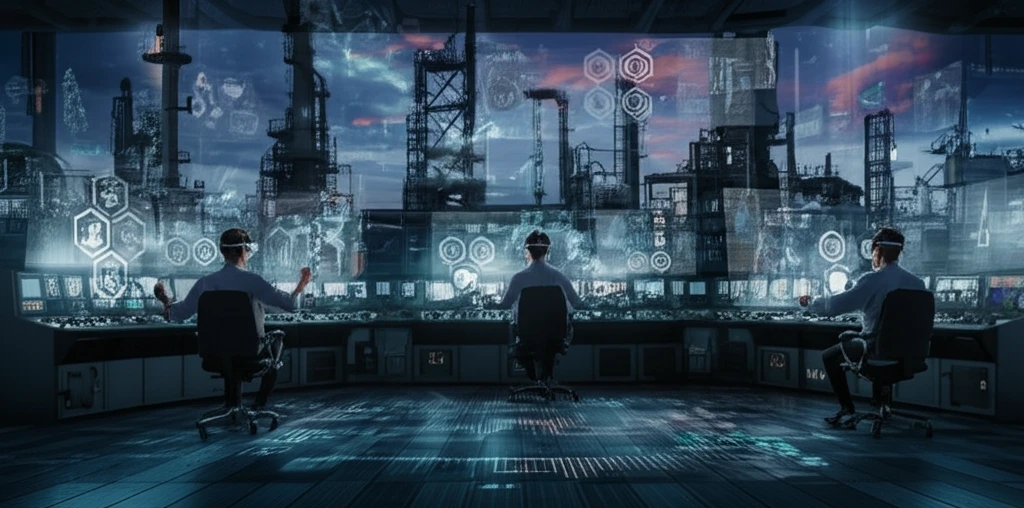
Imagine learning to manage a critical pipeline operation without the risk of explosions or spills. Virtual reality (VR) is rapidly changing this from a far-off concept into a present-day reality, offering immersive, hands-on training experiences that traditional methods simply can't match. VR in the oil and gas sector is primarily used in exploration, operation and maintenance, and training. So that engineers, geologists, scientists, operators, etc., can explore different environments like oilfields [9].
A recent study detailed how a virtual reality solution was developed to mimic the environment and tasks of managing pipeline inspection gauge (PIG) traps—essential components for maintaining pipeline integrity. This innovative approach focuses on enhancing operator training in a safe, controlled, and highly realistic virtual setting. It is important for training programs to be seen as short-term educational processes that are developed in a systemic and organized manner [12].
VR Training by the Numbers
VR training delivers a 300-500% return on investment for corporate organizations, according to ZipDo's 2026 education report. The technology has been shown to improve learning speed, confidence, and incident reduction across industries. Safety-focused VR programs are backed by data from organizations including BLS, PwC, and NSC, with researchers compiling dozens of verified statistics traceable to primary sources. These figures underscore VR's growing role as a serious training tool rather than a novelty.
Why Traditional Training Falls Short
Traditional safety training methods face persistent challenges with knowledge retention and learner engagement, particularly in high-hazard industries. VR training programs have been shown to complete in roughly one-quarter of the time required by conventional classroom approaches. Rather than simply digitizing existing methods, VR creates entirely new possibilities for hands-on employee experience and skill development. The rise of VR is driven by the recognized limitations of passive learning formats in preparing workers for real-world risks.
The Roots of Immersive Training Technology
The history of mixed reality traces back to foundational work in combining real and virtual environments. Early milestones in the development of immersive technologies laid the groundwork for today's VR training platforms. Researchers and engineers spent decades refining head-mounted displays, motion tracking, and spatial computing before VR became commercially viable for enterprise use. This long arc of innovation helps explain why VR training is only now reaching mainstream adoption in industries like oil and gas.
The Problem with Traditional Oil Industry Training
Traditional training in the oil industry has several pain points. It's often expensive, requiring significant resources and downtime. It can also be inherently risky, exposing trainees to potentially hazardous environments. Moreover, traditional methods may not fully prepare operators for the complex, real-time decision-making required in the field. Industrial operations require compliance with efficiency, safety and environmentally friendly environments [14].
- Safety First: VR eliminates the risks associated with traditional on-site training.
- Cost-Effective: Reduces expenses related to equipment, personnel, and potential accidents.
- Immersive Learning: Provides a realistic and engaging training experience that enhances knowledge retention.
- Flexible and Scalable: VR modules can be easily updated and deployed to train large numbers of employees across different locations.
New Research Backs VR's Enterprise Case
Recent research and industry developments continue to validate VR training's effectiveness in workforce development. Maersk Training, a major VR safety training provider, was recently acquired by OpenGate Capital in a deal expected to close later in 2026, signaling strong investor confidence in the sector. Analysts note that VR training solves the workplace 'revolving door' problem by allowing businesses to capture senior staff expertise in repeatable digital experiences. Learning technology showcases highlighting simulations, AR, and VR are now common at major industry conferences.
When VR Training Doesn't Make Sense
VR training is not universally the right answer for every training scenario. Basic tasks such as ladder safety or proper lifting technique may not cross the 'dangerous' threshold required to justify VR investment. AR and VR solve different training problems, fail in different ways, and carry different cost structures. Understanding these distinctions is critical for training buyers making procurement decisions, as over-investing in VR for low-risk scenarios can undermine ROI.
VR vs. Traditional Training: What Workers Report
Workers on the ground are reporting measurable differences between VR and traditional training outcomes. A construction site safety manager in Texas noted that new hires were more confident around equipment after VR training compared to classroom-only instruction. Warehouse environments, where high turnover meets high hazard density, experience the most acute problems with knowledge retention from conventional training. VR's immersive format helps address this retention gap by engaging learners more deeply than e-learning modules.
The Future of Oil Industry Training is Virtual
Virtual reality is not just a futuristic concept; it's a practical solution that addresses the limitations of traditional training methods in the oil industry. As VR technology continues to evolve, we can expect even more sophisticated and immersive training applications that will further enhance safety, efficiency, and performance in this critical sector. In fact, The present simulator in virtual reality becomes the base on which is possible develop several industrial applications in a virtual way, not only with the objective of training staff, but also to be able to recreate the conditions of the plant process with the objective to know the responses of the process to a certain situation.
Industry Voices on VR Training's Momentum
Experts in immersive learning emphasize VR training's ability to boost learning speed, engagement, and retention compared to traditional methods. Companies developing VR training content highlight its capacity to construct riskless environments and accelerate onboarding processes. Despite these advantages, industry surveys suggest that only just over a quarter of all businesses are currently using VR to train employees. AI integration is increasingly seen as a complementary technology that can enhance VR training through adaptive, personalized learning paths.
What's Next for VR Training Technology
VR training is expected to become significantly more sophisticated with advancements in artificial intelligence, haptic feedback, and 5G connectivity. These improvements will enhance the realism and accessibility of immersive training experiences, particularly for remote or distributed workforces. Future trends point toward personalized learning experiences powered by AI integration, offering transformative and adaptable solutions across industries. The convergence of these technologies could make VR training a standard component of workforce development within the next decade.
VR Training Beyond the Oil Patch
AR and VR training modules are gaining traction in aviation MRO (maintenance, repair, and overhaul) for supporting complex maintenance tasks through visualization, standardization, and remote guidance. These applications demonstrate how immersive technologies can improve skill development and safety practices in high-stakes operational environments. The broader adoption of VR training across industries highlights both the technology's versatility and the systemic challenges of scaling immersive learning programs. As adoption grows, organizations must address infrastructure requirements, content development costs, and workforce readiness to realize VR training's full potential.
Real Outcomes from Virtual Training
VR in healthcare training is transforming traditional methods, ensuring practitioners are better prepared for real-world challenges while maintaining safety and efficiency. A case study of a VR training reel that reached 25 million views demonstrated how immersive content can fundamentally shift organizational approaches to training creation and distribution. VR brings the training situation to the learner, enabling users to gain hands-on experience in realistic simulated scenarios at any time and any place. This immersive format allows employees to practice without the real-life risk of making mistakes on the first attempt.