
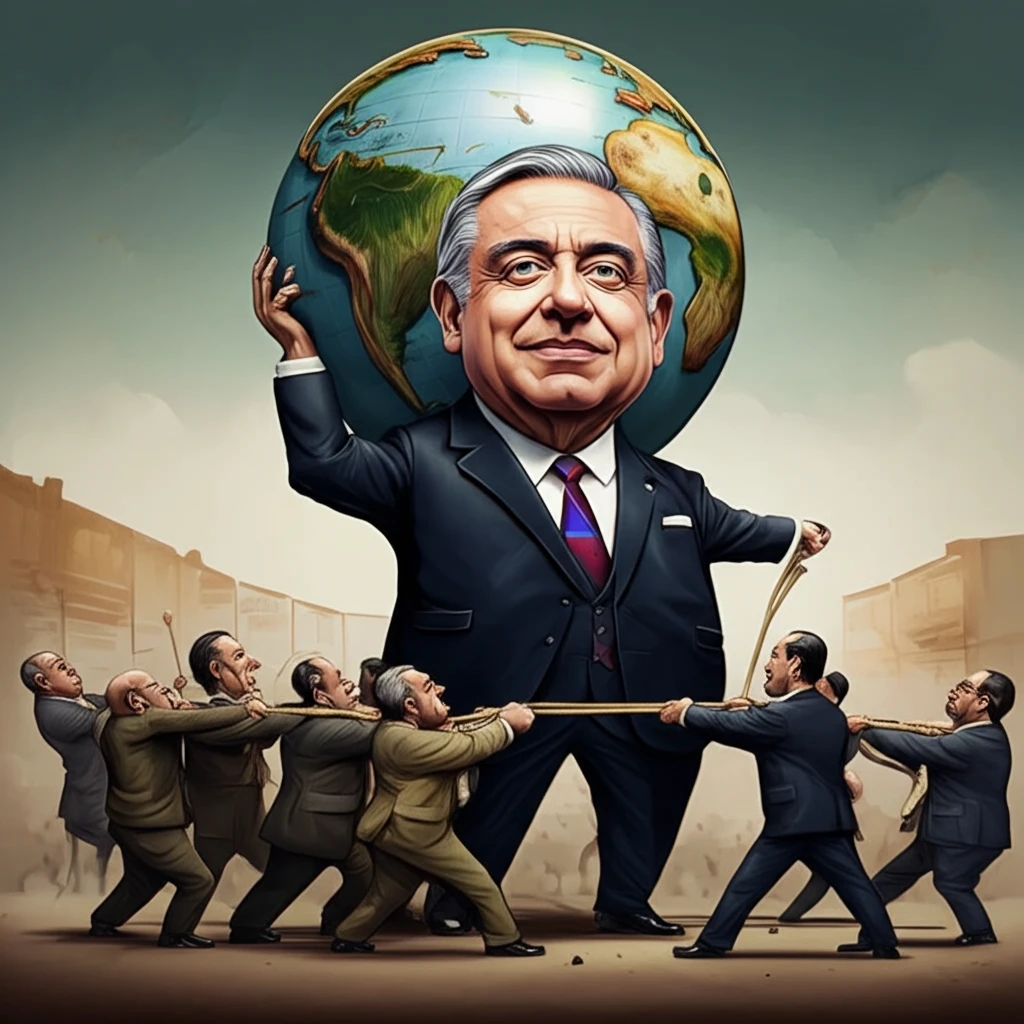
Legislative Gridlock or Global Harmony? How Latin American Foreign Policy Navigates Presidential Power

"Uncover the surprising factors that shape international relations in Latin America and how they defy conventional wisdom."
In the intricate world of international relations, understanding the forces that shape a nation's foreign policy is paramount. Across Latin America, a critical interplay exists between presidents and legislators, setting the stage for international engagements. This dynamic raises a fundamental question: How do Latin American presidents navigate their legislative bodies to enact their foreign policy agendas?
Conventional wisdom suggests that a president's influence in foreign affairs often surpasses their domestic clout. However, recent research unveils a more nuanced reality, particularly within the Latin American context. This study delves into the factors that truly drive legislative support for presidential foreign policy initiatives, challenging long-held assumptions and revealing the surprising undercurrents of political decision-making.
By examining roll-call votes of 22 Latin American presidents across eight countries from 1994 to 2014, and enriching the data with selected case studies, a clearer picture emerges. It's a narrative where political party ideologies, coalition sizes, and the effective number of parties (ENP) wield considerable influence. Surprisingly, presidential popularity and the perceived importance of the policy itself often take a back seat, leading to counter-intuitive outcomes that reshape our understanding of Latin American politics.
Current Landscape
Latin American foreign policy operates within a complex interplay of presidential authority and institutional constraints that varies significantly across the region's diverse political systems. Recent scholarship highlights how executive dominance in foreign affairs coexists with gradual democratic erosion in several countries, though comprehensive cross-national statistics on policy outcomes remain limited. The region's foreign policy trajectories reflect both continuity in development and security goals and abrupt shifts tied to leadership changes.
Methodological Foundations
Scholars predominantly analyze Latin American foreign policy through Foreign Policy Analysis (FPA) frameworks that center political leaders—especially presidents—as primary decision-makers shaping public policies for development and security through international cooperation. Expert surveys spanning 1980–2014 have mapped regional foreign policy preferences, while indices of presidential hegemony track executive power across 18 countries from 1925 to 2016. These approaches reveal patterns of continuity and change but face limitations in capturing informal power dynamics and the gradual erosion of democratic checks on presidential authority that may not appear in formal constitutional provisions.
Historical Foundations
The study of Latin American foreign policy has evolved from state-centric diplomatic histories to leader-focused analyses that recognize presidents as pivotal actors in regional and global engagement. Foundational work established that foreign policy serves as an instrument for achieving higher development and security levels through international cooperation, though the degree of presidential autonomy has fluctuated across historical periods. Early research identified ideological orientation and institutional design as key determinants of policy direction, setting the stage for contemporary debates about executive power.
What Really Drives Foreign Policy in Latin America? Beyond Popularity and 'High Politics'
The research uncovers a fascinating paradox: large governing coalitions and minimal ideological differences among parties can actually decrease support for a president's foreign policy initiatives. This defies the traditional expectation that a united front strengthens a president's hand. To grasp this, one must consider the strategic calculus within these political systems.
- Coalition Size: Larger coalitions can paradoxically decrease support as opposition parties feel less pressure to conform.
- Ideological Distance: Smaller ideological gaps encourage parties to differentiate on foreign policy.
- Effective Number of Parties (ENP): A significant factor, influencing the dynamics of coalition formation and legislative outcomes.
Recent Scholarly Advances
A systematic review published in 2025 comprehensively maps the current state of Foreign Policy Analysis in Latin America, emphasizing the region's significant but often overlooked contributions to understanding political leaders' roles—particularly presidents—in foreign policy decision-making. The review synthesizes decades of scholarship examining how individual leaders shape national positions on regional integration, extra-regional partnerships, and multilateral engagement. This consolidated assessment reveals both theoretical advances and persistent gaps in explaining variation across countries and time periods.
Critical Perspectives
Critics argue that conventional analyses overstate presidential control and underestimate structural constraints, noting that Latin American regionalism exhibits swift ideological reversals that differentiate it from other regions and challenge leader-centric explanations. The Global North is said to hold three major misconceptions: viewing the region as homogeneous, assuming turbulence prevents meaningful global influence, and overlooking the agency of smaller states. Empirical work on presidential breakdowns demonstrates that leaders sometimes fail to translate domestic authority into foreign policy success, while U.S. engagement strategies face an inflection point as Latin American countries diversify partnerships beyond Washington.
Cross-Regional Insights
Comparative research on Latin American foreign policy remains less developed than single-country studies, limiting systematic understanding of how presidential power operates across different institutional contexts. Existing comparisons suggest that variation in constitutional design, party systems, and legislative strength creates meaningful differences in executive autonomy that affect foreign policy consistency. The region's experience with both presidential and parliamentary systems, alongside diverse electoral rules, offers a natural laboratory for testing theories of executive leadership in international affairs that has not been fully exploited.
The Future of Foreign Policy in Latin America
This research provides a new lens through which to view the formulation of foreign policy in Latin America. By understanding the nuanced interplay between presidential power, legislative dynamics, and strategic political maneuvering, we can better anticipate the trajectory of international relations in the region. As Latin American nations continue to navigate an increasingly complex global landscape, these insights become invaluable for policymakers, scholars, and anyone seeking to understand the forces shaping our world.
Expert Assessment
Recent analysis of U.S. policy toward Latin America under the second Trump administration describes an unprecedented concentration of hard power instruments—including economic coercion and tariff threats—coupled with the elimination of soft power tools that characterized previous engagements. This approach has accelerated Latin American efforts to diversify foreign policy portfolios away from exclusive reliance on Washington, widening diplomatic and economic ties with extra-hemispheric powers. Experts characterize this as a return to Cold War-era interventionism that risks long-term strategic alienation despite potential short-term compliance gains.
Emerging Trajectories
The future of Latin American foreign policy will likely be shaped by continuing tensions between presidential ambitions for autonomous action and the structural realities of economic interdependence with major powers. Digital diplomacy, climate leadership, and technology governance represent emerging arenas where regional coordination could amplify influence beyond what individual presidents achieve bilaterally. Institutional innovations—including stronger legislative oversight and civil society participation—may gradually reshape the traditionally executive-dominated foreign policy process across the region.
Structural Dynamics
U.S.–Latin American relations have long been defined by asymmetric power dynamics, with Washington facing periodic competition from extracontinental powers for regional influence since the Cold War. The current diversification of Latin American foreign policy portfolios reflects both push factors—including tariff threats and interventionism from the second Trump administration—and pull factors from deepening ties with China, the EU, and other partners. Domestic democratic consolidation remains intertwined with foreign policy autonomy, as congressional authority over immigration and human rights instruments demonstrates how U.S. domestic politics cascades into regional diplomatic calculations. Middle-range theoretical frameworks now seek to explain patterns of change and continuity that neither pure structuralism nor leader-centric accounts fully capture.
Lived Consequences
Behind high-level diplomatic maneuvers, ordinary citizens across Latin America experience foreign policy through migration flows, trade-dependent livelihoods, and the tangible effects of great power competition on local economies. Presidential decisions on alignment with global powers directly affect remittance corridors, commodity market access, and technology transfer opportunities that shape daily life. The human dimension of foreign policy—often abstracted in academic literature—includes families separated by visa policies, workers in export sectors vulnerable to tariff shifts, and communities on the frontlines of climate change where international cooperation determines adaptation capacity.